UniversityAdvanced

MPhil Mathematics

An independent MPhil pathway for advanced course notes, literature reading, research methods and rigorous problem-solving support.

Subject and course map

What you study in MPhil Mathematics

A research-preparation map for MPhil Mathematics: advanced theory, applied modelling, computational methods and the research practices needed for a thesis. Programme titles and sequencing are institution-specific.

Course family

Advanced Analysis

Advanced Analysis

Choose from real, complex, functional or harmonic analysis according to the research direction. The emphasis may be theoretical, applied or computational depending on the programme, course level and learner's chosen specialization.

Browse related Library resources →
Course family

Advanced Algebra and Number Theory

Advanced AlgebraNumber Theory

Build structural and arithmetic depth through selected algebraic topics and research literature. The emphasis may be theoretical, applied or computational depending on the programme, course level and learner's chosen specialization.

Browse related Library resources →
Course family

Geometry and Topology

GeometryTopology

Use spaces, manifolds, invariants and geometric methods to describe higher-level mathematical structure. The emphasis may be theoretical, applied or computational depending on the programme, course level and learner's chosen specialization.

Browse related Library resources →
Course family

PDE, Dynamical Systems and Applied Mathematics

PDEDynamical SystemsApplied Mathematics

Develop models, existence arguments, qualitative analysis and applications to scientific problems. The emphasis may be theoretical, applied or computational depending on the programme, course level and learner's chosen specialization.

Browse related Library resources →
Course family

Computational Mathematics and Optimization

Computational MathematicsOptimization

Link algorithms, approximation, simulation, optimization and transparent validation. The emphasis may be theoretical, applied or computational depending on the programme, course level and learner's chosen specialization.

Browse related Library resources →
Course family

Research Seminar and Thesis

Research SeminarThesis

Read critically, identify a contribution, keep a reproducible record and communicate results clearly. The emphasis may be theoretical, applied or computational depending on the programme, course level and learner's chosen specialization.

Browse related Library resources →
Higher-education questions
Which subjects are common in BS Mathematics?

Calculus, linear algebra, discrete mathematics, analysis, algebra, differential equations, probability or statistics and computing are common subject families, but each university approves its own scheme.

What is studied in Real Analysis?

Real Analysis develops rigorous ideas of sequences, limits, continuity, convergence, differentiation, integration and the structures that support advanced mathematics.

How do MSc and MS Mathematics differ?

The distinction depends on the institution. An MSc may be course-led, while an MS is often more research-oriented; check the official programme and thesis requirements.

Where can I find research and thesis support?

Use the research Library shelf, the existing Mathematics Software & Tools page and your institution’s supervisor or research office for approved direction.
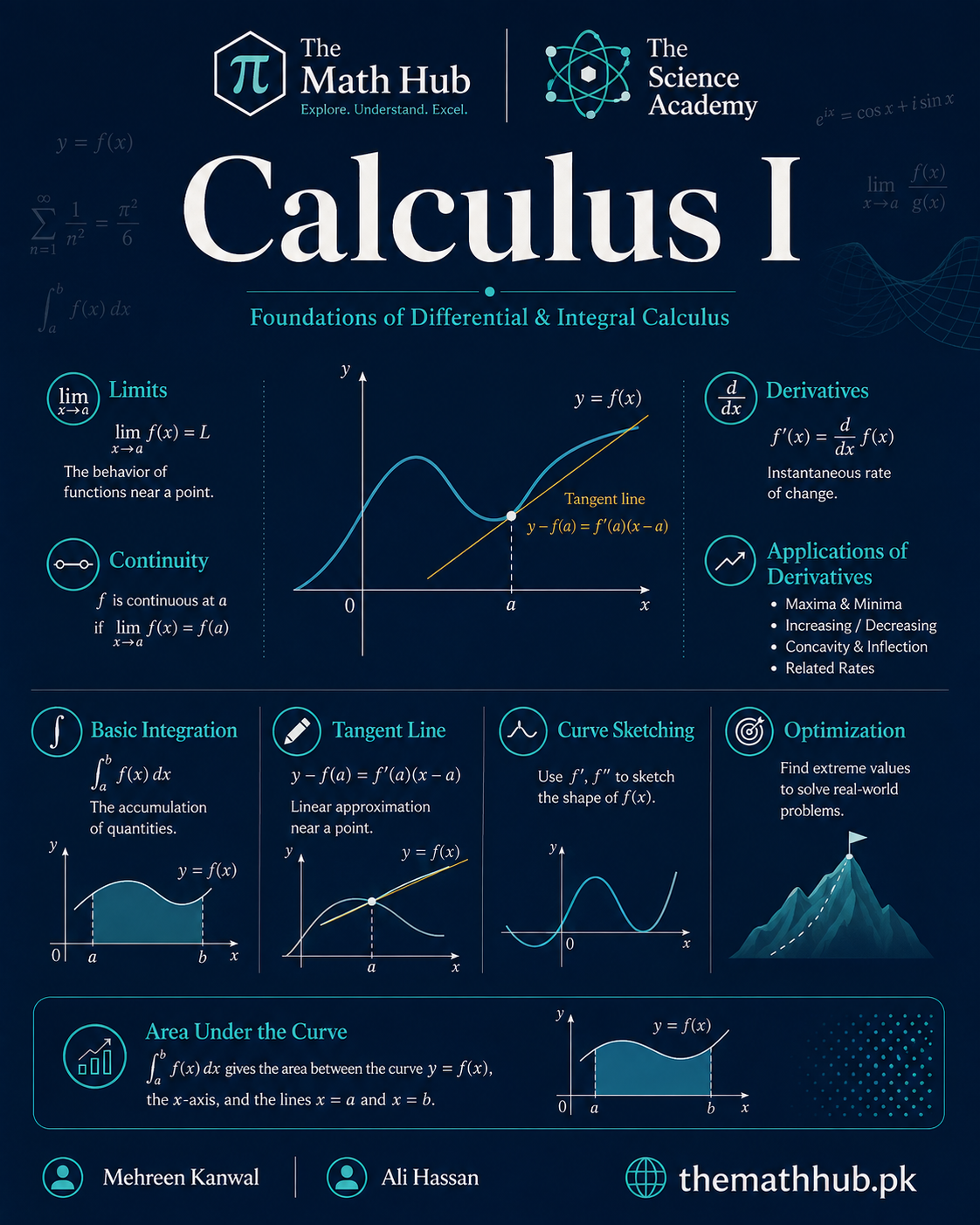
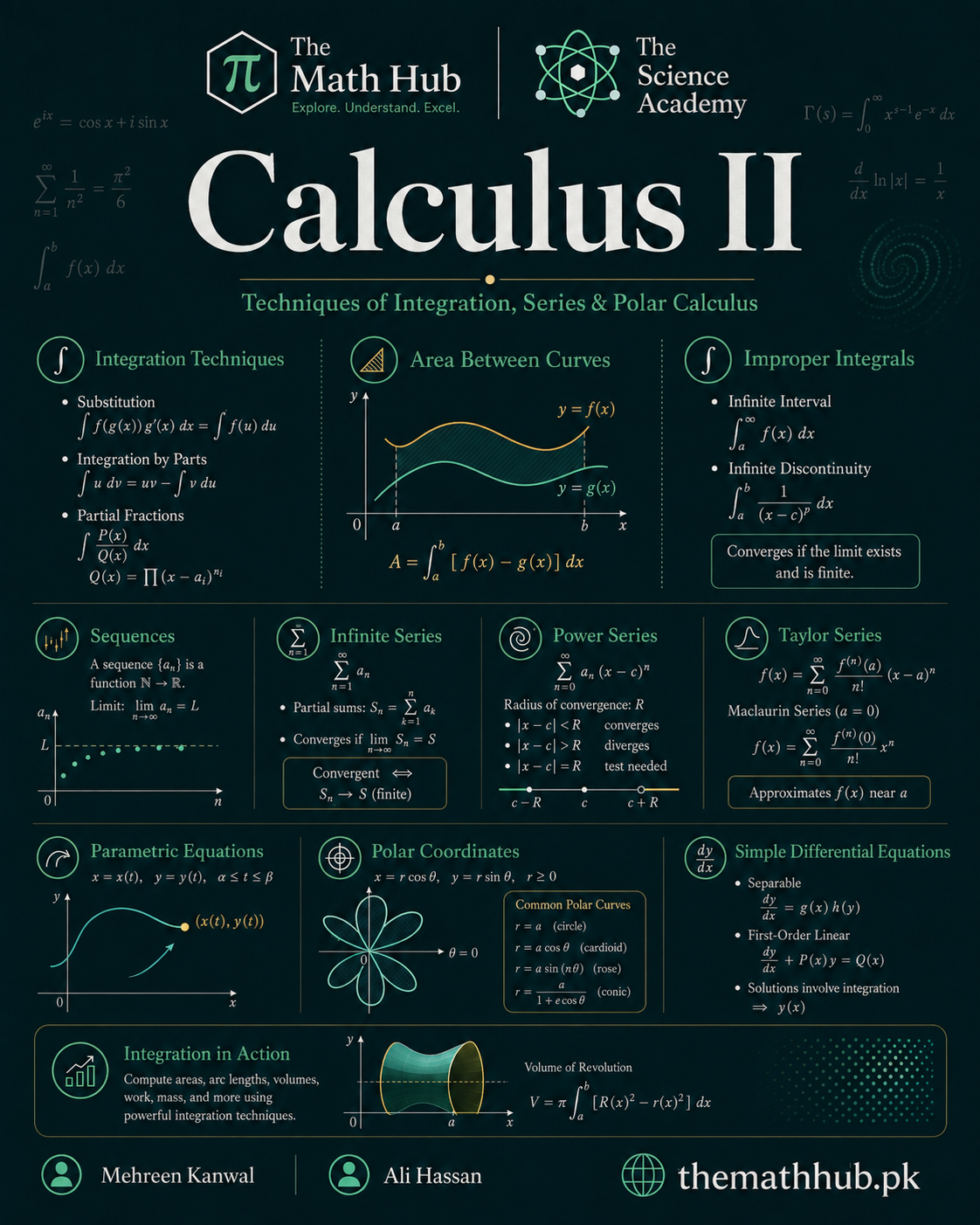
Degree to course discovery

Degree → University → Subject → Resource

Use the degree pathway, university programme, Mathematics subject and genuine The Math Hub Library resource together. University eligibility, semester placement and current programme rules remain institution-specific.

MPhil Mathematics · complete book shelf

All University Mathematics Books & Notes

This same poster directory is mirrored across ADP, BS, BSc, MSc, MS and MPhil Mathematics. Every card opens one canonical The Math Hub HTML resource, so a book remains easy to find from any programme section without creating duplicate pages.

Graph Theory Volume I complete solved mathematics book by The Math Hub
Canonical book / notes

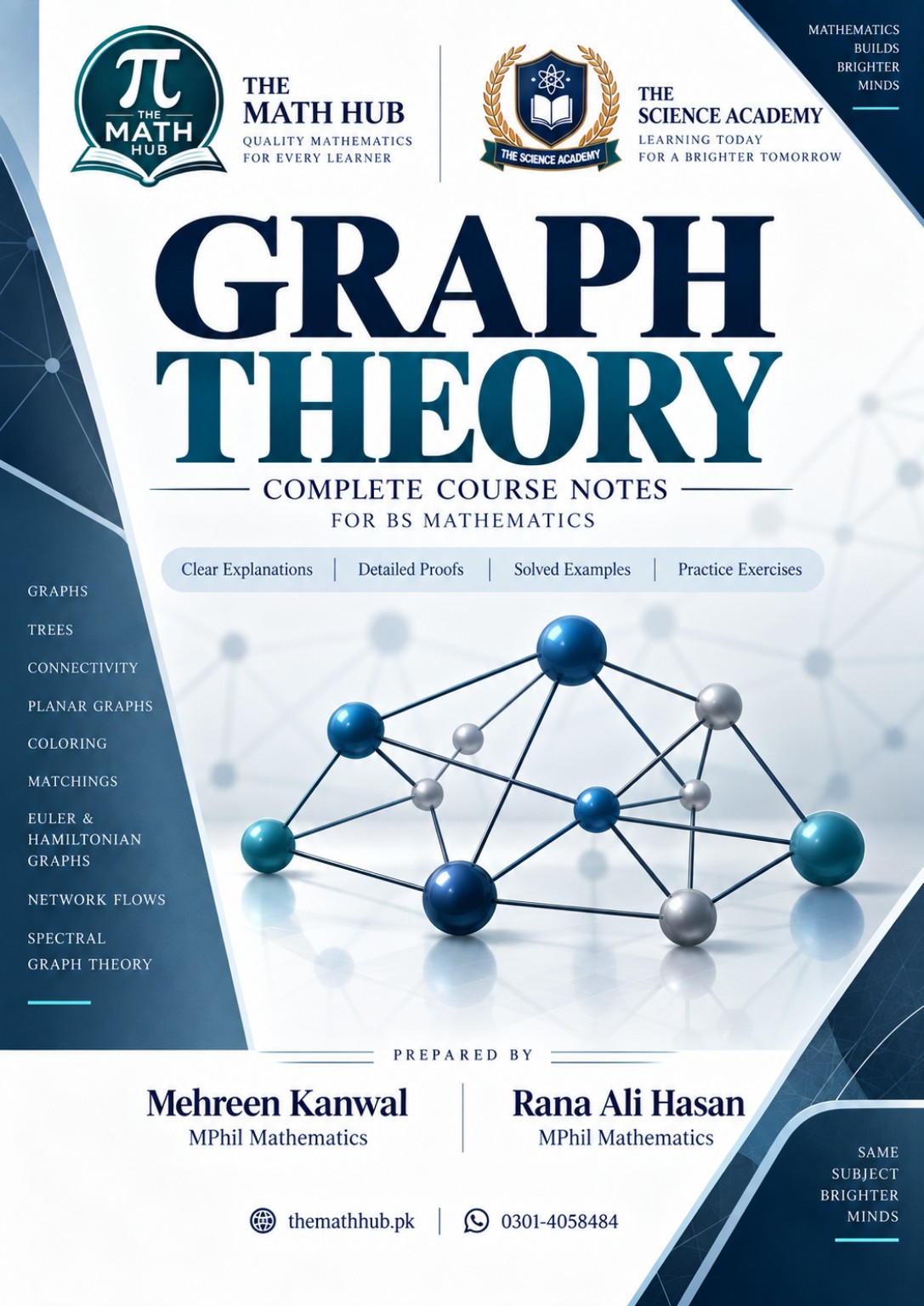
Graph Theory — Volume I

A 21-chapter university Graph Theory resource covering graph models, degree sequences, isomorphism, matrices, paths, connectivity, Eulerian and Hamiltonian graphs, trees, spanning trees, graph algorithms, planarity, duals, colouring, matching, digraphs, network flows, enumeration and applications.

Open canonical resource →
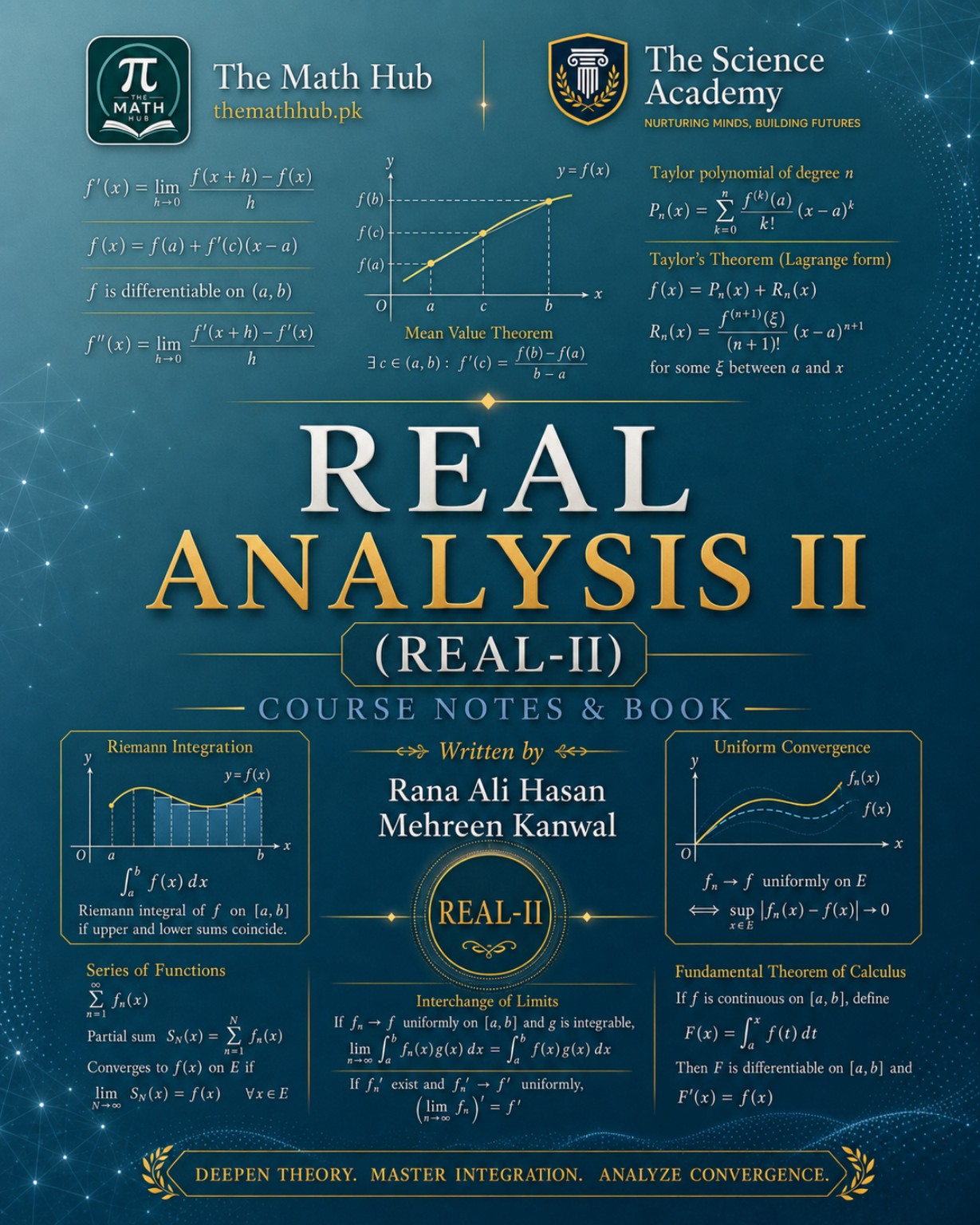
Real Analysis II complete course book poster
Canonical book / notes

Real Analysis II — Complete Course Book

A complete 20-chapter Real Analysis II course resource covering rigorous Riemann and Riemann-Stieltjes integration, bounded variation, improper integrals, uniform convergence, power series, approximation, Fourier series, Euclidean spaces, multivariable analysis and multiple Riemann integration.

Open canonical resource →

Programme placement is a discovery aid; course titles, semester placement and official syllabus rules remain institution-specific. The poster, title and canonical link above are the same across every mirrored degree section.
Supporting / advanced reference discovery

Integral Equations — Complete Solved Solutions

Use the Integral Equations solutions resource only where the approved course overlaps; it supports advanced reference and revision. Study Integral Equations with 426 mathematics-first worked problems and applications covering Fredholm, Volterra, integro-differential, singular and nonlinear equations, plus numerical methods and applications. Reference-aligned to Abdul-Majid Wazwaz, Second Edition.
Open the complete Integral Equations Solutions resource →
Classical-to-modern bridge resource

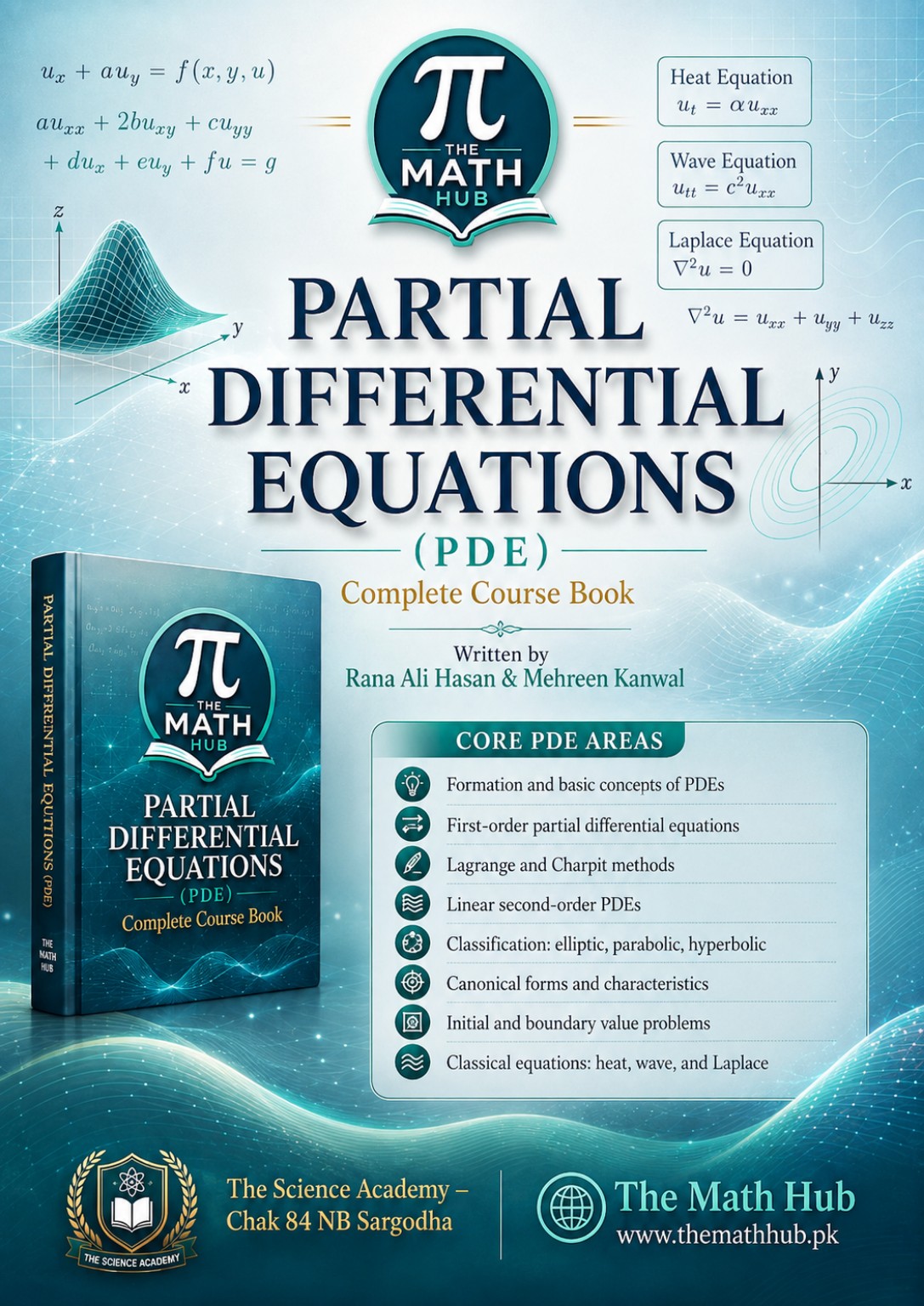
Partial Differential Equations (PDE) — Complete Course Book

Use the canonical 32-chapter resource as a structured bridge from classical wave, heat, Laplace and transform methods to distributions, Sobolev spaces, weak formulations, variational methods and nonlinear PDE themes.

Open the complete Partial Differential Equations (PDE) resource →
Graduate refresher / research preparation

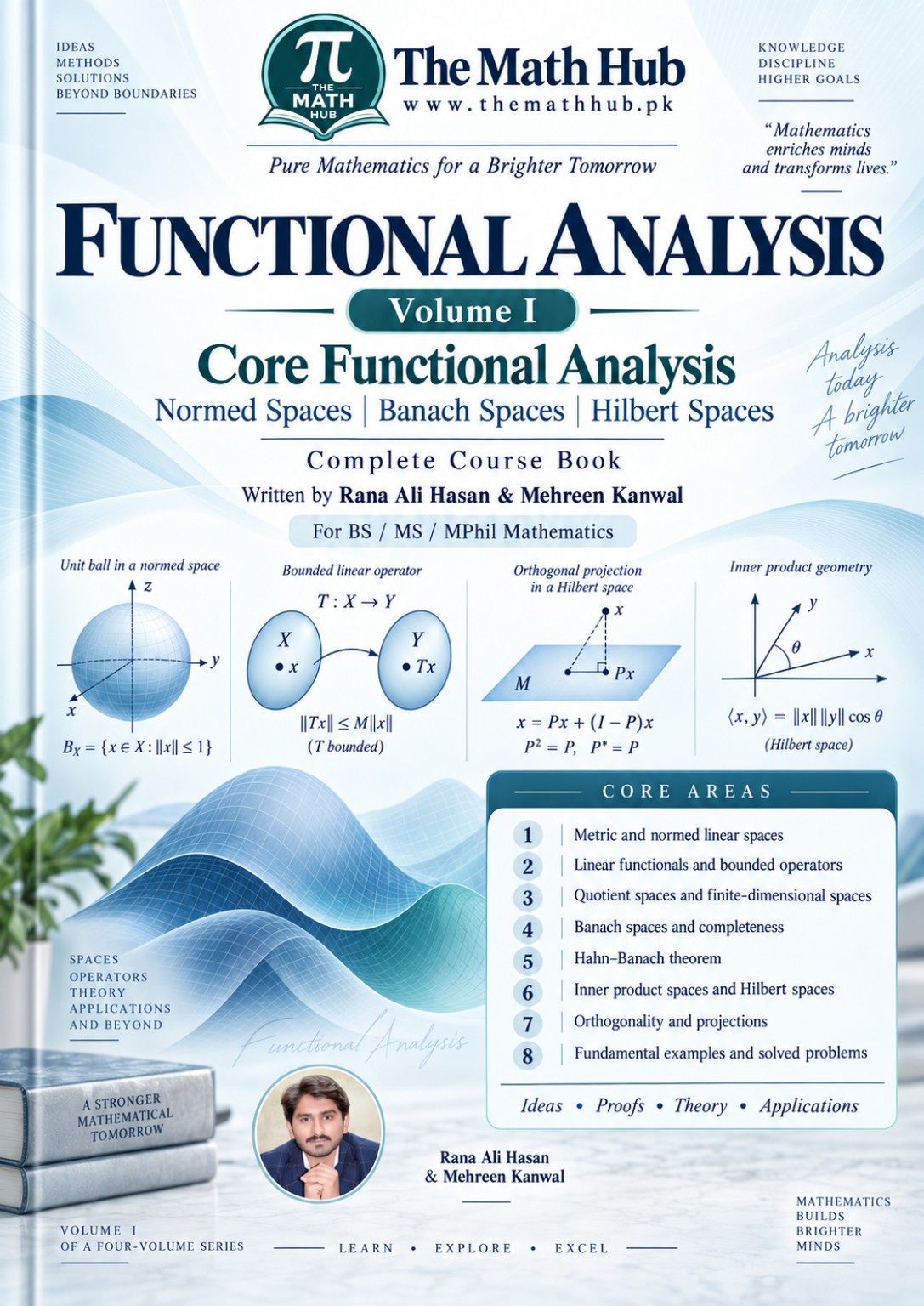
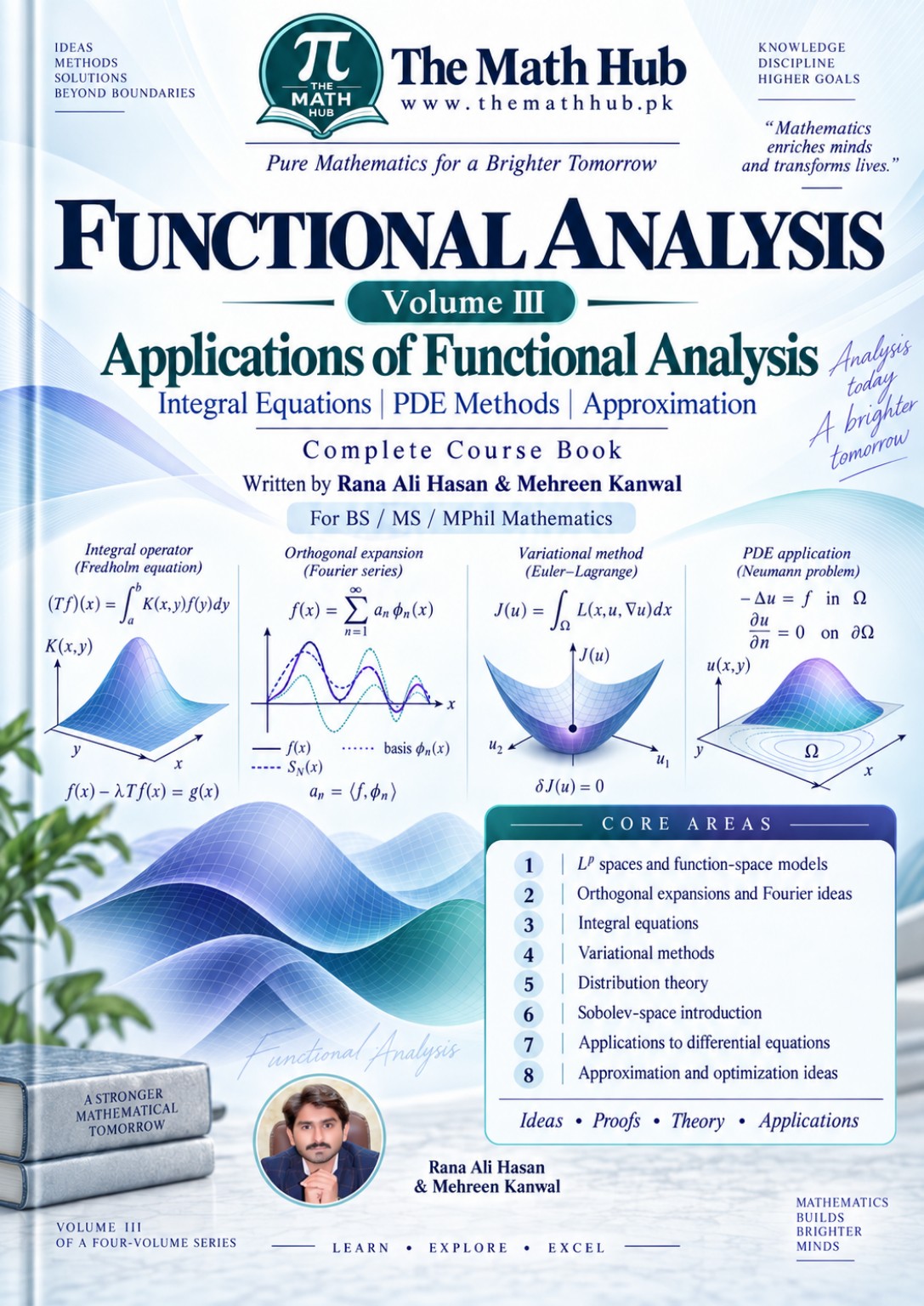
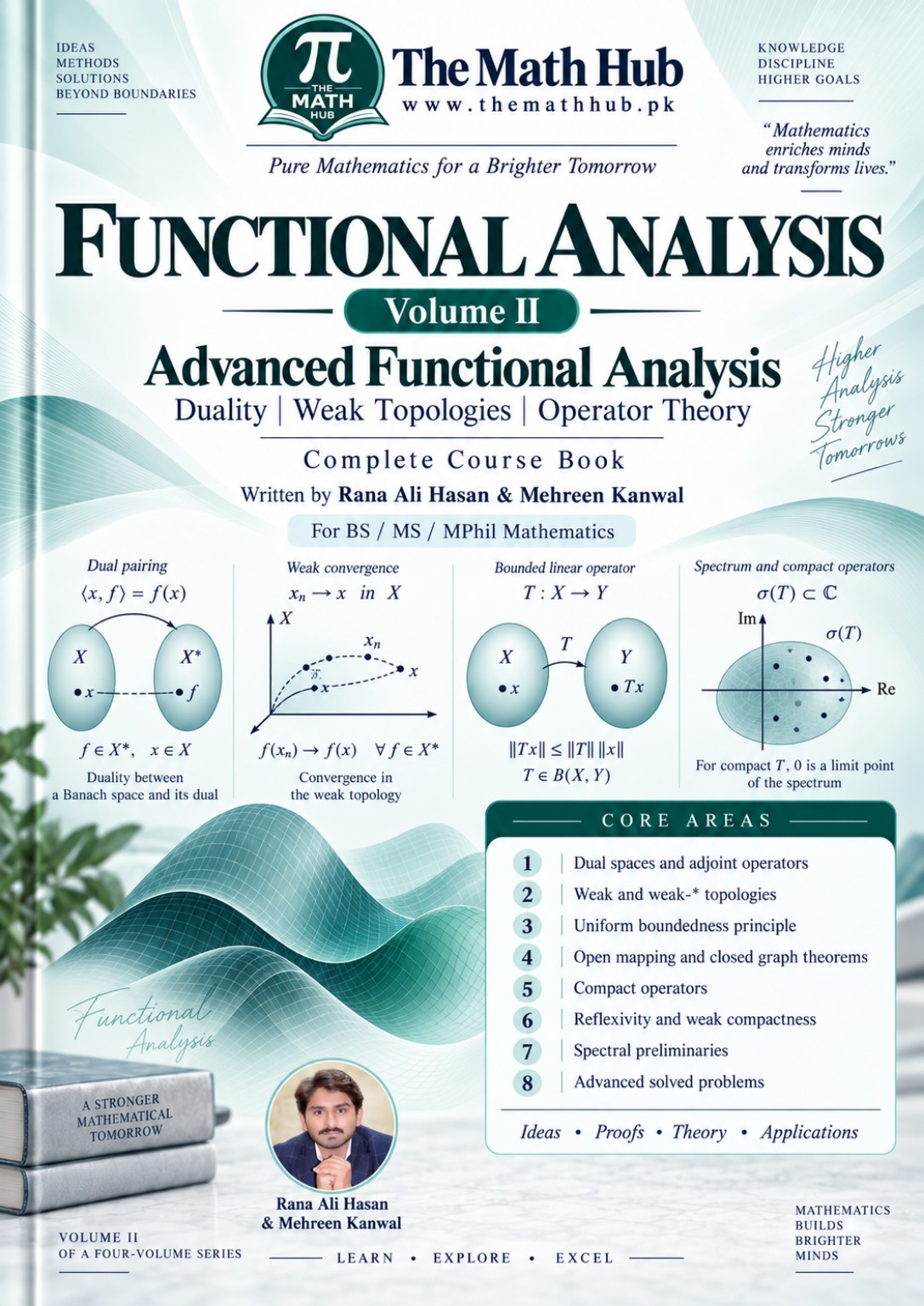
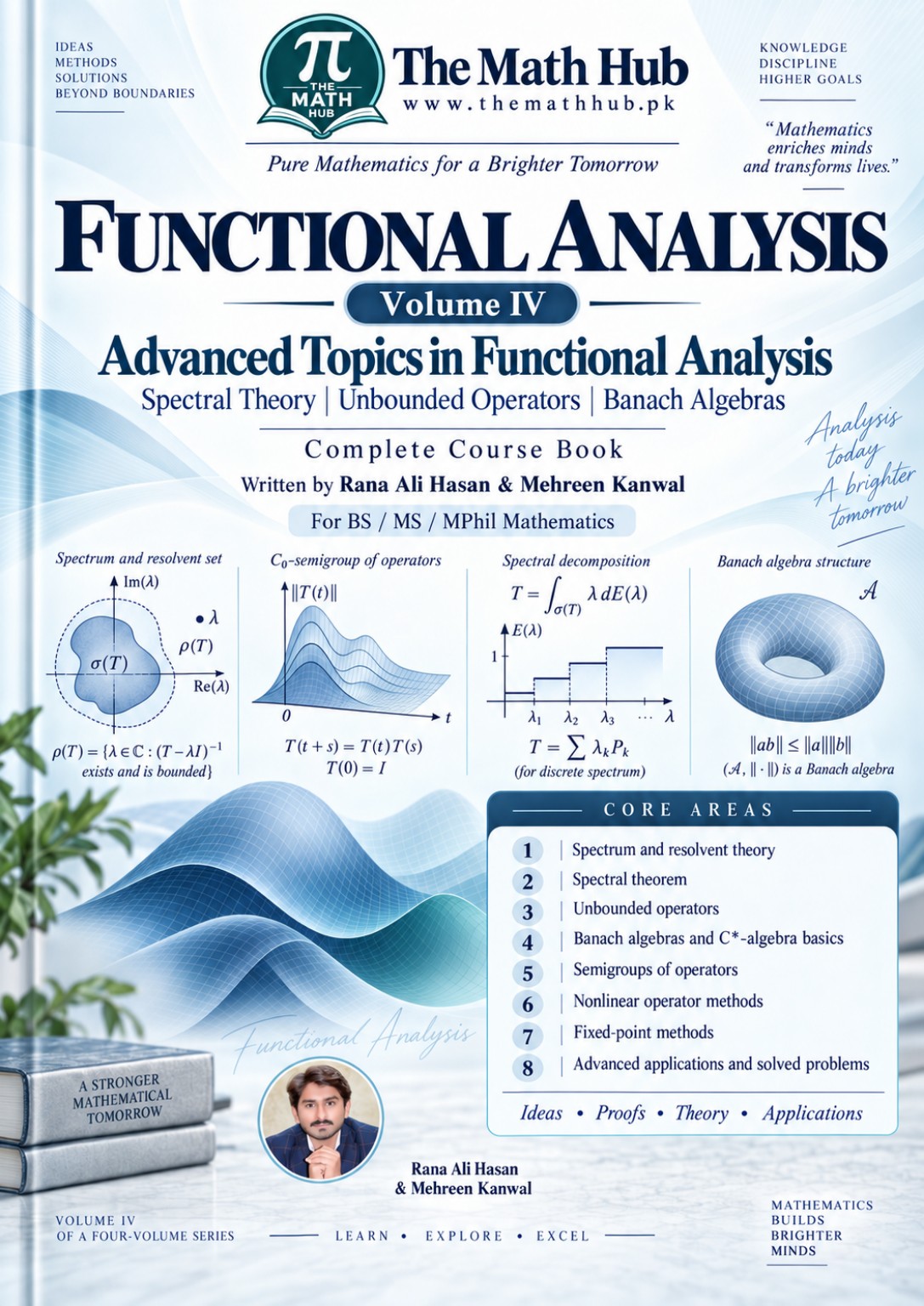
Functional Analysis — Volumes I–IV

Use the four-volume Functional Analysis sequence as a graduate bridge from core spaces and operators through weak topologies, applications, spectral theory and research-preparation topics. University course names, codes and semester placement remain institution-specific.

Open the Functional Analysis series hub →
Graduate foundation / revision bridge

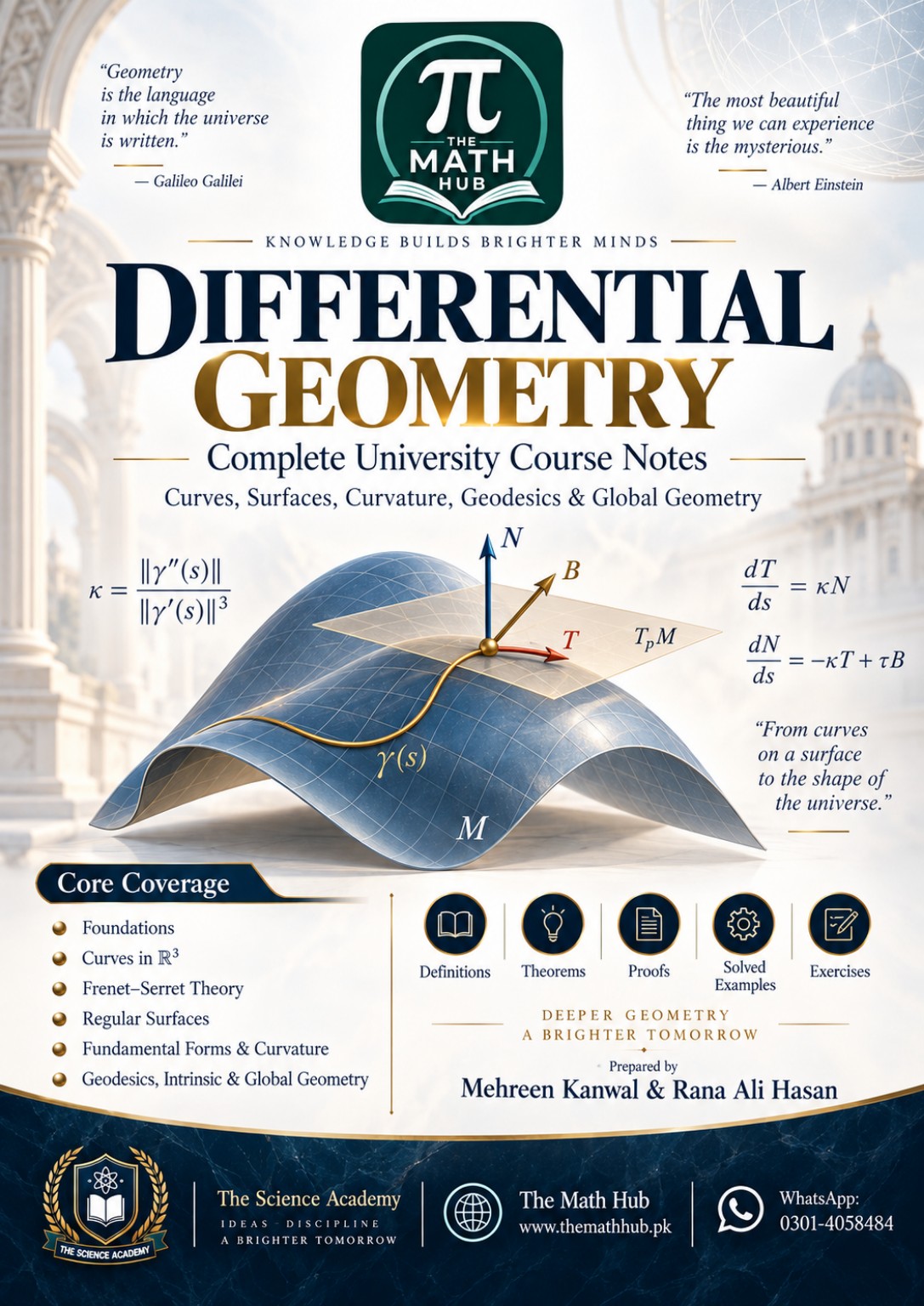
Differential Geometry — Complete Solved University Notes

Use this 30-chapter resource as rigorous BS/MSc foundation and revision before Riemannian Geometry, manifolds, relativity or geometric analysis. It is a bridge resource, not a complete MPhil research text.

Open the complete Differential Geometry resource →
Foundation / prerequisite consolidation / revision

Graph Theory Volume I — Complete Notes, Proofs & Algorithms

Use Graph Theory Volume I as foundation, prerequisite consolidation and revision for MS/MPhil Graph Theory and related discrete mathematics; it is not a replacement for advanced postgraduate or research-level graph theory.

Open the complete Graph Theory Volume I resource →
Graduate refresher / research preparation

Real Analysis I Volumes I–III and Real Analysis II

Use Real Analysis I Volume III for rigorous undergraduate foundations and Real Analysis II as a separate refresher across advanced integration, convergence, approximation, Fourier series and Euclidean-space methods before graduate study or research.

Volume II keeps its separate reserved placement on the Real Analysis I family page until the exact asset is available.

Open the Real Analysis I volume family →Explore Volume III →Open the separate Real Analysis II resource →
Graduate refresher / research preparation

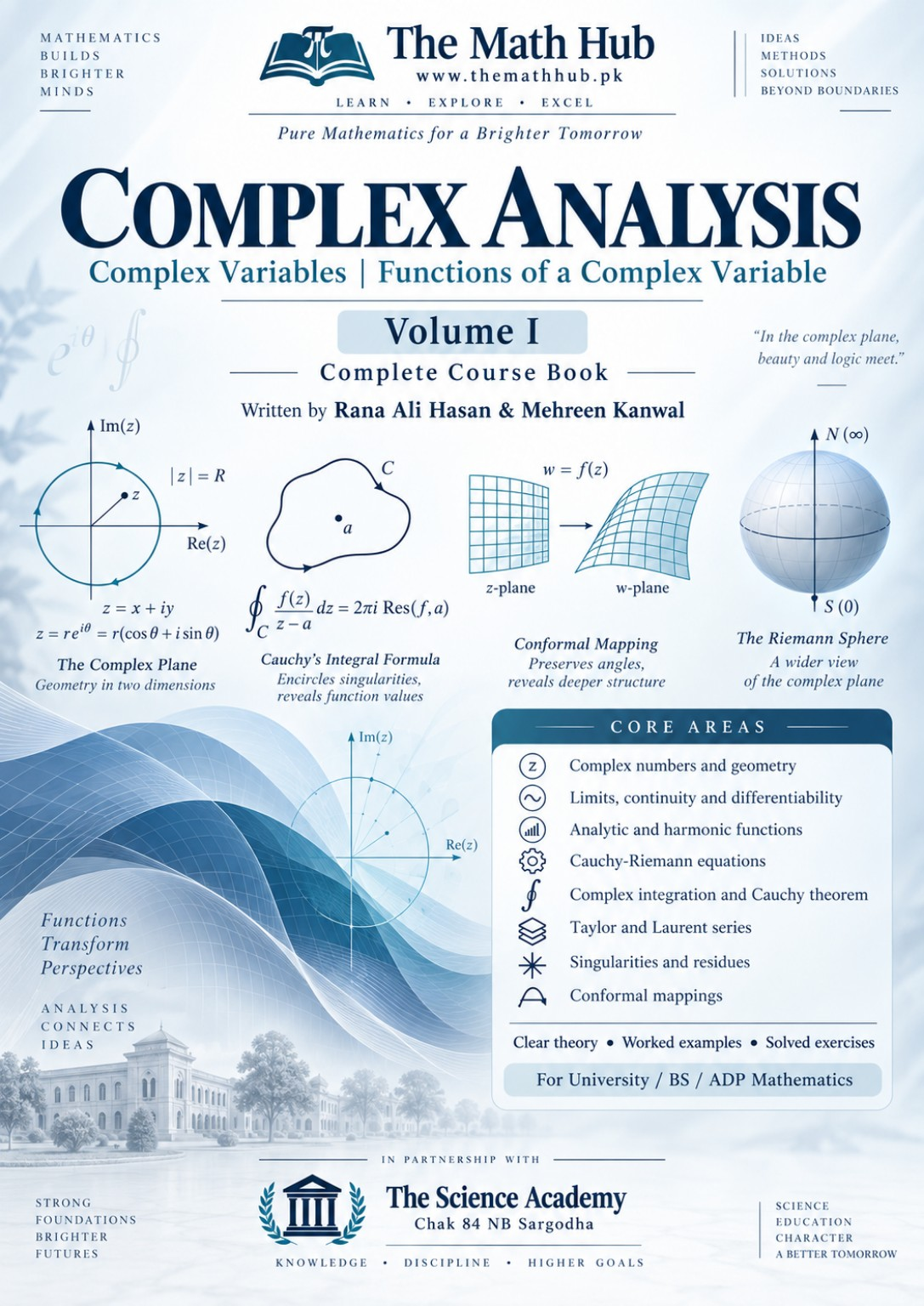
Complex Analysis — Volume I / Complex Analysis I / Complex Variables

Use the advanced end of this 54-chapter resource as a structured revision bridge for one-variable complex function theory; it is not a substitute for a research-level graduate text.

Open the complete Complex Analysis Volume I resource →
Degree-specific questions

mphil mathematics FAQs

Which universities offer MPhil Mathematics?

MPhil Mathematics pathways are shown for the universities where they are included in the supplied programme bank.

What is Operations Research?

Operations Research applies optimization and quantitative methods to allocation, scheduling and decision making.

How do I choose an MPhil Mathematics research topic?

Start from a subject area, review current literature, identify a focused problem and develop it with an approved research supervisor.

What is a Mathematics research proposal?

It states the research problem, background, aims, methods, expected contribution and relevant literature.

What is a literature review in Mathematics?

A literature review critically organises existing definitions, results, methods and research gaps relevant to the proposed mathematical problem.

What are common PhD Mathematics research areas?

Pure Mathematics, applied Mathematics, computational Mathematics, modelling, analysis, algebra, geometry, numerical work and mathematical physics are common broad areas.

What software is useful for Mathematics research?

Python, MATLAB, symbolic tools, numerical software, typesetting tools and subject-specific packages may be useful; use the existing Software & Tools page.

How do I write a Mathematics thesis?

Follow the university's approved format, define the problem precisely, present rigorous methods and results, cite sources and work under formal supervision.