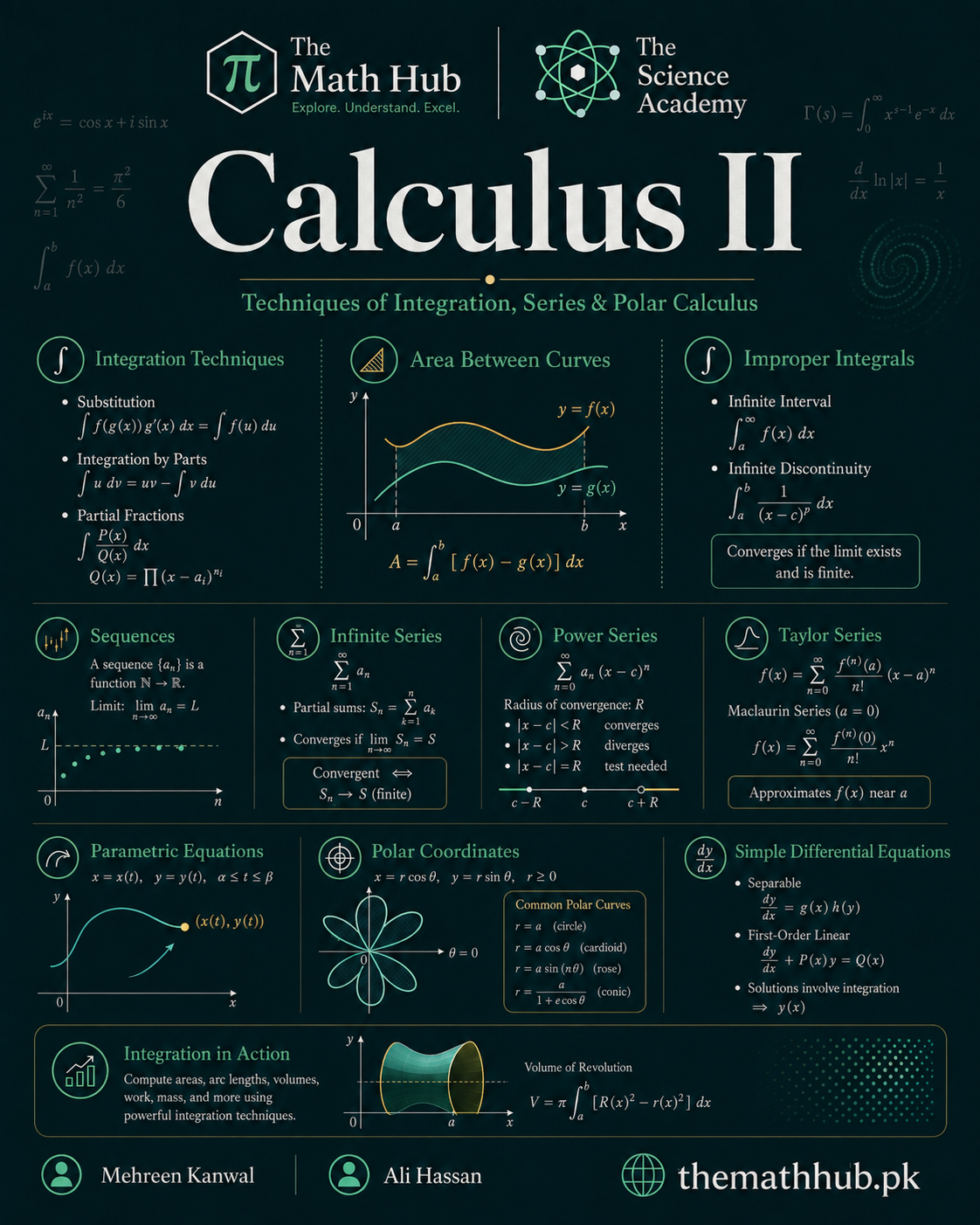
Select and apply advanced integration techniques
CourseCalculus IILevelUniversity / UndergraduateResourceNotes, solutions & exercisesChapters10
Course identity
What is Calculus II?
Calculus II extends integration into a flexible problem-solving toolkit and introduces infinite processes. Convergence, power series and Taylor approximation connect calculus with numerical analysis, differential equations, physics, engineering and scientific computing, while parametric and polar methods describe curves that Cartesian equations handle awkwardly.
Also known as: Calculus 2 · Calculus-II · Integral Calculus · Advanced Single Variable Calculus · Series and Polar Calculus. Exact titles, codes, semester placement and topic boundaries vary by university and programme.
Open the complete Calculus II resourceView / Download PDFBackup Access
Purpose and relevance
Why do we study Calculus II?
Calculus II extends integration into a flexible problem-solving toolkit and introduces infinite processes. Convergence, power series and Taylor approximation connect calculus with numerical analysis, differential equations, physics, engineering and scientific computing, while parametric and polar methods describe curves that Cartesian equations handle awkwardly.
Who should use these notes?
- BS Mathematics and AD / ADP Mathematics students
- BSc Mathematics learners and university-affiliated degree-college students
- Physics, engineering, computing and other quantitative-programme learners
- Students preparing for midterms, finals or foundation revision
Learning outcomes
What students will learn
The course develops conceptual understanding, symbolic fluency, graphical reasoning, modelling and university-level problem solving.
Evaluate improper integrals and numerical approximations
Analyse sequences and infinite series for convergence
Find intervals of convergence of power series
Construct and use Taylor, Maclaurin and binomial series
Differentiate and integrate parametric and polar curves
Complete course contents
Calculus II chapter-by-chapter notes
Open each chapter to review its purpose and complete topic coverage.
Chapter 01Applications of Definite Integrals
Extends integral modelling to geometric and physical applications.
Topics covered
- Area between curves and average value
- Volumes by slicing, disks, washers and shells
- Arc length and surface area
- Work, fluid force, moments and centre of mass
Why this chapter matters: Extends integral modelling to geometric and physical applications. Use the notes to connect definitions and formulas with worked examples, graphical meaning and practice exercises.
Chapter 02Transcendental Functions
Develops inverse, exponential, logarithmic and hyperbolic functions within calculus.
Topics covered
- Inverse functions and inverse differentiation
- Natural logarithm and exponential functions
- Growth and decay models
- Inverse trigonometric functions
- Hyperbolic and inverse hyperbolic functions
- L’Hôpital’s Rule and relative rates of growth
Why this chapter matters: Develops inverse, exponential, logarithmic and hyperbolic functions within calculus. Use the notes to connect definitions and formulas with worked examples, graphical meaning and practice exercises.
Chapter 03Integration Techniques I
Builds systematic methods for products and trigonometric expressions.
Topics covered
- Integration by parts and LIATE
- Tabular integration
- Trigonometric integrals
- Powers and products of sine, cosine, tangent and secant
- Reduction strategies
Why this chapter matters: Builds systematic methods for products and trigonometric expressions. Use the notes to connect definitions and formulas with worked examples, graphical meaning and practice exercises.
Chapter 04Integration Techniques II
Handles algebraic forms, radicals, approximations and unbounded behaviour.
Topics covered
- Trigonometric substitution
- Partial fractions and polynomial division
- Rationalising substitutions
- Improper integrals
- Trapezoidal and Simpson’s rules
- Gamma-function context and technique selection
Why this chapter matters: Handles algebraic forms, radicals, approximations and unbounded behaviour. Use the notes to connect definitions and formulas with worked examples, graphical meaning and practice exercises.
Chapter 05Sequences and Infinite Series
Introduces infinite ordered lists and sums through limits and partial sums.
Topics covered
- Limits, monotone and bounded sequences
- Infinite series and partial sums
- Geometric and telescoping series
- Harmonic and p-series
- Necessary divergence condition
Why this chapter matters: Introduces infinite ordered lists and sums through limits and partial sums. Use the notes to connect definitions and formulas with worked examples, graphical meaning and practice exercises.
Chapter 06Tests for Convergence
Creates a decision toolkit for determining whether infinite series converge.
Topics covered
- Integral, comparison and limit-comparison tests
- Alternating Series Test and error estimate
- Absolute and conditional convergence
- Ratio and Root Tests
- Choosing a convergence test
Why this chapter matters: Creates a decision toolkit for determining whether infinite series converge. Use the notes to connect definitions and formulas with worked examples, graphical meaning and practice exercises.
Chapter 07Power Series
Represents functions by infinite polynomials and determines where those representations work.
Topics covered
- Centre, radius and interval of convergence
- Endpoint testing
- Geometric power series
- Algebra of power series
- Term-by-term differentiation and integration
Why this chapter matters: Represents functions by infinite polynomials and determines where those representations work. Use the notes to connect definitions and formulas with worked examples, graphical meaning and practice exercises.
Chapter 08Taylor, Maclaurin and Binomial Series
Approximates functions locally and controls approximation error.
Topics covered
- Taylor polynomials and Taylor’s theorem
- Maclaurin series
- Remainder and error estimates
- Standard exponential, trigonometric and logarithmic series
- Binomial series
- Approximating limits and integrals
Why this chapter matters: Approximates functions locally and controls approximation error. Use the notes to connect definitions and formulas with worked examples, graphical meaning and practice exercises.
Chapter 09Parametric Equations and Calculus
Describes curves through a parameter and applies differential and integral calculus to them.
Topics covered
- Eliminating and choosing parameters
- First and second parametric derivatives
- Tangents and concavity
- Parametric area and arc length
- Cycloids and astroids
Why this chapter matters: Describes curves through a parameter and applies differential and integral calculus to them. Use the notes to connect definitions and formulas with worked examples, graphical meaning and practice exercises.
Chapter 10Polar Coordinates and Conic Sections
Uses radius and angle to model symmetric curves and focus–directrix geometry.
Topics covered
- Cartesian–polar conversion and negative radius
- Symmetry and polar graphing
- Rose curves, cardioids and limaçons
- Polar tangents, area and arc length
- Conics, eccentricity and polar equations
Why this chapter matters: Uses radius and angle to model symmetric curves and focus–directrix geometry. Use the notes to connect definitions and formulas with worked examples, graphical meaning and practice exercises.
Get the complete Calculus II bookView / Download PDFBackup Access
Learning journey
How the ideas progress
Integral Applications→Transcendental Functions→Advanced Integration→Improper & Numerical Integration→Sequences→Infinite Series→Convergence Tests→Power Series→Taylor & Maclaurin→Parametric Curves→Polar Coordinates & Conics
Study decisions
How to study and prepare
Start with definitions and visual meaning, reproduce worked examples without looking, then solve mixed exercises. For a midterm or final, classify each problem before choosing a method and write the conditions that justify the method.
Important questions and practice
- Area between curves and average value
- Volumes by slicing, disks, washers and shells
- Arc length and surface area
- Work, fluid force, moments and centre of mass
- Inverse functions and inverse differentiation
- Natural logarithm and exponential functions
- Growth and decay models
- Inverse trigonometric functions
- Hyperbolic and inverse hyperbolic functions
- L’Hôpital’s Rule and relative rates of growth
The resource supports conceptual questions, short questions, long problems, review and university exam preparation. It does not claim unavailable past papers or unsupported answer keys.
Skills developed
From technique to modelling
- Mathematical notation and logical reasoning
- Algebraic and graphical interpretation
- Method selection and multi-step problem solving
- Approximation, estimation and error awareness
- Quantitative modelling for mathematics, physics, engineering and computing
Pakistan university relevance
Programme and institutional context
Calculus course titles, codes, semester placement and topic boundaries vary by university and programme. Students should compare this resource with their current departmental scheme of studies.
Punjab public universities and institutions
University of the PunjabGovernment College University LahoreUniversity of EducationUniversity of Engineering and Technology LahoreLahore College for Women UniversityInformation Technology UniversityUniversity of Home EconomicsThe Islamia University of BahawalpurGovernment Sadiq College Women UniversityThal University BhakkarGhazi UniversityGovernment College University FaisalabadGovernment College Women University FaisalabadUniversity of GujratUniversity of JhangUniversity of KamaliaUniversity of LayyahBahauddin Zakariya UniversityThe Women University MultanMuhammad Nawaz Sharif University of Engineering and TechnologyEmerson University MultanBaba Guru Nanak UniversityUniversity of NarowalUniversity of OkaraKhwaja Fareed University of Engineering and Information TechnologyFatima Jinnah Women UniversityRawalpindi Women UniversityUniversity of ChakwalKohsar University MurreeUniversity of SargodhaUniversity of MianwaliUniversity of SahiwalGovernment College Women University SialkotUniversity of Engineering and Technology Taxila
Punjab private / non-public institutions
The University of FaisalabadGIFT UniversityUniversity of ChenabUniversity of SialkotGrand Asian UniversitySuperior UniversityAli Institute of EducationQarshi UniversityMinhaj UniversityForman Christian CollegeUniversity of Central PunjabLahore School of EconomicsInstitute of Management and SciencesUniversity of Management and TechnologyNational College of Business Administration and EconomicsImperial CollegeUniversity of LahoreLahore Leads UniversityBeaconhouse National UniversityHajvery UniversityUniversity of South AsiaLahore Institute of Science and TechnologyLahore Garrison UniversityNUR International UniversityGreen International UniversityRashid Latif Khan UniversityInstitute of Southern PunjabTIMES Institute / TIMES UniversityMultan University of Science and TechnologyNamal UniversitySouth Punjab Institute of Science and TechnologyGhazi National Institute of Engineering and SciencesHITEC UniversityUniversity of Wah
Course-name examples and important distinction
Relevant researched course naming includes Calculus-I/II/III, Single Variable Calculus, Calculus and Analytical Geometry, Multivariable Calculus and Vector Calculus at institutions such as the University of the Punjab, University of Sargodha, University of Gujrat, UCP, UMT, GCUF, COMSATS, IUB, Virtual University and UET Taxila.
These examples establish subject relevance, not an exact universal syllabus. In particular, Virtual University MTH301 uses a different content model from this traditional Calculus II resource.
University-affiliated and degree-college students
These notes may support learners in degree colleges across Punjab, including Faisalabad, Gujranwala, Gujrat, Jhang, Lahore, Mianwali, Multan, Rawalpindi, Sahiwal, Sargodha, Sialkot and other districts. They do not imply that every college offers the same course.
ADP and BS learners can use the full sequence; legacy BSc learners can connect it with Calculus and Analytic Geometry, while MSc learners should use it as foundation and vector-calculus revision.
Recommended references
International and Pakistani calculus books
Thomas’ Calculus — 15th Edition
Authors: Joel R. Hass, Christopher E. Heil, Przemyslaw Bogacki and Maurice D. Weir
Useful for: Complete university calculus sequence and rigorous worked examples.
Official book page ↗Calculus / Calculus: Early Transcendentals — 9th Edition
Authors: James Stewart, Daniel K. Clegg and Saleem Watson
Useful for: Conceptual explanations, modelling and extensive practice.
Official book page ↗Calculus — 12th Edition
Authors: Howard Anton, Irl C. Bivens and Stephen Davis
Useful for: Clear methods and a broad range of applications.
Official book page ↗Calculus — 12th Edition
Authors: Ron Larson and Bruce H. Edwards
Useful for: Structured examples and problem practice.
Official book page ↗Calculus & Its Applications — 15th Edition
Authors: Larry J. Goldstein, David C. Lay, David I. Schneider, Nakhle H. Asmar and William E. Tavernetti
Useful for: Applied calculus and quantitative modelling.
Official book page ↗Pakistani / local references
- S. M. Yusuf and Muhammad Amin: Calculus with Analytic Geometry
- Zia Ul Haq: Calculus and Analytical Geometry
No pirated commercial-book PDFs are offered.
Free & legal learning resources
- OpenStax Calculus Volume 1 — Gilbert Strang and Edwin “Jed” Herman
- OpenStax Calculus Volume 2 — Gilbert Strang and Edwin “Jed” Herman
- OpenStax Calculus Volume 3 — Gilbert Strang and Edwin “Jed” Herman
Other useful legal learning resources include MIT OpenCourseWare, Khan Academy, Paul’s Online Math Notes, Mathematics LibreTexts, UBC CLP, Active Calculus, Whitman Calculus, Michael Corral Vector Calculus and Math Insight.
Student questions
Calculus II FAQs
What is Calculus II?
Calculus II is an advanced single-variable calculus course focused on integration techniques, infinite series, power series, parametric equations and polar calculus.
Is Calculus II mainly integration?
Advanced integration is central, but sequences, convergence and series occupy a substantial part of the course.
Why is Calculus II important?
It supplies techniques and infinite-process concepts used throughout science, engineering, differential equations and numerical work.
What should I know first?
You should be comfortable with Calculus I limits, derivatives and basic integrals.
What is integration by parts?
It reverses the product rule: ∫u dv = uv − ∫v du.
When is trigonometric substitution useful?
It is useful for radicals containing forms such as a²−x², a²+x² and x²−a².
What is an improper integral?
It has an infinite interval or an unbounded integrand and is defined through a limit.
What is an infinite series?
It is the limit, when it exists, of the sequence of partial sums of infinitely many terms.
Absolute versus conditional convergence?
Absolute convergence means the series of absolute values converges; conditional convergence occurs when the original converges but the absolute series does not.
What is radius of convergence?
It is the distance from a power series centre within which the series converges; endpoints require separate tests.
Taylor versus Maclaurin series?
A Maclaurin series is a Taylor series centred at zero.
What are parametric equations?
They express coordinates as functions of a shared parameter, making many curves and motions easier to describe.
What are polar coordinates?
They locate points by distance from the origin and angle from a reference axis.
Is VU MTH301 the same syllabus?
No. Course codes and content models vary; compare this traditional Calculus II resource with your current university outline.
What comes after Calculus II?
Calculus III usually moves to multivariable functions, multiple integration and vector calculus.
Study the complete Calculus II notesView / Download PDFBackup Access