What Is Linear Algebra?
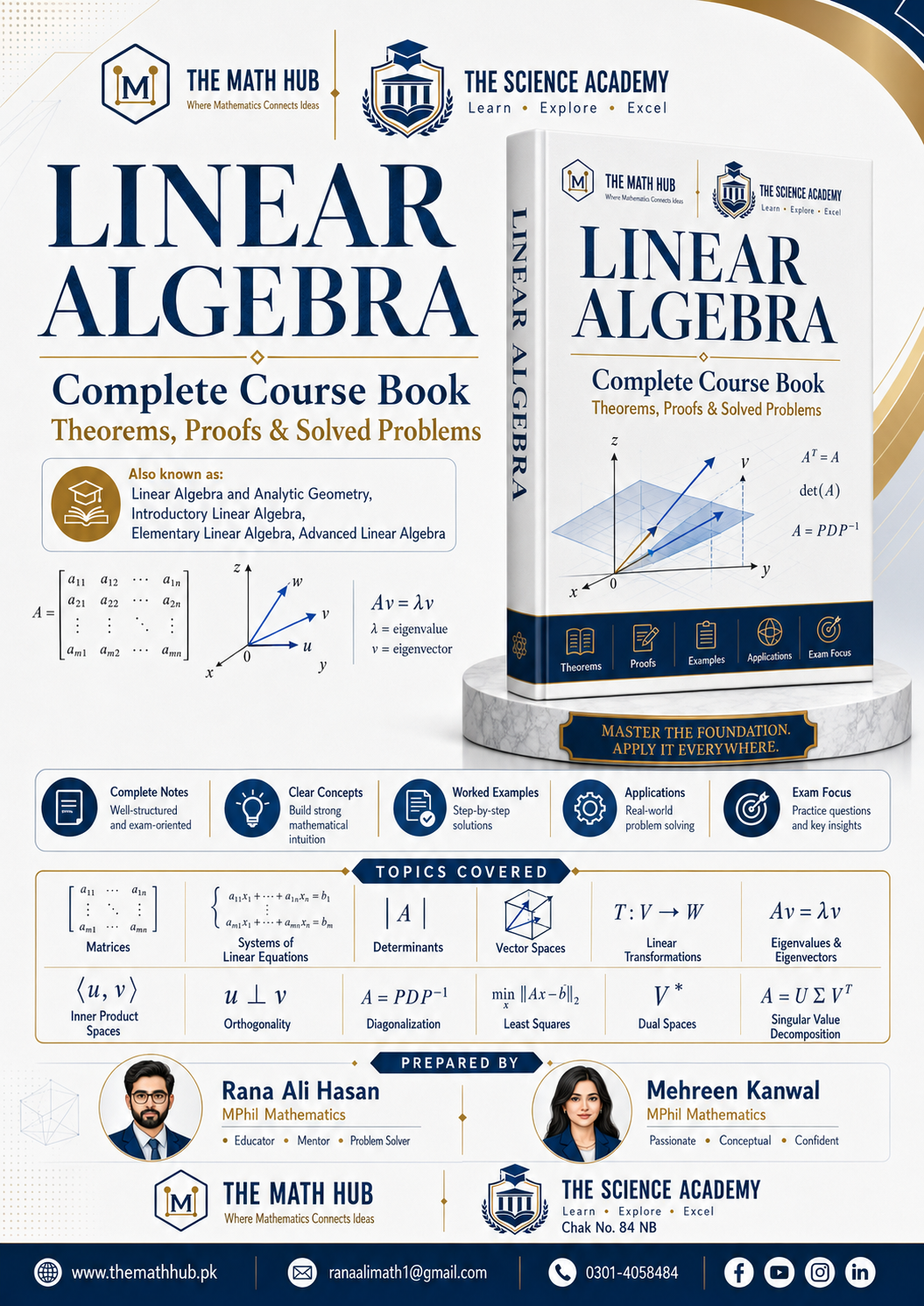
Linear Algebra studies vectors, matrices, systems of equations, vector spaces and linear transformations. This complete university-level learning resource connects matrix computation with the abstract ideas that explain why those computations work.
Students may encounter overlapping material under titles such as Linear Algebra, Elementary Linear Algebra, Introductory Linear Algebra, Matrix Algebra, Matrix Theory, Applied Linear Algebra or Linear Algebra and Its Applications. Course titles and topic boundaries vary by university and programme; these are search and curriculum variants, not duplicate books or duplicate canonical pages.
Overview / About This Book
Linear Algebra — Complete Course Book, Theorems, Proofs & Solved Problems is designed as a structured companion for self-study, revision and classroom support. It moves from definitions and matrix calculations to propositions, lemmas, theorem statements, formal proof ideas, worked examples, practice exercises, factorizations, algorithms and applications.
The resource is independently prepared by The Math Hub. It is not an official university textbook, and the university material below is included only for course naming, curriculum alignment and discovery context.
Resource Metadata
Why Study This Course?
Linear Algebra gives students a common language for equations, geometry, data, transformations and computation. It explains how a system can be reduced, when a matrix is invertible, how dimensions measure freedom, and why eigenvalues, orthogonality and factorization matter in applications.
For BS Mathematics and related university study, the subject supports later work in differential equations, numerical analysis, optimization, probability, statistics, abstract algebra, analysis and mathematical modelling. It also underpins computer graphics, machine learning, AI, data science and scientific computing.
Purpose and Benefits
Build accurate matrix and equation-solving technique.
Move from coordinates to vector spaces and structural reasoning.
Develop theorem, proof and counterexample habits.
Connect eigenvalue and orthogonality theory to algorithms.
Practise worked examples, exercises and exam preparation.
Recognize applications in data, AI, graphics and computation.
Who This Resource Is For
This Linear Algebra study guide is for BS Mathematics, ADP / Associate Degree Mathematics and legacy BSc Mathematics learners, as well as students in computer science, AI, machine learning, data science, engineering, physics and other programmes where the subject is part of the approved course plan. It can also support MSc prerequisite or revision work when the topics match the learner’s needs.
Learning Outcomes
- Represent and manipulate matrices, systems, vector spaces and linear maps with correct notation.
- Use row reduction, determinants, factorization, basis methods and rank-nullity in structured solutions.
- Compute and interpret eigenvalues, eigenvectors, diagonalization, inner products, projections and SVD.
- Read theorem hypotheses, follow proof structure, test conditions and distinguish valid conclusions from false converses.
- Apply Linear Algebra methods to approximation, regression, Markov chains, PageRank, graphics, data compression and numerical computation.
Complete 19-Chapter Course Contents
Exactly 19 entries mirror the detailed coverage below. Select an entry to jump to its crawlable chapter block.
Detailed Chapter-by-Chapter Coverage — All 19
Matrices & Matrix Algebra
What is taught
- matrix types
- matrix notation
- equality
- addition and scalar multiplication
- matrix multiplication
- transpose
- symmetric/skew-symmetric matrices
- inverse matrices
- elementary matrices
- block matrices
- matrix identities
Why this chapter is taught: Build the computational language used throughout Linear Algebra and establish the algebraic rules that distinguish matrix operations from ordinary scalar arithmetic.
Learning outcomes / benefits
- Recognize matrix types
- perform operations accurately
- test invertibility
- use block and elementary matrices
- explain why multiplication is generally noncommutative
Applications / connections: systems of equations; computer graphics; data tables; transformations; numerical computation.
Worked examples and exercises: Use the complete course book for the chapter’s definitions, theorem or method, worked calculations, proof structure and corresponding practice exercises. The PDF remains the source for the full printed treatment.
Open the complete book for Chapter 1 ↗ · Return to Course Contents · Next chapter
Linear Systems & Row Reduction
What is taught
- linear systems
- augmented matrices
- elementary row operations
- Gaussian elimination
- Gauss-Jordan elimination
- row echelon form
- reduced row echelon form
- pivot/free variables
- consistency
- unique/infinite/no solutions
- rank consistency
Why this chapter is taught: Convert systems into a systematic matrix procedure and teach students how solution structure is encoded by pivots and free variables.
Learning outcomes / benefits
- Reduce matrices to REF/RREF
- classify solution sets
- parameterize infinitely many solutions
- connect row reduction with rank
Applications / connections: engineering systems; networks; balancing models; optimization constraints; computational solvers.
Worked examples and exercises: Use the complete course book for the chapter’s definitions, theorem or method, worked calculations, proof structure and corresponding practice exercises. The PDF remains the source for the full printed treatment.
Open the complete book for Chapter 2 ↗ · Return to Course Contents · Previous chapter · Next chapter
Invertibility & Factorization
What is taught
- invertible matrix theorem
- equivalent invertibility conditions
- elementary matrices
- inverse via row reduction
- LU factorization
- permutation matrices
- PLU factorization
- triangular systems
- forward/back substitution
Why this chapter is taught: Connect invertibility to solvability and introduce matrix factorization as a reusable computational strategy.
Learning outcomes / benefits
- Apply the invertible matrix theorem
- compute inverses
- derive and use LU or PLU
- solve repeated systems efficiently
Applications / connections: numerical linear algebra; scientific computing; repeated system solving.
Worked examples and exercises: Use the complete course book for the chapter’s definitions, theorem or method, worked calculations, proof structure and corresponding practice exercises. The PDF remains the source for the full printed treatment.
Open the complete book for Chapter 3 ↗ · Return to Course Contents · Previous chapter · Next chapter
Determinants
What is taught
- determinant definition
- 2x2 and 3x3 determinants
- cofactors
- minors
- Laplace expansion
- determinant row-operation rules
- multiplicativity
- determinant of triangular matrices
- invertibility criterion
- adjugate
- Cramer's Rule
- geometric volume interpretation
Why this chapter is taught: Provide a scalar invariant that detects invertibility and encodes area/volume scaling.
Learning outcomes / benefits
- Compute determinants by multiple methods
- use determinant properties efficiently
- apply Cramer's Rule
- interpret determinant geometrically
Applications / connections: orientation; Jacobian intuition; eigenvalue characteristic polynomial; geometric scaling.
Worked examples and exercises: Use the complete course book for the chapter’s definitions, theorem or method, worked calculations, proof structure and corresponding practice exercises. The PDF remains the source for the full printed treatment.
Open the complete book for Chapter 4 ↗ · Return to Course Contents · Previous chapter · Next chapter
Vector Spaces & Subspaces
What is taught
- fields
- Abelian groups
- vector-space axioms
- examples/nonexamples
- Rⁿ
- polynomial spaces
- matrix spaces
- function spaces
- subspaces
- subspace test
- intersections
- sums of subspaces
Why this chapter is taught: Move from coordinate calculations to the abstract setting that unifies many mathematical objects.
Learning outcomes / benefits
- Verify vector-space axioms
- test subspaces
- construct examples and nonexamples
- recognize common vector spaces
Applications / connections: polynomials; differential equations; function spaces; data vectors.
Worked examples and exercises: Use the complete course book for the chapter’s definitions, theorem or method, worked calculations, proof structure and corresponding practice exercises. The PDF remains the source for the full printed treatment.
Open the complete book for Chapter 5 ↗ · Return to Course Contents · Previous chapter · Next chapter
Span & Linear Independence
What is taught
- linear combinations
- span
- generating sets
- linear dependence
- linear independence
- dependence equations
- redundant vectors
- geometric interpretation
- independence in polynomial/function spaces
Why this chapter is taught: Distinguish generating a space from having a nonredundant generating set, preparing for basis and dimension.
Learning outcomes / benefits
- Test span and independence
- remove redundant generators
- interpret dependence geometrically and algebraically
Applications / connections: basis construction; feature redundancy; coordinate systems.
Worked examples and exercises: Use the complete course book for the chapter’s definitions, theorem or method, worked calculations, proof structure and corresponding practice exercises. The PDF remains the source for the full printed treatment.
Open the complete book for Chapter 6 ↗ · Return to Course Contents · Previous chapter · Next chapter
Basis & Dimension
What is taught
- basis definition
- standard basis
- coordinate vectors
- ordered bases
- Steinitz Exchange Lemma
- basis extension
- dimension
- finite-dimensional spaces
- dimension theorem
- coordinates relative to a basis
Why this chapter is taught: Give every finite-dimensional vector space a minimal coordinate framework and quantify its number of degrees of freedom.
Learning outcomes / benefits
- Find bases
- compute dimension
- extend independent sets
- reduce spanning sets
- change between abstract vectors and coordinates
Applications / connections: data representation; model dimension; degrees of freedom.
Worked examples and exercises: Use the complete course book for the chapter’s definitions, theorem or method, worked calculations, proof structure and corresponding practice exercises. The PDF remains the source for the full printed treatment.
Open the complete book for Chapter 7 ↗ · Return to Course Contents · Previous chapter · Next chapter
Fundamental Subspaces
What is taught
- row space
- column space
- null space
- left null space
- rank
- nullity
- row/column rank
- direct sums
- internal/external direct sum
- quotient spaces
- change of basis
- transition matrices
Why this chapter is taught: Reveal the internal geometry of a matrix and connect equations, transformations and coordinates.
Learning outcomes / benefits
- Find fundamental subspaces
- build bases
- use direct sums and quotients
- interpret change-of-basis matrices
Applications / connections: linear systems; data compression; coordinate transformations.
Worked examples and exercises: Use the complete course book for the chapter’s definitions, theorem or method, worked calculations, proof structure and corresponding practice exercises. The PDF remains the source for the full printed treatment.
Open the complete book for Chapter 8 ↗ · Return to Course Contents · Previous chapter · Next chapter
Linear Transformations
What is taught
- definition
- linearity test
- domain/codomain
- kernel
- image/range
- injective
- surjective
- bijective
- isomorphism
- composition
- inverse transformation
- transformation examples
- geometric transformations
Why this chapter is taught: Shift the focus from matrices as arrays to linear maps as structure-preserving functions.
Learning outcomes / benefits
- Verify linearity
- calculate kernel and image
- test one-to-one and onto behavior
- construct isomorphisms
Applications / connections: geometry; graphics; differential operators; coordinate mappings.
Worked examples and exercises: Use the complete course book for the chapter’s definitions, theorem or method, worked calculations, proof structure and corresponding practice exercises. The PDF remains the source for the full printed treatment.
Open the complete book for Chapter 9 ↗ · Return to Course Contents · Previous chapter · Next chapter
Rank & Nullity
What is taught
- Rank-Nullity Theorem
- dimension of kernel/image
- matrix representation of transformations
- standard matrix
- similarity
- change of basis
- First Isomorphism Theorem for vector spaces
- rank tests for injectivity/surjectivity
Why this chapter is taught: Connect domain dimension, lost information and image dimension in one central theorem.
Learning outcomes / benefits
- Apply Rank-Nullity
- determine injectivity and surjectivity from dimensions
- construct matrices of maps
- relate similarity to basis change
Applications / connections: dimension reduction; system solvability; coordinate representation.
Worked examples and exercises: Use the complete course book for the chapter’s definitions, theorem or method, worked calculations, proof structure and corresponding practice exercises. The PDF remains the source for the full printed treatment.
Open the complete book for Chapter 10 ↗ · Return to Course Contents · Previous chapter · Next chapter
Eigenvalues & Eigenvectors
What is taught
- eigenvalue equation Av = λv
- characteristic polynomial
- characteristic equation
- eigenspaces
- algebraic multiplicity
- geometric multiplicity
- repeated eigenvalues
- complex eigenvalues
- eigenvectors of triangular matrices
Why this chapter is taught: Identify directions preserved by a linear transformation and prepare for diagonalization and spectral methods.
Learning outcomes / benefits
- Compute eigenvalues and eigenvectors
- find eigenspaces
- compare multiplicities
- interpret invariant directions
Applications / connections: stability; dynamical systems; PCA; vibration modes; PageRank.
Worked examples and exercises: Use the complete course book for the chapter’s definitions, theorem or method, worked calculations, proof structure and corresponding practice exercises. The PDF remains the source for the full printed treatment.
Open the complete book for Chapter 11 ↗ · Return to Course Contents · Previous chapter · Next chapter
Diagonalization
What is taught
- diagonalizable matrices
- eigenbasis
- P⁻¹AP = D
- criteria for diagonalizability
- repeated eigenvalues
- Cayley-Hamilton Theorem
- minimal polynomial
- powers/functions of matrices
- matrix exponential introduction
Why this chapter is taught: Turn complicated repeated matrix operations into simpler diagonal computations whenever enough eigenvectors exist.
Learning outcomes / benefits
- Test diagonalizability
- construct P and D
- use Cayley-Hamilton and minimal polynomials
- compute matrix powers and functions
Applications / connections: differential equations; discrete dynamics; matrix exponentials.
Worked examples and exercises: Use the complete course book for the chapter’s definitions, theorem or method, worked calculations, proof structure and corresponding practice exercises. The PDF remains the source for the full printed treatment.
Open the complete book for Chapter 12 ↗ · Return to Course Contents · Previous chapter · Next chapter
Inner Product Spaces
What is taught
- inner products
- Euclidean dot product
- weighted/function inner products
- norm
- distance
- angle
- Cauchy-Schwarz inequality
- triangle inequality
- orthogonality
- orthogonal complement
- orthonormal sets
- Bessel inequality
- Parseval identity
Why this chapter is taught: Add geometry—length, angle and orthogonality—to abstract vector spaces.
Learning outcomes / benefits
- Verify inner products
- compute norms and angles
- prove and use Cauchy-Schwarz
- work with orthogonal complements
Applications / connections: approximation; Fourier ideas; geometry; statistics.
Worked examples and exercises: Use the complete course book for the chapter’s definitions, theorem or method, worked calculations, proof structure and corresponding practice exercises. The PDF remains the source for the full printed treatment.
Open the complete book for Chapter 13 ↗ · Return to Course Contents · Previous chapter · Next chapter
Gram-Schmidt & QR
What is taught
- Gram-Schmidt process
- orthogonal bases
- orthonormal bases
- projections
- projection matrices
- QR factorization
- classical/modified Gram-Schmidt
- Householder reflections
Why this chapter is taught: Construct numerically and geometrically useful orthonormal bases and factor matrices for stable computation.
Learning outcomes / benefits
- Perform Gram-Schmidt
- build QR factorizations
- compute projections
- understand Householder transformations
Applications / connections: least squares; numerical algorithms; orthogonalization.
Worked examples and exercises: Use the complete course book for the chapter’s definitions, theorem or method, worked calculations, proof structure and corresponding practice exercises. The PDF remains the source for the full printed treatment.
Open the complete book for Chapter 14 ↗ · Return to Course Contents · Previous chapter · Next chapter
Least Squares
What is taught
- inconsistent systems
- best approximation
- orthogonal projection onto column space
- normal equations AᵀA x = Aᵀb
- least-squares solution
- regression
- residual vector
- geometric interpretation
- uniqueness conditions
Why this chapter is taught: Show how Linear Algebra solves overdetermined systems by finding the best approximate solution.
Learning outcomes / benefits
- Derive and use normal equations
- calculate residuals
- fit simple regression models
- interpret projection geometry
Applications / connections: data fitting; statistics; machine learning; measurement.
Worked examples and exercises: Use the complete course book for the chapter’s definitions, theorem or method, worked calculations, proof structure and corresponding practice exercises. The PDF remains the source for the full printed treatment.
Open the complete book for Chapter 15 ↗ · Return to Course Contents · Previous chapter · Next chapter
Dual Spaces
What is taught
- linear functionals
- dual space V*
- dual basis
- coordinate functionals
- annihilators
- transpose/dual map
- finite-dimensional duality
- Riesz Representation Theorem in inner-product settings
Why this chapter is taught: Introduce spaces of linear measurements and prepare students for more advanced algebra and analysis.
Learning outcomes / benefits
- Construct dual bases
- calculate functionals and annihilators
- relate vectors to functionals in inner-product spaces
Applications / connections: optimization; functional analysis; differential geometry.
Worked examples and exercises: Use the complete course book for the chapter’s definitions, theorem or method, worked calculations, proof structure and corresponding practice exercises. The PDF remains the source for the full printed treatment.
Open the complete book for Chapter 16 ↗ · Return to Course Contents · Previous chapter · Next chapter
Spectral Theory
What is taught
- spectral theorem
- symmetric/self-adjoint matrices
- orthogonal/unitary diagonalization
- Schur decomposition
- quadratic forms
- positive definiteness
- Sylvester criterion
- Cholesky factorization
- singular values
- Singular Value Decomposition
- low-rank approximation
- PCA
Why this chapter is taught: Bring together eigenvalue, orthogonality and factorization ideas into powerful structural and computational results.
Learning outcomes / benefits
- Apply the spectral theorem
- classify quadratic forms
- compute and use SVD
- understand low-rank approximation
- connect SVD to PCA
Applications / connections: machine learning; data compression; statistics; optimization; signal processing.
Worked examples and exercises: Use the complete course book for the chapter’s definitions, theorem or method, worked calculations, proof structure and corresponding practice exercises. The PDF remains the source for the full printed treatment.
Open the complete book for Chapter 17 ↗ · Return to Course Contents · Previous chapter · Next chapter
Canonical Forms
What is taught
- generalized eigenvectors
- Jordan chains
- Jordan canonical form
- nilpotent blocks
- minimal polynomial connection
- rational canonical form
- invariant factors
- companion matrices
- Smith normal form context
Why this chapter is taught: Explain how matrices can still be structurally simplified when diagonalization fails.
Learning outcomes / benefits
- Find generalized eigenspaces
- construct Jordan forms in representative cases
- understand rational and Smith canonical ideas
Applications / connections: differential systems; module viewpoint; classification.
Worked examples and exercises: Use the complete course book for the chapter’s definitions, theorem or method, worked calculations, proof structure and corresponding practice exercises. The PDF remains the source for the full printed treatment.
Open the complete book for Chapter 18 ↗ · Return to Course Contents · Previous chapter · Next chapter
Computational Linear Algebra
What is taught
- Markov chains
- transition matrices
- stationary distributions
- PageRank
- matrix exponential
- condition numbers
- sensitivity
- ill-conditioned systems
- power method
- inverse power method
- QR eigenvalue algorithm
- numerical stability
- PCA workflow
- computer graphics transformations
- cryptographic matrix applications
Why this chapter is taught: Connect theory to algorithms and real computational applications while introducing numerical reliability.
Learning outcomes / benefits
- Use basic iterative eigenvalue methods
- interpret condition numbers
- model Markov and PageRank systems
- connect SVD/PCA with data applications
Applications / connections: AI and machine learning; search ranking; graphics; scientific computing; cryptography.
Worked examples and exercises: Use the complete course book for the chapter’s definitions, theorem or method, worked calculations, proof structure and corresponding practice exercises. The PDF remains the source for the full printed treatment.
Open the complete book for Chapter 19 ↗ · Return to Course Contents · Previous chapter
Important Theorems, Methods and Concepts
- matrix identities, elementary matrices and block-matrix computation
- Gaussian and Gauss-Jordan elimination, REF/RREF, pivots and free variables
- the Invertible Matrix Theorem, LU/PLU factorization and triangular solves
- determinants, cofactors, Laplace expansion, Cramer's Rule and geometric scaling
- vector spaces, subspaces, span, linear independence, basis and dimension
- fundamental subspaces, quotient spaces, change of basis and transition matrices
- linear transformations, kernels, images, rank-nullity and isomorphism ideas
- eigenvalues, eigenvectors, eigenspaces, diagonalization and Cayley-Hamilton
- inner products, Cauchy-Schwarz, orthogonality, Gram-Schmidt and QR
- least squares, normal equations, projections, residuals and regression
- dual spaces, spectral theorem, quadratic forms, positive definiteness and Cholesky
- singular values, SVD, low-rank approximation, PCA and numerical stability
- Jordan/canonical forms, Markov chains, PageRank, iterative methods, graphics and cryptographic applications
Important named results genuinely represented in the course map include the Invertible Matrix Theorem, Rank–Nullity Theorem, Cayley-Hamilton Theorem, Cauchy-Schwarz inequality, spectral theorem, Sylvester criterion, Gram-Schmidt process, Singular Value Decomposition and related matrix and vector-space methods.
Worked-Example / Exercise / Solution Scope
The resource is theorem-and-problem oriented. Students encounter definitions, propositions, lemmas, theorem statements, formal proofs, matrix computations, factorizations, algorithms, worked examples and practice exercises across the 19-chapter progression. Topics include row reduction, inverse and determinant calculations, basis and dimension, transformation kernels and images, eigenvalue computations, orthogonalization, least squares, SVD and applications.
Use the PDF for the full printed examples and exercises. This HTML page keeps the complete topic map and study context crawlable without claiming an unaudited total number of questions.
Applications / Connections
Pure and applied mathematics
Vector spaces, transformations, rank-nullity, inner products, spectral theory and canonical forms connect Linear Algebra with differential equations, geometry, optimization, analysis and mathematical modelling.
Computing and data
Matrix methods support computer graphics, data tables, regression, PCA, data compression, PageRank, Markov chains, AI, machine learning, signal processing, scientific computing and cryptographic applications.
How to Use This Book
- Read the definition and notation before attempting a calculation or proof.
- Study the theorem statement, hypotheses and proof strategy; do not skip the reason each step is valid.
- Work through one example, then attempt a related exercise without looking at the solution.
- Check dimensions, pivots, assumptions, signs and final interpretation in computational questions.
- Use the chapter links for revision and the View PDF / Download PDF actions for the complete book.
Programme Relevance
The same canonical HTML page is surfaced through discovery cards in ADP Mathematics, BS Mathematics, Legacy BSc Mathematics, the Mathematics Library, the Algebra subject hub and the supported Mathematics for Computing & Other Programs route. These placements are discovery paths only; they do not clone the full SEO body or create separate Linear Algebra pages.
Pakistan University / Course Crosswalk
These entries help learners recognize course names and topic overlap. They are not endorsements, official notes or claims that every listed institution uses the same semester, code or syllabus. Confirm current wording with the institution’s approved scheme.
University of the Punjab
Linear Algebra appears as a distinct Mathematics course; Group Theory and Rings/Modules are separate. This distinction reinforces Linear Algebra ≠ Abstract Algebra.
NUST
Research registry includes MATH-222 Linear Algebra in BSCS context; use current verified scheme wording only.
Quaid-i-Azam University
Major Mathematics institution; use current verified course wording from the preserved source ledger.
COMSATS University Islamabad
Mathematics/computing context; use only verified current programme wording.
UET Lahore / UET Taxila
Engineering/computing matrix-method context; UET Taxila was included in the prior Linear Algebra registry.
University of Karachi
Mathematics programme discovery context.
IIUI
Mathematics/computing programme discovery context.
University of Sargodha
MATH-5107 Linear Algebra; prior researched scope includes Gaussian/Gauss-Jordan, vector spaces, bases, quotient spaces, transformations, rank/nullity, eigenvalues, dual spaces, inner products, Cauchy inequality, Gram-Schmidt and diagonalization.
UCP
Algebra-I (Group Theory), Linear Algebra and Algebra-II (Rings & Fields) are distinct identities in the prior mapping.
UMT
Prior mapping places Linear Algebra before later Algebra I/II in the sequence.
Virtual University
MTH501 Linear Algebra.
IBA Karachi
MTS203 Linear Algebra in BS Mathematics / BSCS-related context.
FAST-NUCES
MT104 Linear Algebra in BSCS research.
HITEC University
MT-203 Linear Algebra in AI/CS/SE/Cyber Security context from prior research.
ITU
MT121 Linear Algebra in BSCS/BSAI; also Software Engineering / Computer Engineering context.
Air University
MA201 Linear Algebra in BSCS research.
Bahria University
GSC121 Linear Algebra in BSCS / Software Engineering research.
PIEAS
PAM-524 Linear Algebra in MSCS research; advanced topics included SVD, orthogonality, Jordan, least squares, Markov/Perron-Frobenius context.
Curated public / major display priority
Curated private display priority
The curated display order is a Math Hub presentation priority, not an objective national ranking.
Recommended Reference Books
- Howard Anton / Chris Rorres / Anton Kaul — Elementary Linear Algebra
- David C. Lay, Steven R. Lay & Judi J. McDonald — Linear Algebra and Its Applications
- Gilbert Strang — Introduction to Linear Algebra
- Friedberg, Insel & Spence — Linear Algebra
- Sheldon Axler — Linear Algebra Done Right
Free and Legal Learning Resources
- Sheldon Axler — Linear Algebra Done Right (open access edition where legally available)
- Jim Hefferon — Linear Algebra
- Robert Beezer — A First Course in Linear Algebra
- MIT OpenCourseWare / Gilbert Strang
Reference books are listed as independent study and course-alignment sources. The Math Hub does not reproduce copyrighted reference-book text.
Linear Algebra vs Abstract Algebra
Linear Algebra focuses on vector spaces, matrices, linear systems, linear transformations, eigenvalues, inner products and related computational or geometric methods. Abstract Algebra / Group Theory focuses on groups and their structures, including subgroups, cosets, normality, homomorphisms and Sylow theory. University programmes may place both in an algebra pathway, but they are distinct subject identities and should not be merged into one resource page.
Frequently Asked Questions
All 40 Resource-01 questions are represented below with the dedicated course answers.
Q1. What should a student understand in Matrices & Matrix Algebra?
This part of Linear Algebra — Complete Course Book, Theorems, Proofs & Solved Problems focuses on Matrices & Matrix Algebra. The detailed resource block explains the core definitions or methods, worked examples or proof structure where applicable, and how the topic connects to later material.
Q2. Why is Matrices & Matrix Algebra important in this course?
Matrices & Matrix Algebra is included because it supports the course progression and gives students a structured way to move from foundational ideas to later applications, proofs or problem-solving methods.
Q3. What should a student understand in Linear Systems & Row Reduction?
This part of Linear Algebra — Complete Course Book, Theorems, Proofs & Solved Problems focuses on Linear Systems & Row Reduction. The detailed resource block explains the core definitions or methods, worked examples or proof structure where applicable, and how the topic connects to later material.
Q4. Why is Linear Systems & Row Reduction important in this course?
Linear Systems & Row Reduction is included because it supports the course progression and gives students a structured way to move from foundational ideas to later applications, proofs or problem-solving methods.
Q5. What should a student understand in Invertibility & Factorization?
This part of Linear Algebra — Complete Course Book, Theorems, Proofs & Solved Problems focuses on Invertibility & Factorization. The detailed resource block explains the core definitions or methods, worked examples or proof structure where applicable, and how the topic connects to later material.
Q6. Why is Invertibility & Factorization important in this course?
Invertibility & Factorization is included because it supports the course progression and gives students a structured way to move from foundational ideas to later applications, proofs or problem-solving methods.
Q7. What should a student understand in Determinants?
This part of Linear Algebra — Complete Course Book, Theorems, Proofs & Solved Problems focuses on Determinants. The detailed resource block explains the core definitions or methods, worked examples or proof structure where applicable, and how the topic connects to later material.
Q8. Why is Determinants important in this course?
Determinants is included because it supports the course progression and gives students a structured way to move from foundational ideas to later applications, proofs or problem-solving methods.
Q9. What should a student understand in Vector Spaces & Subspaces?
This part of Linear Algebra — Complete Course Book, Theorems, Proofs & Solved Problems focuses on Vector Spaces & Subspaces. The detailed resource block explains the core definitions or methods, worked examples or proof structure where applicable, and how the topic connects to later material.
Q10. Why is Vector Spaces & Subspaces important in this course?
Vector Spaces & Subspaces is included because it supports the course progression and gives students a structured way to move from foundational ideas to later applications, proofs or problem-solving methods.
Q11. What should a student understand in Span & Linear Independence?
This part of Linear Algebra — Complete Course Book, Theorems, Proofs & Solved Problems focuses on Span & Linear Independence. The detailed resource block explains the core definitions or methods, worked examples or proof structure where applicable, and how the topic connects to later material.
Q12. Why is Span & Linear Independence important in this course?
Span & Linear Independence is included because it supports the course progression and gives students a structured way to move from foundational ideas to later applications, proofs or problem-solving methods.
Q13. What should a student understand in Basis & Dimension?
This part of Linear Algebra — Complete Course Book, Theorems, Proofs & Solved Problems focuses on Basis & Dimension. The detailed resource block explains the core definitions or methods, worked examples or proof structure where applicable, and how the topic connects to later material.
Q14. Why is Basis & Dimension important in this course?
Basis & Dimension is included because it supports the course progression and gives students a structured way to move from foundational ideas to later applications, proofs or problem-solving methods.
Q15. What should a student understand in Fundamental Subspaces?
This part of Linear Algebra — Complete Course Book, Theorems, Proofs & Solved Problems focuses on Fundamental Subspaces. The detailed resource block explains the core definitions or methods, worked examples or proof structure where applicable, and how the topic connects to later material.
Q16. Why is Fundamental Subspaces important in this course?
Fundamental Subspaces is included because it supports the course progression and gives students a structured way to move from foundational ideas to later applications, proofs or problem-solving methods.
Q17. What should a student understand in Linear Transformations?
This part of Linear Algebra — Complete Course Book, Theorems, Proofs & Solved Problems focuses on Linear Transformations. The detailed resource block explains the core definitions or methods, worked examples or proof structure where applicable, and how the topic connects to later material.
Q18. Why is Linear Transformations important in this course?
Linear Transformations is included because it supports the course progression and gives students a structured way to move from foundational ideas to later applications, proofs or problem-solving methods.
Q19. What should a student understand in Rank & Nullity?
This part of Linear Algebra — Complete Course Book, Theorems, Proofs & Solved Problems focuses on Rank & Nullity. The detailed resource block explains the core definitions or methods, worked examples or proof structure where applicable, and how the topic connects to later material.
Q20. Why is Rank & Nullity important in this course?
Rank & Nullity is included because it supports the course progression and gives students a structured way to move from foundational ideas to later applications, proofs or problem-solving methods.
Q21. What should a student understand in Eigenvalues & Eigenvectors?
This part of Linear Algebra — Complete Course Book, Theorems, Proofs & Solved Problems focuses on Eigenvalues & Eigenvectors. The detailed resource block explains the core definitions or methods, worked examples or proof structure where applicable, and how the topic connects to later material.
Q22. Why is Eigenvalues & Eigenvectors important in this course?
Eigenvalues & Eigenvectors is included because it supports the course progression and gives students a structured way to move from foundational ideas to later applications, proofs or problem-solving methods.
Q23. What should a student understand in Diagonalization?
This part of Linear Algebra — Complete Course Book, Theorems, Proofs & Solved Problems focuses on Diagonalization. The detailed resource block explains the core definitions or methods, worked examples or proof structure where applicable, and how the topic connects to later material.
Q24. Why is Diagonalization important in this course?
Diagonalization is included because it supports the course progression and gives students a structured way to move from foundational ideas to later applications, proofs or problem-solving methods.
Q25. What should a student understand in Inner Product Spaces?
This part of Linear Algebra — Complete Course Book, Theorems, Proofs & Solved Problems focuses on Inner Product Spaces. The detailed resource block explains the core definitions or methods, worked examples or proof structure where applicable, and how the topic connects to later material.
Q26. Why is Inner Product Spaces important in this course?
Inner Product Spaces is included because it supports the course progression and gives students a structured way to move from foundational ideas to later applications, proofs or problem-solving methods.
Q27. What should a student understand in Gram-Schmidt & QR?
This part of Linear Algebra — Complete Course Book, Theorems, Proofs & Solved Problems focuses on Gram-Schmidt & QR. The detailed resource block explains the core definitions or methods, worked examples or proof structure where applicable, and how the topic connects to later material.
Q28. Why is Gram-Schmidt & QR important in this course?
Gram-Schmidt & QR is included because it supports the course progression and gives students a structured way to move from foundational ideas to later applications, proofs or problem-solving methods.
Q29. What should a student understand in Least Squares?
This part of Linear Algebra — Complete Course Book, Theorems, Proofs & Solved Problems focuses on Least Squares. The detailed resource block explains the core definitions or methods, worked examples or proof structure where applicable, and how the topic connects to later material.
Q30. Why is Least Squares important in this course?
Least Squares is included because it supports the course progression and gives students a structured way to move from foundational ideas to later applications, proofs or problem-solving methods.
Q31. What should a student understand in Dual Spaces?
This part of Linear Algebra — Complete Course Book, Theorems, Proofs & Solved Problems focuses on Dual Spaces. The detailed resource block explains the core definitions or methods, worked examples or proof structure where applicable, and how the topic connects to later material.
Q32. Why is Dual Spaces important in this course?
Dual Spaces is included because it supports the course progression and gives students a structured way to move from foundational ideas to later applications, proofs or problem-solving methods.
Q33. What should a student understand in Spectral Theory?
This part of Linear Algebra — Complete Course Book, Theorems, Proofs & Solved Problems focuses on Spectral Theory. The detailed resource block explains the core definitions or methods, worked examples or proof structure where applicable, and how the topic connects to later material.
Q34. Why is Spectral Theory important in this course?
Spectral Theory is included because it supports the course progression and gives students a structured way to move from foundational ideas to later applications, proofs or problem-solving methods.
Q35. What should a student understand in Canonical Forms?
This part of Linear Algebra — Complete Course Book, Theorems, Proofs & Solved Problems focuses on Canonical Forms. The detailed resource block explains the core definitions or methods, worked examples or proof structure where applicable, and how the topic connects to later material.
Q36. Why is Canonical Forms important in this course?
Canonical Forms is included because it supports the course progression and gives students a structured way to move from foundational ideas to later applications, proofs or problem-solving methods.
Q37. What should a student understand in Computational Linear Algebra?
This part of Linear Algebra — Complete Course Book, Theorems, Proofs & Solved Problems focuses on Computational Linear Algebra. The detailed resource block explains the core definitions or methods, worked examples or proof structure where applicable, and how the topic connects to later material.
Q38. Why is Computational Linear Algebra important in this course?
Computational Linear Algebra is included because it supports the course progression and gives students a structured way to move from foundational ideas to later applications, proofs or problem-solving methods.
Q39. Is this an official university textbook?
No. It is an independently prepared The Math Hub learning resource. University curricula are used for naming, alignment and discovery context only.
Q40. Where should this resource appear on The Math Hub?
The canonical page is reused from the relevant ADP, BS, BSc, Library and subject-hub discovery surfaces listed in this dossier; those surfaces must not clone the full SEO page.