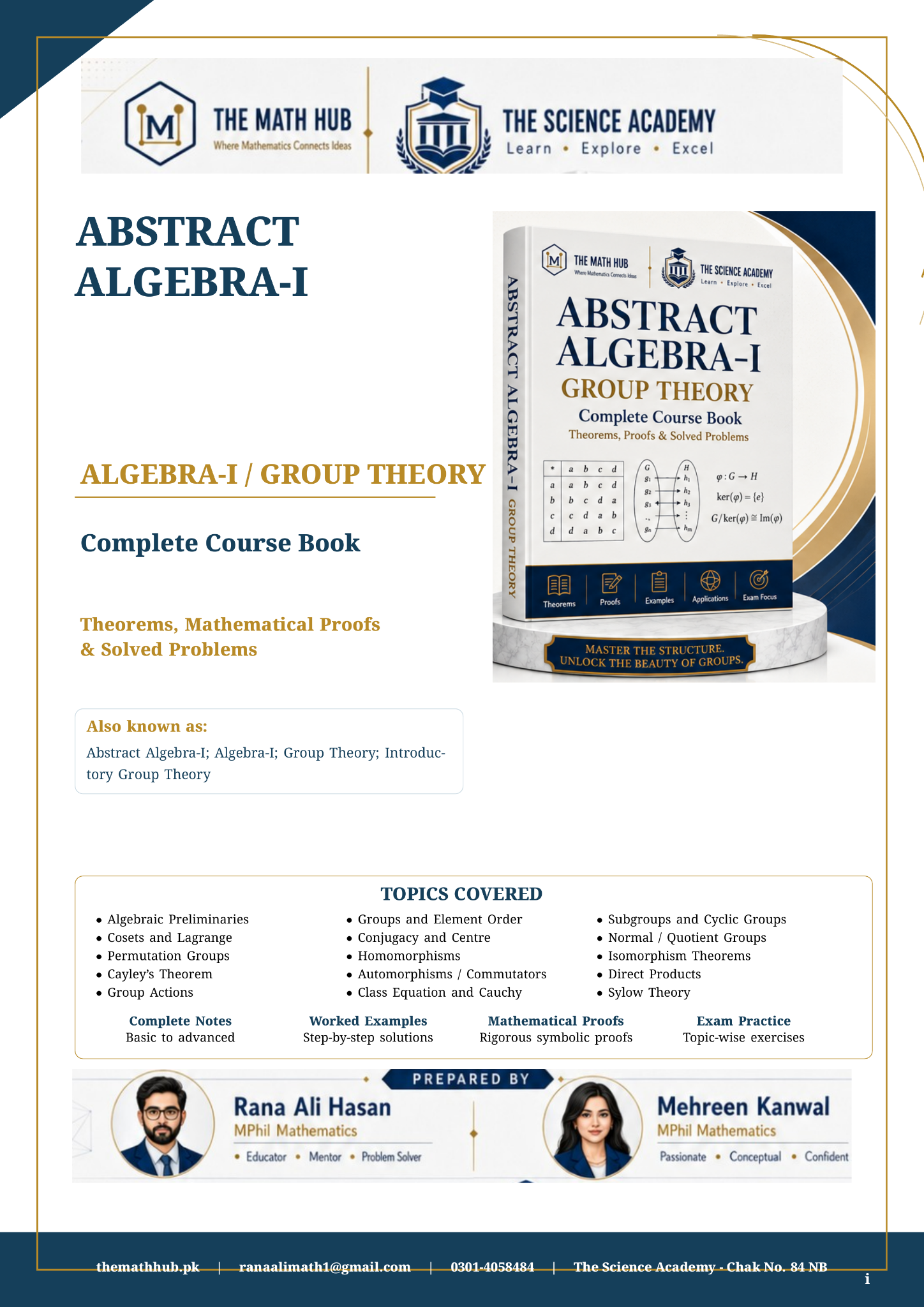
Overview / About This Book
Abstract Algebra-I (Algebra-I / Algebra 1): Group Theory is a structured university-level learning companion rather than a bare PDF link. It develops the language of sets and operations, introduces group axioms and elementary properties, and then builds toward finite-group structure through subgroups, cosets, normality, quotient groups, homomorphisms, actions and Sylow theory.
The page supports self-study, revision and classroom use by showing how definitions, theorem statements, proof strategies, worked examples and exercises connect. University names and course codes below are curriculum and discovery context only; this is an independently prepared Math Hub resource, not an official university book.
Aliases / Course-Name Variants
The central academic identity is Group Theory. Students may legitimately find substantially overlapping introductory material under Abstract Algebra I, Abstract Algebra-I, Algebra-I, Algebra 1, Introductory Abstract Algebra, Modern Algebra or a finite-group-theory component. These are search and curriculum variants, not duplicate canonical pages.
Linear Algebra is a different subject: it studies vector spaces, matrices and linear transformations, while this resource studies groups and their structure.
Resource Metadata
Why Study This Course?
Group Theory gives students a precise way to study symmetry, operations and structure. It explains how a group is built from axioms, how subgroups and cosets reveal internal organization, and how homomorphisms and quotient groups preserve the information that matters.
The later chapters connect abstract reasoning with permutation groups, group actions, conjugacy, finite p-groups, Cauchy’s theorem and Sylow theory. This makes the course a foundation for further Abstract Algebra, algebraic number theory, Galois theory, representation theory, geometry, topology and mathematical physics.
Purpose and Benefits
Build accurate algebraic notation and proof habits.
Move from group axioms to structural consequences.
Practise subgroup, coset, order and quotient computations.
Understand kernels, images and isomorphism theorems.
Use actions, class equations, Cauchy and Sylow results.
Prepare for BS, ADP, BSc and MSc revision contexts.
Who This Resource Is For
This Group Theory study guide is for BS Mathematics, ADP / Associate Degree Mathematics, legacy BSc Mathematics and students taking Group Theory or Abstract Algebra. It can also support MSc prerequisite or revision work and related learners in physics, computer science, cryptography, engineering and other programmes when the topics match the approved course plan.
Learning Outcomes
- Translate definitions and algebraic conditions into precise symbolic statements.
- Test groups, subgroups, cyclic structures, cosets, normality and quotient operations.
- Compute orders, permutations, kernels, images, conjugacy classes, automorphisms and direct products.
- State theorem hypotheses accurately and follow proof, counterexample and classification strategies.
- Apply group actions, Orbit–Stabilizer, the class equation, Cauchy’s theorem and Sylow theorems to finite groups.
Complete 18-Chapter Course Contents
Exactly 18 entries mirror the detailed coverage below. Each entry links to its own crawlable chapter block.
Detailed Chapter-by-Chapter Coverage — All 18
Algebraic Preliminaries
What is taught
- sets and set notation
- subsets and set operations
- ordered pairs and Cartesian products
- relations
- reflexive, symmetric and transitive relations
- equivalence relations, classes and partitions
- functions and mappings
- injective, surjective and bijective maps
- composition, identity and inverse mappings
- binary operations
- closure, associativity and commutativity
- identity and inverse under an operation
- groupoids, semigroups and monoids
- modular arithmetic
Why this chapter is taught: Builds the precise language needed before group axioms can be stated and prevents proof errors caused by vague handling of mappings, equivalence classes and operations.
Learning outcomes / benefits
- translate algebraic conditions into symbols
- test properties of relations and functions
- verify whether operations are well-defined and closed
- recognize the groupoid → semigroup → monoid progression
Applications / connections: discrete mathematics; logic and proof; number theory; computer-science relations and functions; quotient constructions later in algebra.
Worked examples and exercises: The complete course book provides the chapter’s definitions, theorem or method, worked calculations, proof structure and corresponding practice exercises. The PDF remains the source for the full printed treatment.
Open the complete book for Chapter 1 ↗ · Return to Course Contents · Next chapter
Groups and Elementary Properties
What is taught
- definition of a group
- closure, associativity, identity and inverse axioms
- Abelian versus non-Abelian groups
- uniqueness of identity and inverse
- cancellation laws
- solving ax = b and ya = b
- inverse of a product
- integer powers and exponent laws
- additive and multiplicative groups
- integers modulo n and units modulo n
- dihedral groups
- quaternion group
- general linear groups
- symmetry examples
Why this chapter is taught: Introduces the central structure of Group Theory and trains students to prove consequences from axioms rather than rely on familiar arithmetic.
Learning outcomes / benefits
- verify group axioms
- distinguish Abelian and non-Abelian examples
- derive elementary laws rigorously
- work fluently with additive and multiplicative notation
Applications / connections: symmetry; crystallography; particle physics; coding and cryptography; permutation structures; matrix groups.
Worked examples and exercises: The complete course book provides the chapter’s definitions, theorem or method, worked calculations, proof structure and corresponding practice exercises. The PDF remains the source for the full printed treatment.
Open the complete book for Chapter 2 ↗ · Return to Course Contents · Previous chapter · Next chapter
Order of Groups and Elements
What is taught
- finite and infinite groups
- order of a group
- order of an element
- powers of an element
- cyclic subgroup generated by one element
- the criterion aⁿ = e
- minimal positive exponent
- order of an inverse
- order under conjugation
- order of a power
- gcd formula for order of aᵏ
- involutions
- inverse pairing
- products of commuting elements
- coprime-order product theorem
- element-order tables
Why this chapter is taught: Element order converts abstract structure into divisibility information and is essential for cyclic groups, Lagrange, Cauchy and Sylow theory.
Learning outcomes / benefits
- compute element orders
- prove divisibility and order formulas
- connect powers with generated subgroups
- use gcd and lcm reasoning inside groups
Applications / connections: finite-group classification; cryptographic cyclic subgroups; roots of unity; permutation cycle orders.
Worked examples and exercises: The complete course book provides the chapter’s definitions, theorem or method, worked calculations, proof structure and corresponding practice exercises. The PDF remains the source for the full printed treatment.
Open the complete book for Chapter 3 ↗ · Return to Course Contents · Previous chapter · Next chapter
Subgroups and Generated Subgroups
What is taught
- definition and notation of a subgroup
- one-step and two-step subgroup tests
- finite subgroup test
- trivial and improper subgroups
- intersections of subgroups
- the union caveat
- generated subgroup
- subgroup generated by a subset
- finite generating sets
- subgroup lattices
- subgroups of Z and Zₙ
- permutation subgroups
- matrix subgroups
- closure under products and inverses
Why this chapter is taught: Teaches how smaller algebraic structures sit inside a group, forming the foundation for decomposition, cosets, normality and classification.
Learning outcomes / benefits
- apply subgroup tests efficiently
- construct generated subgroups
- build subgroup lattices
- produce counterexamples to false closure claims
Applications / connections: symmetry substructures; invariant transformations; algebraic decomposition; computational group algorithms.
Worked examples and exercises: The complete course book provides the chapter’s definitions, theorem or method, worked calculations, proof structure and corresponding practice exercises. The PDF remains the source for the full printed treatment.
Open the complete book for Chapter 4 ↗ · Return to Course Contents · Previous chapter · Next chapter
Cyclic Groups
What is taught
- cyclic groups and generators
- generator notation ⟨a⟩
- finite versus infinite cyclic groups
- why cyclic groups are Abelian
- classification up to isomorphism
- generators of Zₙ
- gcd criterion for generators
- order of powers
- subgroups of cyclic groups
- unique subgroup for each divisor
- divisor correspondence
- Euler phi function
- number of generators
- cyclic homomorphisms
- examples and nonexamples
Why this chapter is taught: Cyclic groups are the simplest complete model of group structure and make classification theorems accessible.
Learning outcomes / benefits
- identify generators
- classify cyclic groups
- enumerate subgroups from divisors
- connect Euler phi with generator counts
Applications / connections: modular arithmetic; cryptography; roots of unity; periodic phenomena.
Worked examples and exercises: The complete course book provides the chapter’s definitions, theorem or method, worked calculations, proof structure and corresponding practice exercises. The PDF remains the source for the full printed treatment.
Open the complete book for Chapter 5 ↗ · Return to Course Contents · Previous chapter · Next chapter
Cosets and Lagrange’s Theorem
What is taught
- left cosets
- right cosets
- coset representatives
- equality and disjointness of cosets
- cosets partition a group
- index of a subgroup
- finite coset counting
- Lagrange’s theorem
- subgroup order divides group order
- element order divides finite group order
- a^|G| = e
- groups of prime order
- converse limitations
- possible subgroup orders
- modular applications
Why this chapter is taught: Lagrange’s theorem is the first major bridge between arithmetic divisibility and group structure.
Learning outcomes / benefits
- compute cosets and index
- prove coset partition results
- apply Lagrange to rule out possibilities
- distinguish a theorem from false converses
Applications / connections: finite-group classification; number theory; Euler and Fermat-style consequences; Orbit–Stabilizer preparation.
Worked examples and exercises: The complete course book provides the chapter’s definitions, theorem or method, worked calculations, proof structure and corresponding practice exercises. The PDF remains the source for the full printed treatment.
Open the complete book for Chapter 6 ↗ · Return to Course Contents · Previous chapter · Next chapter
Conjugacy, Centralizers, Normalizers and Centre
What is taught
- conjugate elements
- conjugacy relation and classes
- centralizer C_G(a)
- centralizer of a subset
- centre Z(G)
- normalizer N_G(H)
- centralizer, centre and normalizer as subgroups
- class size and centralizer index
- conjugacy in Sₙ
- cycle-type connection
- the Abelian-group case
- structural examples
Why this chapter is taught: Introduces internal symmetry. Conjugacy organizes elements by structural similarity and prepares for normal subgroups, class equations and actions.
Learning outcomes / benefits
- compute centralizers and centres
- identify conjugacy classes
- use normalizers to study subgroup stability
- connect conjugacy with permutation cycle type
Applications / connections: symmetry classification; class equation; representation theory; matrix-similarity analogies.
Worked examples and exercises: The complete course book provides the chapter’s definitions, theorem or method, worked calculations, proof structure and corresponding practice exercises. The PDF remains the source for the full printed treatment.
Open the complete book for Chapter 7 ↗ · Return to Course Contents · Previous chapter · Next chapter
Normal Subgroups, Quotient Groups and Simple Groups
What is taught
- definition of normal subgroup
- left/right coset criterion
- conjugation criterion
- kernel implies normal
- centre-derived normal examples
- normal subgroup lattice
- quotient or factor group
- well-defined coset operation
- identity and inverse in a quotient
- order of a quotient group
- simple groups
- proper nontrivial normal subgroups
- cyclic quotient examples
- normal subgroups of Sₙ and Aₙ
- direct-product examples
Why this chapter is taught: Normality is exactly the condition needed for quotient groups. Quotients simplify a group while preserving structure.
Learning outcomes / benefits
- test normality by several criteria
- construct quotient groups
- verify well-defined operations
- recognize simple and nonsimple groups
Applications / connections: homomorphism theorems; classification; Galois-theory preparation; symmetry reduction.
Worked examples and exercises: The complete course book provides the chapter’s definitions, theorem or method, worked calculations, proof structure and corresponding practice exercises. The PDF remains the source for the full printed treatment.
Open the complete book for Chapter 8 ↗ · Return to Course Contents · Previous chapter · Next chapter
Permutation Groups
What is taught
- permutations as bijections
- symmetric group Sₙ
- cycle notation
- disjoint-cycle decomposition
- fixed points
- transpositions
- cycles as products of transpositions
- parity
- even and odd permutations
- sign
- alternating group Aₙ
- order of a permutation
- cycle type
- conjugacy in Sₙ
- composition conventions
- dihedral actions as permutations
- Cayley preparation
Why this chapter is taught: Permutation groups make abstract groups concrete and encode symmetry as rearrangement.
Learning outcomes / benefits
- convert between mapping and cycle notation
- compose permutations accurately
- determine parity and order
- work with Sₙ and Aₙ
Applications / connections: combinatorics; symmetry; Galois theory; algorithms.
Worked examples and exercises: The complete course book provides the chapter’s definitions, theorem or method, worked calculations, proof structure and corresponding practice exercises. The PDF remains the source for the full printed treatment.
Open the complete book for Chapter 9 ↗ · Return to Course Contents · Previous chapter · Next chapter
Group Homomorphisms
What is taught
- definition of homomorphism
- operation preservation
- image of identity
- image of inverses and powers
- kernel
- image
- kernel as a normal subgroup
- image as a subgroup
- injectivity criterion via the kernel
- monomorphism
- epimorphism
- isomorphism
- fibres and cosets of the kernel
- natural quotient map
- Z → Zₙ examples
- cyclic-group homomorphisms
- composition
Why this chapter is taught: Homomorphisms identify which structural information survives under a map and lead to quotient and isomorphism theorems.
Learning outcomes / benefits
- verify homomorphisms
- compute kernel and image
- test injectivity and surjectivity
- construct natural maps and factor maps
Applications / connections: structure-preserving transformations; quotient algorithms; representations; classification.
Worked examples and exercises: The complete course book provides the chapter’s definitions, theorem or method, worked calculations, proof structure and corresponding practice exercises. The PDF remains the source for the full printed treatment.
Open the complete book for Chapter 10 ↗ · Return to Course Contents · Previous chapter · Next chapter
Isomorphism Theorems
What is taught
- First Isomorphism Theorem
- canonical factorization through G/ker φ
- well-defined induced map
- Second Isomorphism Theorem
- product HK
- intersection H ∩ K
- Third Isomorphism Theorem
- nested normal subgroups
- Correspondence or Lattice Theorem
- subgroups containing N
- normality under correspondence
- index and order consequences
- quotient identifications
- proof templates
Why this chapter is taught: These theorems are central structural compression tools: kernels, images and quotient groups become interchangeable descriptions.
Learning outcomes / benefits
- state hypotheses precisely
- construct induced isomorphisms
- use correspondence to classify subgroups
- choose the right theorem for quotient problems
Applications / connections: ring and module isomorphism theorems; linear-algebra quotient spaces; homological-algebra foundations.
Worked examples and exercises: The complete course book provides the chapter’s definitions, theorem or method, worked calculations, proof structure and corresponding practice exercises. The PDF remains the source for the full printed treatment.
Open the complete book for Chapter 11 ↗ · Return to Course Contents · Previous chapter · Next chapter
Cayley’s Theorem
What is taught
- left regular action
- left translations
- permutations induced by elements
- the map G → Sym(G)
- homomorphism proof
- injectivity proof
- regular representation
- finite-group embedding into Sₙ
- cyclic examples
- dihedral examples
- permutation representation
- faithful actions
Why this chapter is taught: Cayley’s theorem proves that every abstract group can be realized as a permutation group.
Learning outcomes / benefits
- construct left translations
- prove that the regular action is faithful
- embed small groups in symmetric groups
- interpret abstract elements as transformations
Applications / connections: permutation representations; computational group theory; symmetry.
Worked examples and exercises: The complete course book provides the chapter’s definitions, theorem or method, worked calculations, proof structure and corresponding practice exercises. The PDF remains the source for the full printed treatment.
Open the complete book for Chapter 12 ↗ · Return to Course Contents · Previous chapter · Next chapter
Endomorphisms and Automorphisms
What is taught
- endomorphism
- automorphism
- Aut(G)
- identity automorphism
- composition and inverse automorphism
- inner automorphism
- Inn(G)
- conjugation maps
- Inn(G) normal in Aut(G)
- centre and inner automorphisms
- outer automorphism idea
- automorphisms of cyclic groups
- Aut(Zₙ) and units
- characteristic subgroups
- examples
Why this chapter is taught: Automorphisms measure symmetries of the group structure itself and connect conjugation to higher-level symmetry.
Learning outcomes / benefits
- compute automorphisms of basic groups
- distinguish inner and outer automorphisms
- prove Aut(G) is a group
- relate the centre to inner automorphisms
Applications / connections: Galois groups; geometry of symmetries; classification; representation theory.
Worked examples and exercises: The complete course book provides the chapter’s definitions, theorem or method, worked calculations, proof structure and corresponding practice exercises. The PDF remains the source for the full printed treatment.
Open the complete book for Chapter 13 ↗ · Return to Course Contents · Previous chapter · Next chapter
Commutators and Derived Subgroup
What is taught
- commutator [a,b]
- commutator identities
- commuting criterion
- derived or commutator subgroup G′
- normality of G′
- abelianization G/G′
- largest Abelian quotient idea
- perfect groups
- derived-series introduction
- commutator calculations
- relation to inner structure
Why this chapter is taught: Commutators measure failure of commutativity; the derived subgroup isolates that failure.
Learning outcomes / benefits
- compute commutators
- prove normality and characteristic behavior
- construct abelianization
- recognize perfect and solvable-direction concepts
Applications / connections: solvable groups; Galois theory; fundamental groups in topology; representation theory.
Worked examples and exercises: The complete course book provides the chapter’s definitions, theorem or method, worked calculations, proof structure and corresponding practice exercises. The PDF remains the source for the full printed treatment.
Open the complete book for Chapter 14 ↗ · Return to Course Contents · Previous chapter · Next chapter
Direct Products
What is taught
- external direct product
- componentwise operation
- identity and inverse
- order of a direct product
- subgroups of products
- internal direct product
- commuting normal subgroups
- trivial intersection
- isomorphism to a product
- cyclicity of Cₘ × Cₙ
- coprime criterion
- element order in products
- decomposition examples
- finite Abelian group preview
Why this chapter is taught: Direct products construct large groups from smaller groups and introduce decomposition as a major algebraic strategy.
Learning outcomes / benefits
- construct product groups
- compute element orders
- test when products are cyclic
- recognize internal direct-product conditions
Applications / connections: finite Abelian groups; modular decomposition; coding structures; product symmetries.
Worked examples and exercises: The complete course book provides the chapter’s definitions, theorem or method, worked calculations, proof structure and corresponding practice exercises. The PDF remains the source for the full printed treatment.
Open the complete book for Chapter 15 ↗ · Return to Course Contents · Previous chapter · Next chapter
Group Actions
What is taught
- definition of group action
- identity and action compatibility
- left actions
- action as a homomorphism to Sym(X)
- orbits
- stabilizers
- orbit equivalence relation
- Orbit–Stabilizer Theorem
- fixed points
- faithful actions
- transitive actions
- coset actions
- conjugation action
- Burnside or Cauchy–Frobenius introduction
- polygon and set examples
Why this chapter is taught: Actions translate group structure into transformations and unify cosets, conjugacy, permutation representations and counting.
Learning outcomes / benefits
- verify actions
- compute orbits and stabilizers
- apply Orbit–Stabilizer
- use actions in structural and counting proofs
Applications / connections: combinatorial enumeration; geometry; physics symmetry; class equation; Sylow theory.
Worked examples and exercises: The complete course book provides the chapter’s definitions, theorem or method, worked calculations, proof structure and corresponding practice exercises. The PDF remains the source for the full printed treatment.
Open the complete book for Chapter 16 ↗ · Return to Course Contents · Previous chapter · Next chapter
Class Equation and Cauchy’s Theorem
What is taught
- conjugation action
- fixed points under conjugation
- centre as singleton conjugacy classes
- class equation
- class sizes as centralizer indices
- finite p-groups
- nontrivial centre of finite p-groups
- groups of order p²
- Cauchy’s theorem
- prime divisors of |G|
- action-based proof idea
- subgroup of order p
- element-existence applications
- small-order examples
Why this chapter is taught: Shows how group actions create arithmetic consequences and guarantees elements and subgroups of prime order.
Learning outcomes / benefits
- derive and use class equations
- prove p-group centre facts
- apply Cauchy to find element orders
- combine counting with subgroup arguments
Applications / connections: finite-group classification; Sylow theory; class theory.
Worked examples and exercises: The complete course book provides the chapter’s definitions, theorem or method, worked calculations, proof structure and corresponding practice exercises. The PDF remains the source for the full printed treatment.
Open the complete book for Chapter 17 ↗ · Return to Course Contents · Previous chapter · Next chapter
Sylow Theory
What is taught
- p-subgroups
- p-groups
- Sylow p-subgroups
- maximal p-subgroups
- First Sylow Theorem
- existence of order pⁿ subgroups
- containment of p-subgroups
- Second Sylow Theorem
- conjugacy of Sylow subgroups
- Third Sylow Theorem
- n_p divides the index
- n_p ≡ 1 mod p
- normal Sylow criterion
- simplicity tests
- orders pq, 12, 15, 21 and 30
- classification-style reasoning
Why this chapter is taught: Sylow theory is one of the strongest undergraduate tools for determining finite-group structure from the prime factorization of |G|.
Learning outcomes / benefits
- compute possible Sylow counts
- prove normality and nonsimplicity
- classify selected small-order groups
- combine Lagrange, Cauchy and actions in multi-step proofs
Applications / connections: finite-group classification; Galois theory; representation theory; symmetry analysis.
Worked examples and exercises: The complete course book provides the chapter’s definitions, theorem or method, worked calculations, proof structure and corresponding practice exercises. The PDF remains the source for the full printed treatment.
Open the complete book for Chapter 18 ↗ · Return to Course Contents · Previous chapter
Important Theorems, Methods and Concepts
- Group axioms, cancellation laws, powers and order of groups and elements.
- Subgroup tests, generated subgroups, cyclic-group classification and Euler’s phi function.
- Cosets, index and Lagrange’s theorem with finite-group consequences.
- Conjugacy, centralizers, normalizers, centre, normal subgroups, quotient groups and simple groups.
- Permutation cycles, transpositions, parity, symmetric and alternating groups.
- Homomorphisms, kernels, images, Cayley’s theorem, automorphisms and commutator subgroup.
- Direct products, group actions, orbits, stabilizers and the Orbit–Stabilizer theorem.
- Class equation, Cauchy’s theorem and the three Sylow theorems.
Worked-Example / Exercise / Solution Scope
The resource is theorem-and-problem oriented. Students encounter definitions, propositions, theorem statements, proof strategies, worked examples, calculations and practice exercises across the 18-chapter progression. The page describes this coverage honestly without inventing an unaudited total number of questions.
For exam preparation, practise testing subgroup criteria, finding element orders and cosets, proving normality, constructing quotient operations, calculating kernels and images, composing permutations, applying isomorphism theorems and using Sylow counts in multi-step arguments.
Applications / Connections
Pure mathematics
Groups organize symmetry and provide language for algebraic number theory, Galois theory, representation theory, geometry, topology and the study of finite structures.
Applied and computational contexts
Permutation and matrix groups connect with crystallography, physics, coding, cryptography, algorithms, computer science, geometric transformations and computational group theory.
How to Use This Book
- Read every definition and notation convention before attempting a proof or computation.
- Study the theorem hypotheses and proof strategy; identify why each step is valid.
- Work through one example, then attempt a related exercise without looking at the solution.
- Check closure, identity, inverses, order, coset representatives, normality and map domains carefully.
- Use the chapter links for revision and the View PDF / Download PDF actions for the complete printed book.
Programme Relevance
The same canonical HTML page is surfaced through discovery cards in ADP Mathematics, BS Mathematics, Legacy BSc Mathematics, the Mathematics Library owner record and the Abstract Algebra subject hub. These are discovery paths only: they do not clone this full SEO body or create duplicate Algebra-I / Algebra 1 pages.
Pakistan University / Course Crosswalk
These entries help learners compare course names and topic alignment. They do not claim endorsement, official notes, a universal semester order or objective national ranking.
University of the Punjab
MATH-206 Group Theory; preliminaries, groups, subgroups, cosets and Lagrange, normal and factor groups, homomorphisms, permutations, Cayley and actions.
NUST
MATH-325 Group Theory-I in prior research; sets and relations, dihedral, quaternion and matrix groups, order, permutations, Lagrange, homomorphisms and factor groups.
Quaid-i-Azam University
MA-306 Group Theory I in current BS Mathematics research.
University of Sargodha
Algebra-I explicitly functions as Group Theory in the preserved curriculum mapping.
FCCU
MATH 313 Group Theory; cyclic groups, cosets and Lagrange, centralizers, quotients, homomorphisms, isomorphism theorems, permutations, Cayley and direct products.
BUITEMS
MATHP-411 Algebra I (Group Theory) in prior research.
University of Balochistan
Group Theory LMS/course evidence including homomorphisms, normal and quotient groups, actions and Sylow applications.
University of Gujrat
Group Theory / Advanced Group Theory in prior programme research.
University of Narowal
Abstract Algebra / group-theory pathway in prior research.
University of Swat
Group Theory in prior curriculum evidence.
University of Malakand
Group Theory in prior curriculum evidence.
Abdul Wali Khan University Mardan
Group Theory / Advanced Group Theory in prior research.
SMIU
Advanced Group Theory and Algebra pathways in BS Mathematical Sciences.
IIUI
MATH-426 Advanced Group Theory.
Gomal University
Algebra-I / Group Theory and advanced group-theory sequence.
LUMS
Algebra I studies Group Theory in depth with later Rings and Fields introduction.
University of Lahore
Metric Spaces and Group Theory / Group Theory-I in programme evidence.
Superior University
Group Theory in BS Mathematics scheme.
Minhaj University Lahore
MATH208 Group Theory.
University of Sargodha and Punjab University curriculum references are provided as course-identity sources only. Confirm current programmes, codes and schemes on each institution’s official website.
Broader Math Hub University Display Priority
The following are curated public and private display orders for consistent discovery presentation, not objective national rankings.
Public / major
- University of the Punjab
- National University of Sciences & Technology (NUST)
- Quaid-i-Azam University
- COMSATS University Islamabad
- UET Lahore
- University of Karachi
- International Islamic University Islamabad (IIUI)
- University of Peshawar
- Government College University Faisalabad (GCUF)
- Bahauddin Zakariya University (BZU)
- University of Sargodha (UOS)
- Government College University Lahore
- IBA Karachi
- Abdul Wali Khan University Mardan
- BUITEMS
- University of Gujrat
- University of Narowal
- The Islamia University of Bahawalpur
- Lahore College for Women University
- University of Swat
- University of Malakand
- University of Balochistan
- Gomal University
- Hazara University
- Karakoram International University
- University of Azad Jammu & Kashmir
Private
- LUMS
- The University of Lahore
- University of Central Punjab (UCP)
- University of Management and Technology (UMT)
- Forman Christian College (FCCU)
- Superior University
- Minhaj University Lahore
- Riphah International University
- Habib University
- Greenwich University
Recommended Reference Books
- John B. Fraleigh, A First Course in Abstract Algebra, 7th ed., Pearson.
- Joseph A. Gallian, Contemporary Abstract Algebra, CRC/Chapman & Hall; use the edition cited by the final book, with the current project files referencing the 10th edition in several places.
- I. N. Herstein, Topics in Algebra, 2nd ed., Wiley.
- David S. Dummit and Richard M. Foote, Abstract Algebra, 3rd ed., Wiley.
- D. S. Malik, John N. Mordeson and M. K. Sen, Fundamentals of Abstract Algebra, McGraw-Hill.
- Joseph J. Rotman, An Introduction to the Theory of Groups; advanced enrichment where appropriate.
- Marshall Hall Jr., The Theory of Groups; advanced finite-group reference where appropriate.
- H. E. Rose, A Course on Finite Groups; finite-group enrichment.
- Sebastian Roman, Fundamentals of Group Theory; course-aligned supplementary reference.
Free / Legal Further Resources
- University of Sargodha curriculum reference ↗ — official curriculum/discovery reference.
- Punjab University BS Mathematics curriculum reference ↗ — official curriculum/discovery reference.
Reference books are listed for independent study and course alignment. The Math Hub does not reproduce copyrighted reference-book text.
Frequently Asked Questions
All 40 Resource-02 questions are represented below with their dedicated Group Theory answers.
Q1. What is Abstract Algebra-I?
In this Math Hub sequence, Abstract Algebra-I is the first proof-based abstract algebra course and is centered on group theory: groups, subgroups, cyclic groups, cosets, normal subgroups, homomorphisms, group actions and Sylow theory.
Q2. Is Abstract Algebra-I the same as Group Theory?
For this resource, Group Theory is the main subject identity. Universities may use the course title Algebra-I, Abstract Algebra-I or simply Group Theory for substantially overlapping material.
Q3. Is Linear Algebra the same as Abstract Algebra-I?
No. Linear Algebra studies vector spaces, matrices and linear transformations. Abstract Algebra-I here studies groups and their structure.
Q4. What should I know before studying Group Theory?
Students should be comfortable with sets, functions, equivalence relations, elementary number theory notation and writing short mathematical proofs. Chapter 1 supplies the algebraic preliminaries used later.
Q5. What is a group?
A group is a set with a binary operation satisfying closure, associativity, identity and inverse axioms. Whether the group is Abelian depends on commutativity.
Q6. What is the difference between a subgroup and a normal subgroup?
Every normal subgroup is a subgroup, but normality additionally ensures that left and right cosets agree, allowing the quotient group G/N to be defined.
Q7. Why is Lagrange’s theorem important?
It connects subgroup size with group size in finite groups and gives powerful consequences for element orders and possible subgroup orders.
Q8. What are quotient groups?
A quotient group collects cosets of a normal subgroup and inherits a well-defined group operation. Quotients are central to homomorphism and structure theorems.
Q9. What is a group homomorphism?
It is a map that preserves the group operation. Its kernel and image reveal important structural information and lead to the isomorphism theorems.
Q10. What does Cayley’s theorem say?
Cayley’s theorem shows that every group is isomorphic to a group of permutations, connecting abstract groups with concrete permutation actions.
Q11. Why are group actions studied?
Actions let a group encode symmetries of another set. Orbits and stabilizers turn this idea into counting and structural tools.
Q12. What is the class equation used for?
It decomposes a finite group into conjugacy classes and is especially useful for proving structural facts about finite p-groups.
Q13. What does Cauchy’s theorem guarantee?
For a finite group, every prime divisor p of the group order occurs as the order of some element, hence produces a subgroup of order p.
Q14. What are Sylow theorems used for?
They control existence, conjugacy and number of maximal p-subgroups and are essential in normality tests and classification of many small finite groups.
Q15. Does the book include proofs?
The production standard for this Math Hub resource is theorem-and-proof oriented: definitions, theorem statements, expanded proofs, worked examples and exercises are integrated chapter by chapter.
Q16. Does it include solved problems?
Yes, the course design uses worked examples throughout. The landing page describes the solved-example coverage honestly without inventing a total count unless the final combined PDF has been audited.
Q17. Which university course names overlap with this book?
Examples include Algebra-I, Abstract Algebra-I and Group Theory. University of Sargodha has used Algebra-I for an introductory group-theory course, while Punjab University’s current BS Mathematics curriculum lists Group Theory.
Q18. Can ADP students use these notes?
Where an ADP or Associate Degree programme includes Group Theory, the same canonical resource can be surfaced from the ADP section. Programme placement does not change the mathematical identity of the book.
Q19. Is this an official University of Sargodha or Punjab University book?
No. It is an independently prepared Math Hub learning resource. Official university curricula are used only as course-identity and topic-alignment references.
Q20. How should I prepare for a Group Theory exam?
Learn definitions precisely, practise subgroup, coset and order computations, reproduce key theorem proofs, solve homomorphism and quotient problems, and use group actions and Sylow results in structured arguments.
Q21. What is the difference between cyclic and Abelian groups?
Every cyclic group is Abelian, but not every Abelian group is cyclic.
Q22. Why are permutation groups important?
They provide concrete models of symmetry, supply examples such as Sₙ and Aₙ, and connect naturally to Cayley’s theorem and group actions.
Q23. What is an automorphism?
An automorphism is an isomorphism from a group to itself. Automorphism groups describe symmetries of the algebraic structure.
Q24. What is the derived subgroup?
It is generated by commutators. The quotient by the derived subgroup is the group’s abelianization.
Q25. Does the resource cover finite-group classification?
It provides classification-style applications for selected small orders using Lagrange, Cauchy, the class equation and Sylow theory; it is not a complete classification of all finite groups.
Q26. What should a student understand in Algebraic Preliminaries?
This part of Abstract Algebra-I (Algebra-I / Algebra 1): Group Theory focuses on Algebraic Preliminaries. The detailed resource block explains the core definitions or methods, worked examples or proof structure where applicable, and how the topic connects to later material.
Q27. Why is Algebraic Preliminaries important in this course?
Algebraic Preliminaries is included because it supports the course progression and gives students a structured way to move from foundational ideas to later applications, proofs or problem-solving methods.
Q28. What should a student understand in Groups and Elementary Properties?
This part of Abstract Algebra-I (Algebra-I / Algebra 1): Group Theory focuses on Groups and Elementary Properties. The detailed resource block explains the core definitions or methods, worked examples or proof structure where applicable, and how the topic connects to later material.
Q29. Why is Groups and Elementary Properties important in this course?
Groups and Elementary Properties is included because it supports the course progression and gives students a structured way to move from foundational ideas to later applications, proofs or problem-solving methods.
Q30. What should a student understand in Order of Groups and Elements?
This part of Abstract Algebra-I (Algebra-I / Algebra 1): Group Theory focuses on Order of Groups and Elements. The detailed resource block explains the core definitions or methods, worked examples or proof structure where applicable, and how the topic connects to later material.
Q31. Why is Order of Groups and Elements important in this course?
Order of Groups and Elements is included because it supports the course progression and gives students a structured way to move from foundational ideas to later applications, proofs or problem-solving methods.
Q32. What should a student understand in Subgroups and Generated Subgroups?
This part of Abstract Algebra-I (Algebra-I / Algebra 1): Group Theory focuses on Subgroups and Generated Subgroups. The detailed resource block explains the core definitions or methods, worked examples or proof structure where applicable, and how the topic connects to later material.
Q33. Why is Subgroups and Generated Subgroups important in this course?
Subgroups and Generated Subgroups is included because it supports the course progression and gives students a structured way to move from foundational ideas to later applications, proofs or problem-solving methods.
Q34. What should a student understand in Cyclic Groups?
This part of Abstract Algebra-I (Algebra-I / Algebra 1): Group Theory focuses on Cyclic Groups. The detailed resource block explains the core definitions or methods, worked examples or proof structure where applicable, and how the topic connects to later material.
Q35. Why is Cyclic Groups important in this course?
Cyclic Groups is included because it supports the course progression and gives students a structured way to move from foundational ideas to later applications, proofs or problem-solving methods.
Q36. What should a student understand in Cosets and Lagrange’s Theorem?
This part of Abstract Algebra-I (Algebra-I / Algebra 1): Group Theory focuses on Cosets and Lagrange’s Theorem. The detailed resource block explains the core definitions or methods, worked examples or proof structure where applicable, and how the topic connects to later material.
Q37. Why is Cosets and Lagrange’s Theorem important in this course?
Cosets and Lagrange’s Theorem is included because it supports the course progression and gives students a structured way to move from foundational ideas to later applications, proofs or problem-solving methods.
Q38. What should a student understand in Conjugacy, Centralizers, Normalizers and Centre?
This part of Abstract Algebra-I (Algebra-I / Algebra 1): Group Theory focuses on Conjugacy, Centralizers, Normalizers and Centre. The detailed resource block explains the core definitions or methods, worked examples or proof structure where applicable, and how the topic connects to later material.
Q39. Why is Conjugacy, Centralizers, Normalizers and Centre important in this course?
Conjugacy, Centralizers, Normalizers and Centre is included because it supports the course progression and gives students a structured way to move from foundational ideas to later applications, proofs or problem-solving methods.
Q40. What should a student understand in Normal Subgroups, Quotient Groups and Simple Groups?
This part of Abstract Algebra-I (Algebra-I / Algebra 1): Group Theory focuses on Normal Subgroups, Quotient Groups and Simple Groups. The detailed resource block explains the core definitions or methods, worked examples or proof structure where applicable, and how the topic connects to later material.