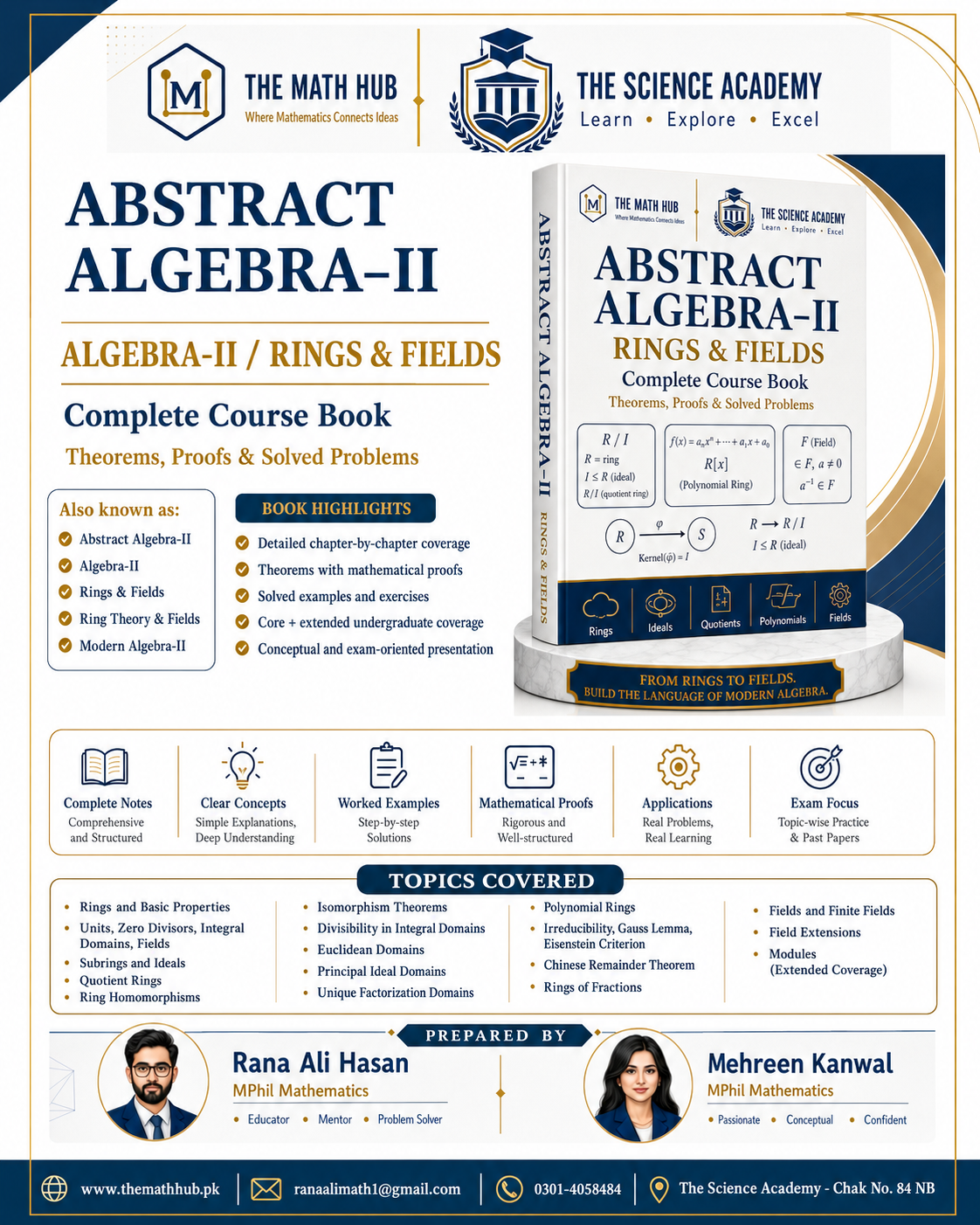
Overview / About This Book
Abstract Algebra-II (Algebra-II / Algebra 2): Rings, Fields & Modules is a structured university-level learning companion rather than a bare PDF link. It connects arithmetic-like structures through rings and ideals, develops quotient and homomorphism techniques, studies divisibility and factorization, then extends the algebraic viewpoint to fields and modules.
The resource supports self-study, revision and classroom support through definitions, theorem statements, proof strategies, worked examples, calculations and exercises. It is independently prepared by The Math Hub and is not an official university textbook.
Aliases / Course-Name Variants
The canonical identity is Abstract Algebra-II — Rings, Fields & Modules. Legitimate overlapping search and course names include Abstract Algebra II, Algebra-II, Algebra 2, Ring Theory, Rings & Fields, Rings and Modules and, in some curricula, Modern Algebra. These aliases do not create duplicate pages.
“Algebra-III” is not the title of this resource. Full Galois Theory is also not claimed here: field extensions and minimal polynomials are covered, while a separate Field/Galois course may follow.
Resource Metadata
Why Study This Course?
Ring Theory gives students a precise language for systems with addition and multiplication. Ideals and quotient rings explain how new structures are formed; homomorphisms show which structure survives a map; and ED/PID/UFD methods rebuild familiar factorization beyond the integers.
The field chapters connect polynomial irreducibility with finite fields and extensions. The final module-theory chapters generalize vector spaces and Abelian groups and prepare learners for commutative algebra, representation theory, homological algebra and algebraic number theory.
Purpose and Benefits
Build accurate ring, field and module notation.
Move from definitions to theorem hypotheses and proofs.
Practise ideals, quotients, homomorphisms and factorization.
Use polynomial, finite-field and extension methods.
Understand modules, direct sums, chain conditions and exactness.
Prepare for BS, ADP, BSc and MSc algebra study where applicable.
Who This Resource Is For
This Abstract Algebra II study guide is for BS Mathematics, ADP / Associate Degree Mathematics where Rings, Fields or Modules is offered, legacy BSc/MSc algebra courses, students of Ring Theory or Rings & Modules, and learners preparing for advanced algebra. It may also support physics, computer science, engineering and other programmes when the topics match the approved course plan.
Learning Outcomes
- Verify rings, subrings, special elements, ideals, fields, modules and submodules.
- Construct quotient rings and quotient modules and prove operations are well-defined.
- Compute kernels, images, gcds, Bézout coefficients, factorizations and polynomial tests.
- Apply ED/PID/UFD implications, Gauss lemma, Eisenstein criterion and the Chinese Remainder Theorem.
- Construct finite fields and field extensions, find minimal polynomials and apply the Tower Law.
- Use module homomorphisms, direct sums, composition series, chain conditions, exact sequences and elementary tensor products.
Complete 23-Chapter Course Contents
Exactly 23 entries mirror the detailed chapter coverage below.
Detailed Chapter-by-Chapter Coverage — All 23
Rings and Fundamental Examples
What is taught
- ring axioms
- addition as an Abelian group
- associative multiplication
- left/right distributive laws
- rings with or without unity
- commutative versus noncommutative rings
- integers Z
- modular rings Zₙ
- matrix rings
- polynomial rings
- function rings
- direct product rings
- quadratic integer rings Z[√d]
- Gaussian integers Z[i]
- Hamilton quaternions
- zero ring convention
Why this chapter is taught: Creates the second major algebraic structure after groups and emphasizes systems with addition and multiplication.
Learning outcomes / benefits
- verify ring axioms
- distinguish commutative and unital cases
- construct standard examples
- recognize familiar number systems as rings
Important theorems, methods and concepts: ring definition and examples; commutative and noncommutative distinctions; direct-product construction.
Applications / connections: number theory; matrix algebra; polynomial algebra; function algebras; algebraic geometry foundations.
Worked examples and exercises: The complete course book develops the chapter-specific definitions, calculations or proof structure above through worked examples, theorem applications and corresponding practice exercises. Open the PDF for the full printed treatment.
Open the complete book for Chapter 1 ↗ · Return to Course Contents · Next chapter
Special Elements, Special Rings and Subrings
What is taught
- units
- group of units U(R)
- zero divisors
- left/right zero divisors
- cancellation
- nilpotent elements
- idempotent elements
- integral domains
- division rings
- fields
- finite integral domains
- finite domain implies field
- characteristic
- prime characteristic in a domain
- prime subrings
- subrings
- subring test
- intersections of subrings
- generated subrings
Why this chapter is taught: Teaches the internal vocabulary controlling arithmetic behavior in rings and distinguishes important ring classes.
Learning outcomes / benefits
- find units, zero divisors, nilpotents and idempotents
- apply subring tests
- classify familiar rings
- compute characteristic
Important theorems, methods and concepts: finite integral domain is a field; characteristic restrictions; subring and generated-subring tests.
Applications / connections: modular arithmetic; matrix algebra; field theory; decomposition via idempotents.
Worked examples and exercises: The complete course book develops the chapter-specific definitions, calculations or proof structure above through worked examples, theorem applications and corresponding practice exercises. Open the PDF for the full printed treatment.
Open the complete book for Chapter 2 ↗ · Return to Course Contents · Previous chapter · Next chapter
Ideals and Operations on Ideals
What is taught
- left ideals
- right ideals
- two-sided ideals
- proper and trivial ideals
- principal ideals
- ideal generated by a set
- finitely generated ideals
- sum I+J
- intersection I∩J
- product IJ
- powers of ideals
- ideal containment
- comaximal ideals
- I+J=R criterion
- product versus intersection
- ideals in Z
- ideals in polynomial rings
- ideal lattices
Why this chapter is taught: Ideals are the ring-theoretic analogue of normal subgroups and are exactly what quotient rings require.
Learning outcomes / benefits
- test ideal conditions
- generate ideals
- compute sums, products and intersections
- use principal-ideal notation correctly
Important theorems, methods and concepts: ideal tests; operations on ideals; comaximality and ideal containment.
Applications / connections: quotient rings; algebraic geometry ideals; number theory; Chinese Remainder Theorem.
Worked examples and exercises: The complete course book develops the chapter-specific definitions, calculations or proof structure above through worked examples, theorem applications and corresponding practice exercises. Open the PDF for the full printed treatment.
Open the complete book for Chapter 3 ↗ · Return to Course Contents · Previous chapter · Next chapter
Prime and Maximal Ideals
What is taught
- prime ideals
- maximal ideals
- properness condition
- prime ideal tests
- maximal ideal tests
- maximal implies prime in commutative unital rings
- radical connection
- (0) prime iff domain
- (0) maximal iff field
- ideals (p) in Z
- prime and maximal ideals in Zₙ
- polynomial examples
- maximal-ideal existence context
- nonunits and maximal ideals
- product-ring examples
- counterexamples to converses
Why this chapter is taught: Prime and maximal ideals translate quotient properties—domains and fields—back into internal ring structure.
Learning outcomes / benefits
- identify prime and maximal ideals
- prove quotient criteria
- build counterexamples
- use inclusion and maximality reasoning
Important theorems, methods and concepts: R/P is a domain exactly when P is prime; R/M is a field exactly when M is maximal; maximal implies prime in the commutative unital setting.
Applications / connections: algebraic geometry; localization; commutative algebra; field construction.
Worked examples and exercises: The complete course book develops the chapter-specific definitions, calculations or proof structure above through worked examples, theorem applications and corresponding practice exercises. Open the PDF for the full printed treatment.
Open the complete book for Chapter 4 ↗ · Return to Course Contents · Previous chapter · Next chapter
Quotient Rings
What is taught
- congruence modulo an ideal
- cosets a+I
- equivalence modulo I
- addition of cosets
- multiplication of cosets
- well-definedness
- zero and unity in quotient
- natural projection R→R/I
- Z/nZ examples
- F[x]/(f) examples
- prime quotient criterion
- maximal quotient criterion
- quotient characteristic
- representative computations
Why this chapter is taught: Quotient rings create new structures by identifying elements modulo an ideal and underpin isomorphism theorems and field constructions.
Learning outcomes / benefits
- construct quotient rings
- prove operations are well-defined
- compute modulo ideals
- identify when a quotient is a domain or field
Important theorems, methods and concepts: factor-ring operations; natural projection; prime and maximal quotient criteria.
Applications / connections: finite fields; polynomial factor rings; coding theory; algebraic number theory.
Worked examples and exercises: The complete course book develops the chapter-specific definitions, calculations or proof structure above through worked examples, theorem applications and corresponding practice exercises. Open the PDF for the full printed treatment.
Open the complete book for Chapter 5 ↗ · Return to Course Contents · Previous chapter · Next chapter
Ring Homomorphisms and Isomorphism Theorems
What is taught
- ring homomorphism definitions and conventions
- addition and multiplication preservation
- unital homomorphisms when required
- kernel
- image
- kernel as ideal
- image as subring
- injectivity criterion
- natural quotient map
- First Isomorphism Theorem
- Second Isomorphism Theorem
- Third Isomorphism Theorem
- Correspondence Theorem
- factor maps
- evaluation maps
- reduction modulo n
Why this chapter is taught: Structure-preserving maps explain why ideals and quotients arise naturally and identify rings through simpler images.
Learning outcomes / benefits
- compute kernels and images
- verify homomorphisms
- apply ring isomorphism theorems
- construct induced maps
Important theorems, methods and concepts: kernel and image structure; three ring isomorphism theorems; correspondence theorem and induced maps.
Applications / connections: module homomorphisms; coordinate maps; number-theoretic reductions.
Worked examples and exercises: The complete course book develops the chapter-specific definitions, calculations or proof structure above through worked examples, theorem applications and corresponding practice exercises. Open the PDF for the full printed treatment.
Open the complete book for Chapter 6 ↗ · Return to Course Contents · Previous chapter · Next chapter
Rings and Fields of Fractions
What is taught
- fractions over an integral domain
- pairs (a,b) with b≠0
- equivalence of fractions
- well-defined addition
- well-defined multiplication
- embedding D into Frac(D)
- Q as Frac(Z)
- rational function field F(x)
- universal property
- uniqueness up to isomorphism
- localization preview
- zero-denominator restrictions
- role of cancellation
Why this chapter is taught: Generalizes Z→Q by systematically turning an integral domain into a field.
Learning outcomes / benefits
- construct fraction fields
- prove operations are well-defined
- use universal-property language
- identify rational function fields
Important theorems, methods and concepts: field-of-fractions construction; canonical embedding; universal property and uniqueness.
Applications / connections: algebraic number theory; function fields; localization; field extensions.
Worked examples and exercises: The complete course book develops the chapter-specific definitions, calculations or proof structure above through worked examples, theorem applications and corresponding practice exercises. Open the PDF for the full printed treatment.
Open the complete book for Chapter 7 ↗ · Return to Course Contents · Previous chapter · Next chapter
Divisibility, Associates, GCD and LCM
What is taught
- divisibility a|b in domains
- divisibility laws
- units divide every element
- associates
- association as equivalence
- principal ideals and associates
- common divisors
- gcd up to associates
- lcm up to associates
- coprime elements
- Bézout combinations
- ideal (a,b)
- divisibility versus ideal inclusion
- gcd-existence caveats
- Z examples
- polynomial examples
Why this chapter is taught: Rebuilds arithmetic divisibility inside general integral domains and prepares ED → PID → UFD.
Learning outcomes / benefits
- reason abstractly about divisibility
- recognize associates
- compute gcd and lcm where possible
- translate divisibility into ideal containment
Important theorems, methods and concepts: associate equivalence; gcd and lcm up to units; Bézout and ideal viewpoints.
Applications / connections: factorization theory; Euclidean algorithms; polynomial gcd; algebraic number theory.
Worked examples and exercises: The complete course book develops the chapter-specific definitions, calculations or proof structure above through worked examples, theorem applications and corresponding practice exercises. Open the PDF for the full printed treatment.
Open the complete book for Chapter 8 ↗ · Return to Course Contents · Previous chapter · Next chapter
Euclidean Domains and Euclidean Algorithm
What is taught
- Euclidean function
- division algorithm
- quotient and remainder
- Euclidean algorithm
- termination
- gcd computation
- back substitution
- Bézout identity
- Z examples
- F[x] examples
- Gaussian norm examples where appropriate
- Euclidean-domain properties
- ED implies PID
- extended Euclidean algorithm
Why this chapter is taught: Shows how division with remainder yields gcds, Bézout identities and strong ideal structure.
Learning outcomes / benefits
- run Euclidean and extended algorithms
- prove Euclidean-domain properties
- derive Bézout coefficients
- work in Z and F[x]
Important theorems, methods and concepts: Euclidean algorithm; Bézout identity; ED ⇒ PID.
Applications / connections: cryptographic modular inverses; coding theory; computational algebra.
Worked examples and exercises: The complete course book develops the chapter-specific definitions, calculations or proof structure above through worked examples, theorem applications and corresponding practice exercises. Open the PDF for the full printed treatment.
Open the complete book for Chapter 9 ↗ · Return to Course Contents · Previous chapter · Next chapter
Principal Ideal Domains
What is taught
- principal ideals
- PID definition
- Z and F[x] examples
- every ideal principal
- ED implies PID
- gcd as generator of (a,b)
- Bézout property
- ascending principal-ideal argument
- factorization preparation
- non-PID examples
- ideal containment and divisibility
- finitely generated ideals
Why this chapter is taught: PIDs connect ideal theory with factorization and provide a clean setting for later module structure.
Learning outcomes / benefits
- prove ideals principal in examples
- derive gcd properties from ideals
- understand ED ⇒ PID
- recognize nonconverse examples
Important theorems, methods and concepts: PID definition; gcd as a principal ideal generator; ED ⇒ PID with converse caveats.
Applications / connections: Smith normal form; module structure; algebraic number theory; Diophantine equations.
Worked examples and exercises: The complete course book develops the chapter-specific definitions, calculations or proof structure above through worked examples, theorem applications and corresponding practice exercises. Open the PDF for the full printed treatment.
Open the complete book for Chapter 10 ↗ · Return to Course Contents · Previous chapter · Next chapter
Irreducibles, Primes and Unique Factorization Domains
What is taught
- irreducible elements
- prime elements
- units and nonunits
- prime implies irreducible
- irreducible implies prime in PID
- factorization into irreducibles
- ACC and principal-ideal growth
- UFD definition
- uniqueness up to units and order
- PID implies UFD
- ED implies UFD
- gcd consequences
- failure of converses
- non-UFD examples
Why this chapter is taught: Explains when familiar unique prime factorization survives outside the integers.
Learning outcomes / benefits
- distinguish prime and irreducible
- prove factorization existence and uniqueness
- navigate ED/PID/UFD implications
- construct counterexamples
Important theorems, methods and concepts: prime versus irreducible; PID ⇒ UFD and ED ⇒ UFD; uniqueness up to associates and order.
Applications / connections: algebraic number theory; polynomial factorization; Diophantine equations.
Worked examples and exercises: The complete course book develops the chapter-specific definitions, calculations or proof structure above through worked examples, theorem applications and corresponding practice exercises. Open the PDF for the full printed treatment.
Open the complete book for Chapter 11 ↗ · Return to Course Contents · Previous chapter · Next chapter
Polynomial Rings
What is taught
- R[x] construction
- coefficients and indeterminate
- addition and multiplication
- degree
- leading coefficient
- degree of product
- units in polynomial rings
- zero-divisor caveats
- polynomial evaluation
- evaluation homomorphism
- roots
- factor theorem
- division algorithm over a field
- remainder theorem
- gcd in F[x]
- multiple roots preview
- multivariable preview
Why this chapter is taught: Polynomial rings bridge ring theory, equations, field theory and applications.
Learning outcomes / benefits
- perform polynomial arithmetic abstractly
- use degree arguments
- apply division, evaluation and root theorems
- view evaluation as a homomorphism
Important theorems, methods and concepts: degree and product rules; evaluation and factor theorems; division algorithm over a field.
Applications / connections: coding theory; algebraic geometry; field extensions; symbolic computation.
Worked examples and exercises: The complete course book develops the chapter-specific definitions, calculations or proof structure above through worked examples, theorem applications and corresponding practice exercises. Open the PDF for the full printed treatment.
Open the complete book for Chapter 12 ↗ · Return to Course Contents · Previous chapter · Next chapter
Polynomial Factorization and Irreducibility
What is taught
- reducible and irreducible polynomials
- content
- primitive polynomials
- Gauss lemma
- factorization over a UFD and fraction field
- Rational Root Theorem
- linear-factor tests
- Eisenstein criterion
- shifted Eisenstein
- reduction modulo p
- mod-p irreducibility
- degree 2/3 root criterion
- factorization over Q/R/C
- cyclotomic-style context
Why this chapter is taught: Irreducibility determines which polynomials produce genuine field extensions and mirrors prime factorization.
Learning outcomes / benefits
- apply several irreducibility tests
- choose efficient criteria
- use primitive and content decomposition
- compare factorization over coefficient fields
Important theorems, methods and concepts: Gauss lemma; Rational Root Theorem; Eisenstein and reduction-mod-p criteria.
Applications / connections: field extensions; algebraic number theory; Galois theory preparation; finite fields.
Worked examples and exercises: The complete course book develops the chapter-specific definitions, calculations or proof structure above through worked examples, theorem applications and corresponding practice exercises. Open the PDF for the full printed treatment.
Open the complete book for Chapter 13 ↗ · Return to Course Contents · Previous chapter · Next chapter
Chinese Remainder Theorem
What is taught
- integer CRT
- pairwise coprime moduli
- constructive solution
- uniqueness modulo product
- comaximal ideals
- I+J=R
- I∩J=IJ for comaximal ideals
- ring CRT map
- kernel and intersection
- surjectivity
- quotient decomposition
- Z/nZ decomposition
- idempotents from CRT
- congruence applications
Why this chapter is taught: CRT decomposes hard congruence and ring problems into independent smaller components.
Learning outcomes / benefits
- solve simultaneous congruences
- prove ring CRT
- decompose quotients
- construct idempotent projections
Important theorems, methods and concepts: integer CRT; ideal-theoretic CRT; quotient-product decomposition.
Applications / connections: cryptography; computer arithmetic; coding theory; finite ring decomposition.
Worked examples and exercises: The complete course book develops the chapter-specific definitions, calculations or proof structure above through worked examples, theorem applications and corresponding practice exercises. Open the PDF for the full printed treatment.
Open the complete book for Chapter 14 ↗ · Return to Course Contents · Previous chapter · Next chapter
Multivariable and Symmetric Polynomials
What is taught
- F[x₁,...,xₙ]
- monomials and multi-indices
- total and partial degree
- multivariable arithmetic
- symmetric polynomials
- elementary symmetric polynomials
- power sums
- fundamental theorem of symmetric polynomials
- rewriting symmetric expressions
- Vieta connections
- permutation action on variables
- discriminant/resultant context
- monomial-order preview
Why this chapter is taught: Extends polynomial algebra to several variables and studies invariants under permutation.
Learning outcomes / benefits
- manipulate multivariable polynomials
- recognize symmetry
- rewrite basic symmetric expressions
- connect roots and coefficients
Important theorems, methods and concepts: elementary symmetric generators; symmetric-expression rewriting; Vieta and permutation connections.
Applications / connections: Galois theory; invariant theory; algebraic geometry; combinatorics.
Worked examples and exercises: The complete course book develops the chapter-specific definitions, calculations or proof structure above through worked examples, theorem applications and corresponding practice exercises. Open the PDF for the full printed treatment.
Open the complete book for Chapter 15 ↗ · Return to Course Contents · Previous chapter · Next chapter
Fields, Subfields and Prime Fields
What is taught
- field axioms
- field versus division ring
- subfields
- subfield test
- characteristic of a field
- characteristic 0 or prime
- prime subfield
- copy of Q in characteristic 0
- copy of Fₚ in characteristic p
- finite-field examples
- Q⊂R⊂C
- field homomorphisms
- intersections of subfields
- generated subfields
Why this chapter is taught: Fields are natural scalar systems for equations and vector spaces; prime fields identify the smallest arithmetic core.
Learning outcomes / benefits
- test subfields
- compute characteristic
- identify prime fields
- construct generated subfields
Important theorems, methods and concepts: field and subfield tests; prime-field classification; characteristic 0 or prime.
Applications / connections: linear algebra; finite fields; field extensions; Galois theory.
Worked examples and exercises: The complete course book develops the chapter-specific definitions, calculations or proof structure above through worked examples, theorem applications and corresponding practice exercises. Open the PDF for the full printed treatment.
Open the complete book for Chapter 16 ↗ · Return to Course Contents · Previous chapter · Next chapter
Finite Fields
What is taught
- finite fields have prime-power order
- characteristic p
- Fₚ
- F_{pⁿ}
- construction via irreducible polynomials
- multiplicative group
- cyclicity context
- Frobenius x↦xᵖ
- roots of x^{pⁿ}−x
- subfields
- uniqueness up to isomorphism
- small-field arithmetic
- primitive elements context
Why this chapter is taught: Finite fields are fundamental in coding theory, cryptography and discrete mathematics.
Learning outcomes / benefits
- construct small extension fields
- perform finite-field arithmetic
- relate irreducible polynomials to field size
- use Frobenius properties
Important theorems, methods and concepts: prime-power order; finite-field construction; Frobenius and subfield structure.
Applications / connections: error-correcting codes; cryptography; finite geometry; number theory.
Worked examples and exercises: The complete course book develops the chapter-specific definitions, calculations or proof structure above through worked examples, theorem applications and corresponding practice exercises. Open the PDF for the full printed treatment.
Open the complete book for Chapter 17 ↗ · Return to Course Contents · Previous chapter · Next chapter
Field Extensions and Minimal Polynomials
What is taught
- extension E/F
- degree [E:F]
- simple extensions F(α)
- algebraic elements
- transcendental elements
- algebraic extensions
- minimal polynomial
- existence and uniqueness
- F[α] versus F(α)
- F[x]/(mα) representation
- basis of simple extension
- degree of an element
- Tower Law
- finite extensions algebraic
- Q(√d), Q(i)
- splitting and Galois preview
Why this chapter is taught: Formalizes adjoining new roots or numbers and measures algebraic complexity.
Learning outcomes / benefits
- find minimal polynomials
- compute extension degrees
- construct bases
- apply Tower Law
- distinguish algebraic and transcendental elements
Important theorems, methods and concepts: minimal polynomial; simple-extension representation; Tower Law; finite extension degree calculations.
Applications / connections: Galois theory; algebraic number theory; constructibility; finite fields.
Worked examples and exercises: The complete course book develops the chapter-specific definitions, calculations or proof structure above through worked examples, theorem applications and corresponding practice exercises. Open the PDF for the full printed treatment.
Open the complete book for Chapter 18 ↗ · Return to Course Contents · Previous chapter · Next chapter
Modules, Submodules and Quotient Modules
What is taught
- left and right modules
- module axioms
- vector spaces as modules
- Abelian groups as Z-modules
- regular module R
- submodules
- submodule test
- generated submodules
- cyclic modules
- annihilators
- quotient modules
- well-defined scalar action
- ideals as R-submodules
- module sums and intersections
- Z and polynomial examples
Why this chapter is taught: Modules unify vector spaces and Abelian groups and extend linear algebra over general rings.
Learning outcomes / benefits
- verify module and submodule axioms
- construct quotient modules
- recognize ideals as modules
- work with generated and cyclic modules
Important theorems, methods and concepts: module definition; submodule and quotient-module tests; ideals as modules.
Applications / connections: representation theory; homological algebra; algebraic topology; linear algebra generalization.
Worked examples and exercises: The complete course book develops the chapter-specific definitions, calculations or proof structure above through worked examples, theorem applications and corresponding practice exercises. Open the PDF for the full printed treatment.
Open the complete book for Chapter 19 ↗ · Return to Course Contents · Previous chapter · Next chapter
Module Homomorphisms, Direct Sums and Isomorphism Theorems
What is taught
- module homomorphism
- kernel and image
- submodule kernels and images
- mono, epi and isomorphism
- First Isomorphism Theorem
- Second and Third Isomorphism Theorems
- Correspondence Theorem
- external direct sums
- finite products versus sums
- internal direct sums
- projection and inclusion maps
- splitting intuition
- decomposition examples
Why this chapter is taught: Transfers homomorphism and quotient machinery to modules and prepares decomposition theory.
Learning outcomes / benefits
- compute kernels and images
- apply module isomorphism theorems
- construct direct sums
- recognize internal decompositions
Important theorems, methods and concepts: module isomorphism theorems; external and internal direct sums; projection and inclusion maps.
Applications / connections: linear transformations; representation theory; exact sequences; homological algebra.
Worked examples and exercises: The complete course book develops the chapter-specific definitions, calculations or proof structure above through worked examples, theorem applications and corresponding practice exercises. Open the PDF for the full printed treatment.
Open the complete book for Chapter 20 ↗ · Return to Course Contents · Previous chapter · Next chapter
Finitely Generated and Free Modules
What is taught
- finite generating sets
- finitely generated modules
- free modules
- basis
- coordinate uniqueness
- rank where defined
- Rⁿ
- submodules of free modules
- presentations
- relations among generators
- quotients of free modules
- free/projective preview
- modules over PID
- structure theorem preview
- Smith-normal-form context
Why this chapter is taught: Free modules are the closest module analogue of vector spaces and present general modules through generators and relations.
Learning outcomes / benefits
- find generators and bases
- distinguish free and finitely generated
- use presentations
- understand quotient-of-free construction
Important theorems, methods and concepts: free-module basis; generators and relations; finitely generated module and PID-structure preview.
Applications / connections: integer linear algebra; PID module classification; coding theory; homology.
Worked examples and exercises: The complete course book develops the chapter-specific definitions, calculations or proof structure above through worked examples, theorem applications and corresponding practice exercises. Open the PDF for the full printed treatment.
Open the complete book for Chapter 21 ↗ · Return to Course Contents · Previous chapter · Next chapter
Composition Series, Chain Conditions, Schur and Zassenhaus
What is taught
- simple modules
- maximal submodules
- composition series
- composition factors
- finite length
- Jordan-Hölder context
- ACC
- DCC
- Noetherian modules
- Artinian modules
- Schur's lemma
- endomorphisms of simple modules
- Zassenhaus butterfly lemma
- refinement ideas
- length arguments
Why this chapter is taught: Introduces finite structural decomposition and chain conditions central to modern ring and module theory.
Learning outcomes / benefits
- recognize simple modules
- analyze composition series
- apply Schur's lemma
- distinguish Noetherian and Artinian
- understand refinement structure
Important theorems, methods and concepts: composition factors and finite length; ACC/DCC and Noetherian/Artinian conditions; Schur and Zassenhaus/butterfly ideas.
Applications / connections: representation theory; commutative algebra; noncommutative algebra; homological algebra.
Worked examples and exercises: The complete course book develops the chapter-specific definitions, calculations or proof structure above through worked examples, theorem applications and corresponding practice exercises. Open the PDF for the full printed treatment.
Open the complete book for Chapter 22 ↗ · Return to Course Contents · Previous chapter · Next chapter
Exact Sequences and Tensor Products
What is taught
- exact sequence
- kernel=image
- short exact sequence
- zero modules at ends
- mono and epi interpretation
- split short exact sequence intuition
- direct-sum relation
- chain-map context
- bilinear maps
- balanced bilinear maps
- tensor-product universal property
- pure tensors
- tensor relations
- R/I tensor examples
- right-exactness preview
- tensoring modules
Why this chapter is taught: Exact sequences compress relationships between modules; tensor products linearize bilinear constructions and open the door to modern algebra.
Learning outcomes / benefits
- check exactness
- interpret short exact sequences
- use basic splitting ideas
- compute elementary tensors
- understand universal-property reasoning
Important theorems, methods and concepts: exactness through kernel=image; short exact sequence and splitting intuition; tensor-product universal property and right-exactness preview.
Applications / connections: homological algebra; algebraic topology; multilinear algebra; differential geometry.
Worked examples and exercises: The complete course book develops the chapter-specific definitions, calculations or proof structure above through worked examples, theorem applications and corresponding practice exercises. Open the PDF for the full printed treatment.
Open the complete book for Chapter 23 ↗ · Return to Course Contents · Previous chapter
Important Theorems, Methods and Concepts
- Rings and Fundamental Examples: ring definition and examples; commutative and noncommutative distinctions; direct-product construction.
- Special Elements, Special Rings and Subrings: finite integral domain is a field; characteristic restrictions; subring and generated-subring tests.
- Ideals and Operations on Ideals: ideal tests; operations on ideals; comaximality and ideal containment.
- Prime and Maximal Ideals: R/P is a domain exactly when P is prime; R/M is a field exactly when M is maximal; maximal implies prime in the commutative unital setting.
- Quotient Rings: factor-ring operations; natural projection; prime and maximal quotient criteria.
- Ring Homomorphisms and Isomorphism Theorems: kernel and image structure; three ring isomorphism theorems; correspondence theorem and induced maps.
- Rings and Fields of Fractions: field-of-fractions construction; canonical embedding; universal property and uniqueness.
- Divisibility, Associates, GCD and LCM: associate equivalence; gcd and lcm up to units; Bézout and ideal viewpoints.
- Euclidean Domains and Euclidean Algorithm: Euclidean algorithm; Bézout identity; ED ⇒ PID.
- Principal Ideal Domains: PID definition; gcd as a principal ideal generator; ED ⇒ PID with converse caveats.
- Irreducibles, Primes and Unique Factorization Domains: prime versus irreducible; PID ⇒ UFD and ED ⇒ UFD; uniqueness up to associates and order.
- Polynomial Rings: degree and product rules; evaluation and factor theorems; division algorithm over a field.
- Polynomial Factorization and Irreducibility: Gauss lemma; Rational Root Theorem; Eisenstein and reduction-mod-p criteria.
- Chinese Remainder Theorem: integer CRT; ideal-theoretic CRT; quotient-product decomposition.
- Multivariable and Symmetric Polynomials: elementary symmetric generators; symmetric-expression rewriting; Vieta and permutation connections.
- Fields, Subfields and Prime Fields: field and subfield tests; prime-field classification; characteristic 0 or prime.
- Finite Fields: prime-power order; finite-field construction; Frobenius and subfield structure.
- Field Extensions and Minimal Polynomials: minimal polynomial; simple-extension representation; Tower Law; finite extension degree calculations.
- Modules, Submodules and Quotient Modules: module definition; submodule and quotient-module tests; ideals as modules.
- Module Homomorphisms, Direct Sums and Isomorphism Theorems: module isomorphism theorems; external and internal direct sums; projection and inclusion maps.
- Finitely Generated and Free Modules: free-module basis; generators and relations; finitely generated module and PID-structure preview.
- Composition Series, Chain Conditions, Schur and Zassenhaus: composition factors and finite length; ACC/DCC and Noetherian/Artinian conditions; Schur and Zassenhaus/butterfly ideas.
- Exact Sequences and Tensor Products: exactness through kernel=image; short exact sequence and splitting intuition; tensor-product universal property and right-exactness preview.
Worked-Example / Exercise / Solution Scope
This is a theorem-and-problem-oriented course book. Each chapter is presented as a sequence of definitions, examples, theorem or method, proof strategy, worked calculations and practice exercises. The page describes the scope without inventing an unaudited total number of questions.
For revision, work from ring and ideal tests to quotient and homomorphism proofs; then practise divisibility, Euclidean algorithms, PID/UFD implications, polynomial irreducibility, CRT, finite-field arithmetic, extension degrees and module decompositions. Compare each solution with its assumptions, method and final interpretation.
Applications / Mathematical Connections
Pure mathematics
Rings and ideals support number theory, commutative algebra and algebraic geometry. Fields and extensions lead toward algebraic number theory and Galois theory. Modules connect to representation theory, homological algebra and algebraic topology.
Applied and computational contexts
Finite fields support coding theory, cryptography and finite geometry. Polynomial and Euclidean methods support symbolic computation, computer arithmetic and computational algebra. Tensor products connect with multilinear algebra and differential geometry.
How to Use This Book
- Read the definition and notation carefully before attempting a proof or computation.
- Mark every theorem hypothesis and identify why each proof step is valid.
- Work through one chapter example, then attempt a related exercise without looking at the solution.
- Check ideal containment, quotient representatives, denominators, divisibility, polynomial coefficient fields and module scalar actions.
- Use the 23 chapter links for revision and the View PDF / Download PDF actions for the complete printed book.
Programme Relevance and Discovery Placements
This one canonical HTML page is surfaced from relevant ADP Mathematics, BS Mathematics, Legacy BSc/MSc Mathematics, Mathematics Library and Abstract Algebra discovery surfaces. Placement is curriculum/discovery context only and does not claim university endorsement or official notes.
Pakistan University / Course Crosswalk
These entries help learners compare course names and topic alignment. They do not claim endorsement, official notes, a universal semester order or objective national ranking.
University of the Punjab
MATH-309 Rings and Modules; ideals, quotient rings, homomorphisms, prime/maximal ideals, factorization, ED/PID/UFD, modules, composition series, exact sequences and tensor products.
NUST
MATH-423 Rings and Fields and MATH-426 Module Theory in prior registry.
University of Karachi
M-601 Theory of Rings & Modules; M-602 Galois Theory is a distinct later identity.
University of Sargodha
MATH-6116 Algebra-II explicitly continues Algebra-I and introduces Ring Theory.
University of Gujrat
Theory of Rings and Fields; Theory of Modules.
University of Narowal
Theory of Rings and Fields; Theory of Modules / Rings and Modules.
University of Swat
Rings and Fields with Group Theory prerequisite in prior research.
University of Malakand
Rings and Fields / Ring Theory.
Abdul Wali Khan University Mardan (AWKUM)
Ring Theory / Algebra-II evidence.
BUITEMS
MATHP-421 Algebra II (Rings and Fields), later Theory of Modules / Rings and Modules / Advanced Ring Theory.
UET Lahore
Modern Algebra / Rings and Modules / advanced algebra discovery; exact current code should be checked in the institution's current source.
LCWU
Rings and Modules / Group Theory-II context.
The Islamia University of Bahawalpur (IUB)
Ring Theory in faculty/programme evidence.
SMIU
MAT-309 Algebra-II (Rings & Fields), Rings & Modules and advanced group-theory pathways.
IIUI
MATH-427 Theory of Modules; MATH-429 Rings and Fields; Galois Theory listed separately.
Gomal University
Algebra-II, Field Theory, Rings and Categories of Modules, Advanced Modules/Ring Theory and Galois Theory.
LUMS
Advanced Algebra develops rings, modules and fields.
University of Lahore
Rings and Field Theory; Field Extensions & Galois Theory; Theory of Modules.
UMT
MA-315 Algebra-II; MA-465 Modules Theory; MA-466 Galois Theory.
Superior University
Ring Theory.
Minhaj University Lahore
MATH306 Ring Theory; MATH405 Rings and Modules.
University of Sargodha and Punjab University references are used as course-identity and topic-alignment sources. Confirm current programmes, codes and schemes on each institution’s official website.
Broader Math Hub University Display Priority
The following curated public and private display orders support consistent discovery presentation; they are not objective national rankings.
Public / major
- University of the Punjab
- National University of Sciences & Technology (NUST)
- Quaid-i-Azam University
- COMSATS University Islamabad
- UET Lahore
- University of Karachi
- International Islamic University Islamabad (IIUI)
- University of Peshawar
- Government College University Faisalabad (GCUF)
- Bahauddin Zakariya University (BZU)
- University of Sargodha (UOS)
- Government College University Lahore
- IBA Karachi
- Abdul Wali Khan University Mardan
- BUITEMS
- University of Gujrat
- University of Narowal
- The Islamia University of Bahawalpur
- Lahore College for Women University
- University of Swat
- University of Malakand
- University of Balochistan
- Gomal University
- Hazara University
- Karakoram International University
- University of Azad Jammu & Kashmir
Private
- LUMS
- The University of Lahore
- University of Central Punjab (UCP)
- University of Management and Technology (UMT)
- Forman Christian College (FCCU)
- Superior University
- Minhaj University Lahore
- Riphah International University
- Habib University
- Greenwich University
Recommended Reference Books
- Joseph A. Gallian, Contemporary Abstract Algebra, CRC/Chapman & Hall (edition matched to the final bibliography).
- David S. Dummit and Richard M. Foote, Abstract Algebra, 3rd ed., Wiley.
- John B. Fraleigh, A First Course in Abstract Algebra, 7th ed., Pearson.
- I. N. Herstein, Topics in Algebra, 2nd ed., Wiley.
- P. B. Bhattacharya, S. K. Jain and S. R. Nagpaul, Basic Abstract Algebra, 2nd ed., Cambridge University Press.
- D. S. Malik, John N. Mordeson and M. K. Sen, Fundamentals of Abstract Algebra, McGraw-Hill.
- P. M. Cohn, Introduction to Ring Theory, Springer.
- Thomas W. Hungerford, Algebra, Springer.
- M. R. Adhikari and A. Adhikari, Groups, Rings and Modules with Applications, Universities Press.
- J. A. Beachy, Introductory Lectures on Rings and Modules, London Mathematical Society Student Texts.
Free / Legal Further Resources
- University of Sargodha curriculum reference ↗ — official curriculum/discovery reference.
- Punjab University MATH-309 curriculum reference ↗ — official curriculum/discovery reference.
Reference books are listed for independent study and course alignment. The Math Hub does not reproduce copyrighted reference-book text.
Frequently Asked Questions
All 40 Resource-03 questions are represented below with their dedicated Rings, Fields & Modules answers.
Q1. What is Abstract Algebra-II in this Math Hub sequence?
It is the rings–fields–modules course that follows the Group Theory volume. It develops rings and ideals, quotient structures, domains and factorization, polynomial/field theory, then module theory.
Q2. Is Abstract Algebra-II the same as Ring Theory?
Ring Theory is the central identity of the first large portion of this resource. Because the book also develops fields, extensions and modules, 'Rings, Fields & Modules' is the fuller canonical descriptor.
Q3. Can the course be called Rings and Modules?
Yes, that is a legitimate overlapping university course title, especially when the syllabus contains ring theory followed by module theory. The page should mention the alias without claiming all universities use exactly the same sequence.
Q4. Is this Algebra-III?
Not as the canonical course title. It may be the third book in a local Math Hub algebra series, but the academic identity of this resource is Abstract Algebra-II / Algebra-II / Ring Theory / Rings & Fields / Rings & Modules.
Q5. What is the difference between a ring and a field?
A field is a commutative ring with identity in which every nonzero element is invertible. General rings may have zero divisors, nonunits or noncommutative multiplication.
Q6. What is an ideal?
An ideal is an additive subgroup with the absorption property needed to form quotient rings. In noncommutative settings, left, right and two-sided ideals must be distinguished.
Q7. What is a maximal ideal?
A proper ideal M is maximal when there is no proper ideal strictly between M and the entire ring. In a commutative ring with identity, R/M is a field exactly when M is maximal.
Q8. What is a prime ideal?
In a commutative ring, a proper ideal P is prime when ab in P implies a in P or b in P. Equivalently, R/P is an integral domain.
Q9. What is a quotient ring?
It is the ring of cosets R/I formed using an ideal I. The ideal condition is what makes multiplication of cosets well-defined.
Q10. Why are ring homomorphisms important?
They preserve ring structure, and their kernels/images connect maps with ideals and quotient rings through isomorphism theorems.
Q11. What is the field of fractions?
For an integral domain D, its field of fractions generalizes the construction of Q from Z by representing fractions a/b and identifying equivalent pairs.
Q12. What is a Euclidean domain?
An integral domain equipped with a Euclidean function supporting division with remainder. The Euclidean algorithm gives gcd computations and leads to the implication ED => PID.
Q13. What is a PID?
A principal ideal domain is an integral domain in which every ideal is generated by one element.
Q14. What is a UFD?
A unique factorization domain is an integral domain where every nonzero nonunit factors into irreducibles uniquely up to order and associates.
Q15. Does PID imply UFD?
Yes. The book treats the proof chain and emphasizes that reverse implications need not hold in general.
Q16. What is Gauss's lemma?
In polynomial factorization, Gauss-style results connect primitive polynomials over a UFD with factorization over its fraction field and support irreducibility arguments.
Q17. What is Eisenstein's criterion?
It is a sufficient irreducibility test for integer/rational polynomials based on divisibility of coefficients by a suitable prime.
Q18. What is the Chinese Remainder Theorem in rings?
For suitable comaximal ideals, it relates a quotient by their intersection/product to a product of quotient rings.
Q19. Does the book cover finite fields?
Yes. The roadmap contains a dedicated finite-fields chapter before field extensions and minimal polynomials.
Q20. Does the book cover Galois theory?
The current 23-chapter roadmap reaches field extensions and minimal polynomials but does not make full Galois theory the canonical course identity. A separate Field/Galois course should not be merged into this page unless explicitly added.
Q21. What is a module?
A module generalizes a vector space by allowing scalars from a ring rather than necessarily a field.
Q22. What is a free module?
A free module has a basis in the module-theoretic sense, allowing unique finite linear combinations of basis elements.
Q23. What is a composition series?
It is a finite chain of submodules whose successive quotient modules are simple. It connects to finite length and Jordan-Hölder-type structure.
Q24. What is Schur's lemma?
In its module/representation form, it gives strong restrictions on homomorphisms between simple modules.
Q25. What is an exact sequence?
An exact sequence is a sequence of homomorphisms in which the image of each map equals the kernel of the next; it efficiently records algebraic structure.
Q26. What is a tensor product?
The tensor product is a construction that converts bilinear behavior into linear behavior and is foundational for more advanced algebra.
Q27. Which Pakistani university names overlap with this resource?
University of Sargodha has used Algebra-II for an introductory ring-theory course. Punjab University's current BS Mathematics curriculum includes Rings and Modules, whose ring and module content strongly overlaps the latter scope of this resource.
Q28. Is this an official university textbook?
No. It is an independently prepared Math Hub resource. Official curricula are used for topic alignment and naming research.
Q29. How should I study this book?
Master ring/ideal definitions first, learn quotient and homomorphism proofs, practise domain/factorization computations, then build field and module concepts in sequence.
Q30. What should I study after this course?
Natural next courses may include Galois/Field Theory, Commutative Algebra, Algebraic Number Theory, Representation Theory or Homological Algebra depending on programme.
Q31. What should a student understand in Rings and Fundamental Examples?
This part of Abstract Algebra-II (Algebra-II / Algebra 2): Rings, Fields & Modules focuses on Rings and Fundamental Examples. The detailed resource block explains the core definitions or methods, worked examples or proof structure where applicable, and how the topic connects to later material.
Q32. Why is Rings and Fundamental Examples important in this course?
Rings and Fundamental Examples is included because it supports the course progression and gives students a structured way to move from foundational ideas to later applications, proofs or problem-solving methods.
Q33. What should a student understand in Special Elements, Special Rings and Subrings?
This part of Abstract Algebra-II (Algebra-II / Algebra 2): Rings, Fields & Modules focuses on Special Elements, Special Rings and Subrings. The detailed resource block explains the core definitions or methods, worked examples or proof structure where applicable, and how the topic connects to later material.
Q34. Why is Special Elements, Special Rings and Subrings important in this course?
Special Elements, Special Rings and Subrings is included because it supports the course progression and gives students a structured way to move from foundational ideas to later applications, proofs or problem-solving methods.
Q35. What should a student understand in Ideals and Operations on Ideals?
This part of Abstract Algebra-II (Algebra-II / Algebra 2): Rings, Fields & Modules focuses on Ideals and Operations on Ideals. The detailed resource block explains the core definitions or methods, worked examples or proof structure where applicable, and how the topic connects to later material.
Q36. Why is Ideals and Operations on Ideals important in this course?
Ideals and Operations on Ideals is included because it supports the course progression and gives students a structured way to move from foundational ideas to later applications, proofs or problem-solving methods.
Q37. What should a student understand in Prime and Maximal Ideals?
This part of Abstract Algebra-II (Algebra-II / Algebra 2): Rings, Fields & Modules focuses on Prime and Maximal Ideals. The detailed resource block explains the core definitions or methods, worked examples or proof structure where applicable, and how the topic connects to later material.
Q38. Why is Prime and Maximal Ideals important in this course?
Prime and Maximal Ideals is included because it supports the course progression and gives students a structured way to move from foundational ideas to later applications, proofs or problem-solving methods.
Q39. What should a student understand in Quotient Rings?
This part of Abstract Algebra-II (Algebra-II / Algebra 2): Rings, Fields & Modules focuses on Quotient Rings. The detailed resource block explains the core definitions or methods, worked examples or proof structure where applicable, and how the topic connects to later material.
Q40. Why is Quotient Rings important in this course?
Quotient Rings is included because it supports the course progression and gives students a structured way to move from foundational ideas to later applications, proofs or problem-solving methods.