For mathematics
Build proof, set, relation, function, counting and graph foundations for undergraduate mathematics.
Discrete Math · Discrete Maths · Discrete Structures · Discrete Mathematical Structures
One complete 20-chapter university resource for AD/ADP Mathematics, BS Mathematics, BSCS, BSIT, Software Engineering, AI, Data Science, Cyber Security and Computer Engineering.
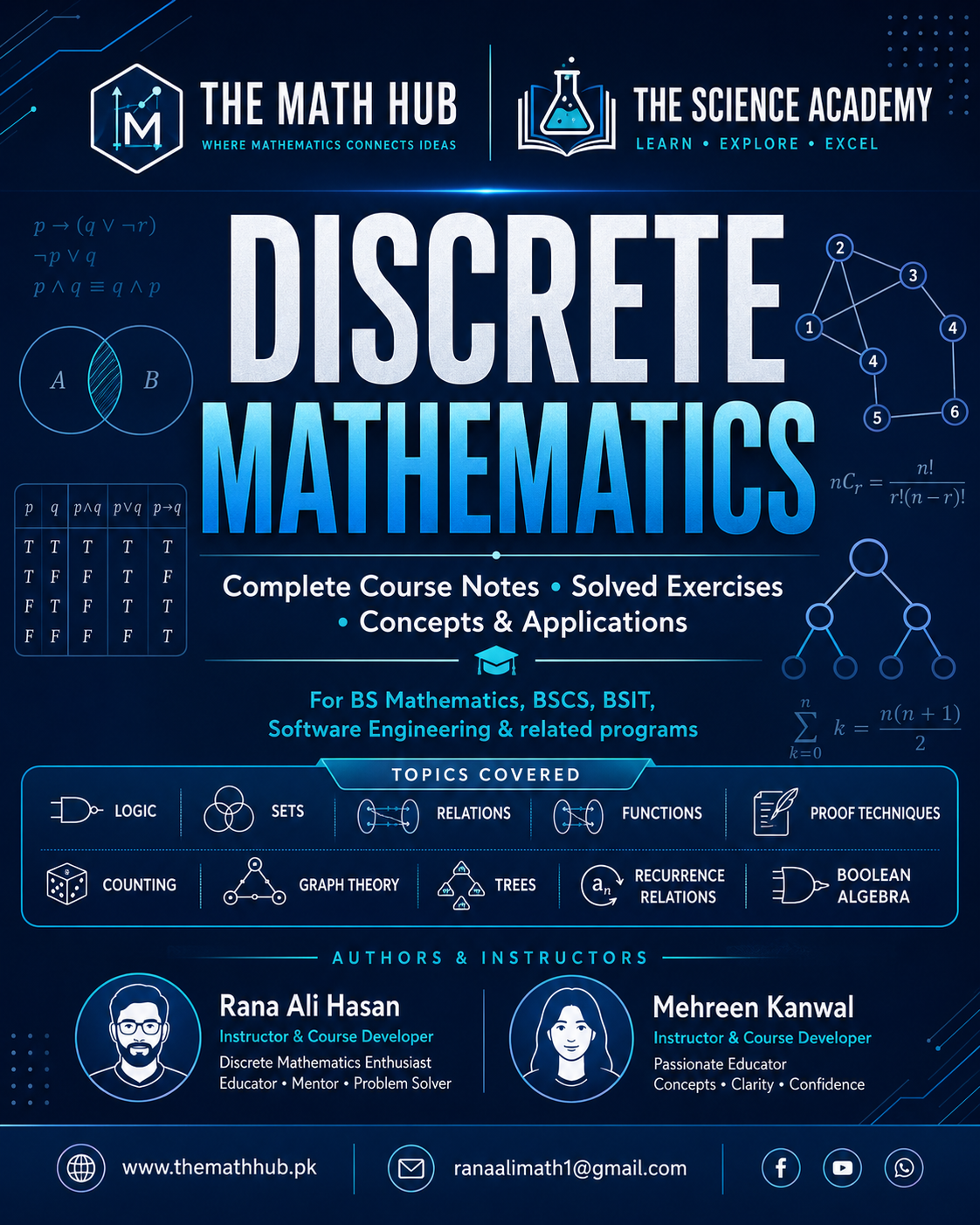
This original The Math Hub course book develops precise logical and proof-writing foundations, then connects sets, relations, functions, induction, algorithms, number theory, combinatorics, probability, graphs, trees, Boolean algebra, automata and advanced discrete methods.
It contains fully solved worked examples and topic-wise exercises. It does not claim every exercise is solved.
Discrete Mathematics studies distinct, countable objects rather than continuously varying quantities. Discrete Structures is a closely related course label, not automatically an identical syllabus.
Build proof, set, relation, function, counting and graph foundations for undergraduate mathematics.
Connect logic, algorithms, complexity, Boolean circuits, automata, cryptography, graphs and data structures.
Use chapter progression, worked examples, decision questions and honest exercise-scope notes.
Students develop formal translation, proof selection, counterexamples, set and relation manipulation, induction, recursion, algorithm analysis, modular computation, combinatorial modelling, probability reasoning, graph algorithms, tree traversal, Boolean simplification and automata reasoning.
Recommended background: basic algebra, mathematical notation and willingness to write careful arguments. Institution-specific prerequisites may differ.
Jump to any chapter for detailed coverage.
Formal logic is the language of proof, algorithmic reasoning and digital logic.
Translate statements, build truth tables and simplify propositions correctly.
Program conditions, digital logic and formal specifications.
Predicate logic extends propositions to variables and domains used in definitions and databases.
Translate quantified language, negate it accurately and test argument validity.
Theorem formulation, database queries, AI reasoning and formal methods.
Proof turns mathematical claims into reliable arguments.
Choose, construct and critique rigorous proofs and disprove universal claims.
Pure mathematics, algorithms, number theory and graph theory.
Sets are the basic language of relations, functions, probability and graphs.
Perform set operations and compare finite, countable and uncountable sizes.
Databases, probability, formal languages and mathematical foundations.
Relations formalize connection, equivalence and order.
Test properties, compute closures, draw Hasse diagrams and identify lattice structure.
Databases, classification, scheduling, dependencies and Boolean structures.
Functions and sequences model transformations and ordered discrete data.
Classify functions, work with sequences and manipulate finite sums and products.
Algorithms, coding, combinatorics and data structures.
Induction and recursion reason about integers, structures and recursive algorithms.
Select base cases, strengthen hypotheses and connect induction to verification.
Recursive algorithms, data structures, number theory and program correctness.
Discrete reasoning becomes computation through specifications, proof and resource analysis.
Write pseudocode, prove correctness and compare algorithmic growth.
Software development, data structures, optimization and complexity theory.
Number theory supplies exact tools for modular computation and cryptography.
Solve modular equations, combine congruences and explain RSA’s mathematical skeleton.
Cryptography, cyber security, hashing and computer arithmetic.
Counting measures finite possibilities without listing them.
Choose rules, handle order/repetition and verify cases without omissions or double-counting.
Probability, passwords, sampling and algorithm analysis.
Structural methods extend basic counting to restrictions and existence arguments.
Count surjections, construct double-counting proofs and model forbidden positions.
Scheduling, allocation, coding, probability and enumerative combinatorics.
Recurrences model earlier-value dependence, counting and recursive runtime.
Classify and solve common recurrences and select a valid analysis method.
Algorithms, population/financial models, strings and tilings.
Generating functions bridge sequences, algebra, recurrences and counting.
Build OGFs, interpret convolution and solve selected recurrence/counting models.
Enumerative combinatorics, coin change, partitions and labelled structures.
Discrete probability attaches uncertainty to finite or countable models.
Build sample spaces and use conditional probability, expectation and standard distributions.
Randomized algorithms, data science, reliability and networks.
Graphs model networks, relationships and combinatorial structure.
Represent graphs, analyze connectivity and apply Euler/Hamilton and planarity results.
Networks, transportation, scheduling, social systems and circuits.
Graph models become algorithms for routing and optimization.
Run traversals, select shortest paths and reason about matching and flow.
Routing, scheduling, assignment, transportation and resource allocation.
Trees model hierarchy and cycle-free structure.
Analyze trees, perform traversals, build codes and find minimum spanning trees.
File systems, search, compilers, compression and network design.
Boolean algebra connects logic with digital hardware.
Move between tables, expressions and circuits and simplify them systematically.
Digital circuits, architecture, control logic and hardware design.
Automata model syntax, pattern recognition and computation.
Manipulate languages, convert automata and distinguish decidable from recognizable.
Compilers, pattern matching, protocols and formal verification.
The final chapter opens the foundations into modern discrete mathematics and theoretical computing.
Recognize advanced structures, symmetry, coding, reductions and computational limits.
Coding, cryptography, network science, randomized methods and complexity theory.
Read definitions → study a theorem or method → reproduce a worked example → attempt the nearby exercise without looking → revisit strategy notes → use the chapter summary for revision. Computing-oriented students should connect each structure to algorithms, data structures, logic or automata where relevant.
Curriculum and discovery context only—not endorsement or official university notes. Course titles, codes, semester placement and topic boundaries vary.
MATH-104 Discrete Mathematics; Graph Theory remains separately identified
Open supplied course context ↗MATH-5111 Discrete Mathematics, 3(3+0)
Open supplied course context ↗MT2343 Discrete Mathematics in Data Science, Computer Engineering and post-ADS context
Open supplied course context ↗MA-105 Discrete Mathematics in BS/Data Science and bridging context
Open supplied course context ↗MTH202 Discrete Mathematics; prerequisite N/A
Open supplied course context ↗CS210 Discrete Mathematics
Open supplied course context ↗Discrete Structures in BSCS, Software Engineering and AI
Open supplied course context ↗CSC102 Discrete Structures
Open supplied course context ↗Discrete Structures/Mathematics course context
Open supplied course context ↗Related mathematics or computing context may also be found at Quaid-i-Azam University, NUST, UET Lahore, GCU Lahore, BZU, IUB, University of Gujrat, University of Peshawar, BUITEMS, University of Karachi, NED, LUMS, FAST-NUCES, GIKI, HITEC, UOL, FCC, Superior, Riphah, Bahria and Air University. This is not a ranking or a claim that every institution teaches the same course.
MIT OCW, Oscar Levin, Applied Discrete Structures, Book of Proof, Applied Combinatorics and generatingfunctionology are included through the supplied lawful links above or in the locked dossier.
It studies distinct and countable structures such as logic, sets, graphs, algorithms, recurrences, probability and formal languages.
The names overlap in many programmes, but course boundaries and codes vary; compare your current departmental scheme.
Logic, proofs, counting, graphs, algorithms, Boolean algebra and automata provide foundations for computing.
Yes. Fully solved worked examples are included, while some later exercises remain unsolved practice.
There are exactly 20 numbered chapters, with content pages 1–494 and consolidated references at page 495.
No. It is an original The Math Hub resource; university references are curriculum/discovery context only.
Yes, as broad undergraduate support, while matching the sequence with their own programme.
Basic algebra and careful reasoning are the main background. Programming helps with applications but is not required for every topic.
Use View / Download PDF for the owner-hosted PDF or Backup Access for the supplied backup copy.
Read definitions, reproduce a worked example, attempt the nearby exercise, review the strategy and revise from the chapter summary.
No. Titles, codes, placement and topic boundaries vary by university and programme.
It may support foundation or revision where relevant; it is not a universal MSc core resource.
Rana Ali Hasan and Mehreen Kanwal, both MPhil Mathematics, prepared it for The Math Hub.
Use the canonical HTML learning page first, then choose the supplied book access route.