University Mathematics · Original Course Resource

Real Analysis II — Complete Course Notes, Proofs & Solved Problems

Real Analysis-II · Real Analysis 2 · Analysis II · Advanced Real Analysis

One progressively developed course resource covering rigorous integration, Riemann-Stieltjes theory, bounded variation, improper integrals, uniform convergence, power and Fourier series, Euclidean spaces, multivariable analysis and multiple Riemann integration.

Associated academic brand: The Science Academy, Chak No. 84 NB, Sargodha.
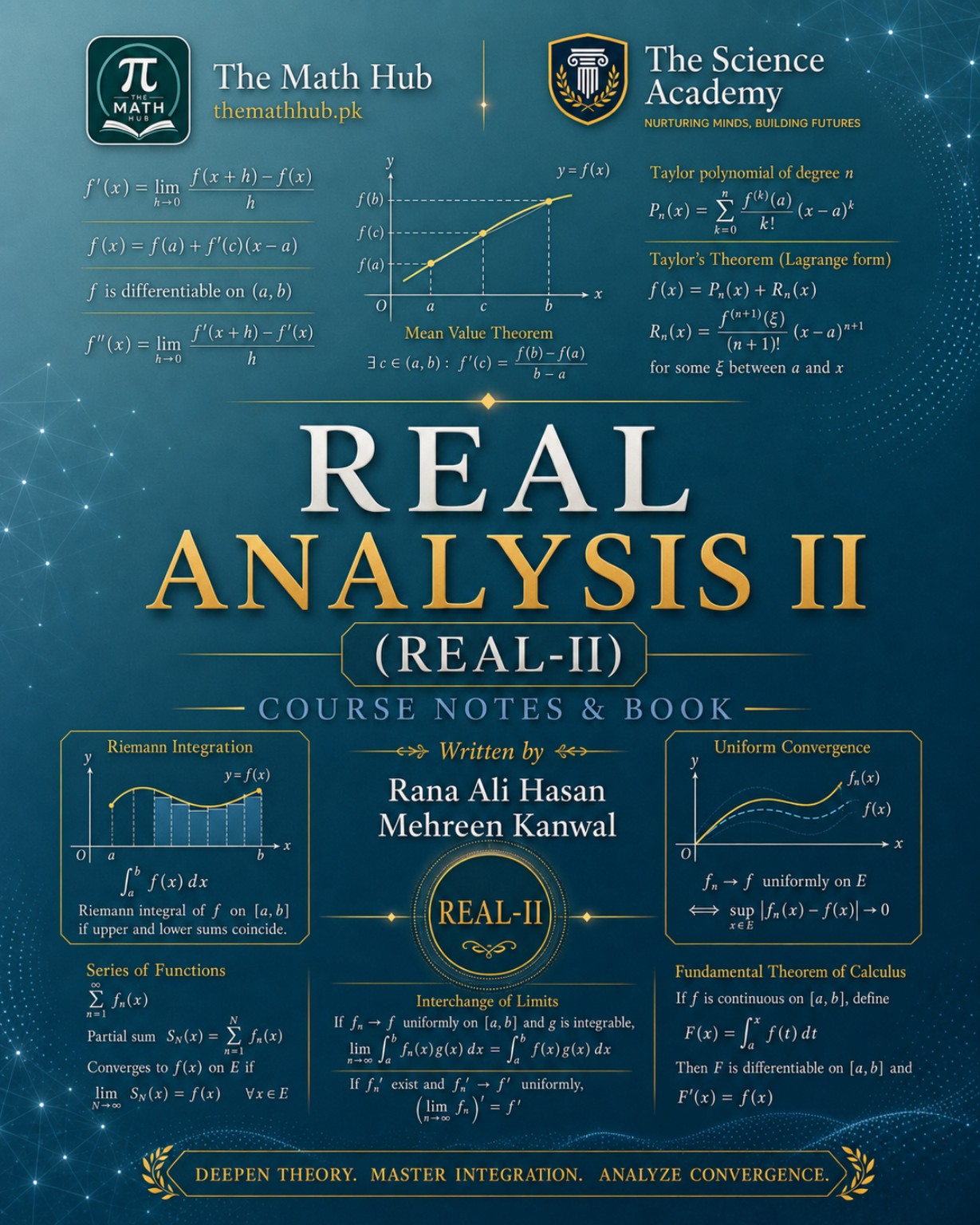
Real Analysis II complete course notes and solved mathematics book by Mehreen Kanwal and Rana Ali Hasan — The Math Hub
About this book

A continuous route from integration to multivariable analysis

Real Analysis II on The Math Hub begins with rigorous Riemann integration and advances through Riemann-Stieltjes theory, bounded variation, improper integrals, uniform convergence, power series, approximation, Fourier series, Euclidean-space analysis, multivariable differentiation and multiple Riemann integration. It is intentionally broader than a single university outline so that students can use one coherent book while studying overlapping Real Analysis-II syllabi across Pakistani universities.

Definitions, hypotheses and intermediate mathematical steps are kept visible. The course includes zero-to-advanced worked examples, proof pathways and exercises; it does not reproduce long copyrighted reference-book exercises.

20numbered chapters
543A4 pages in the verified master PDF
Riemann → Lebesgueadvanced bridge, not a full Measure Theory course
Englishcourse notes and book resource
Why study this course?

What Real Analysis II makes precise

Rigor behind calculus

Real Analysis supplies the rigorous foundations behind limits, continuity, differentiation and integration.

Safe interchange of operations

Uniform convergence explains when limits, sums, derivatives and integrals may be interchanged safely.

Bridges to advanced mathematics

Approximation, Fourier series, R^n, topology, functional analysis, differential geometry, optimization and measure theory appear as connected next steps.

Purpose and benefits

From definitions to usable proof methods

The resource builds the habit of stating hypotheses, selecting a theorem, showing intermediate estimates, checking counterexamples and interpreting the result. This makes it useful for examination preparation as well as later analysis courses.

  • Generalize ordinary integration through Riemann-Stieltjes and bounded variation.
  • Control parameter-dependent limits, series, integrals and derivatives.
  • Use power series, Taylor theory, Fourier methods and polynomial approximation.
  • Move rigorously from the real line to R^n and multiple integration.
Who this resource is for

Relevant learners and programmes

  • BS Mathematics students studying Real Analysis II / Analysis II.
  • University students whose syllabus includes Riemann-Stieltjes integration, improper integrals or uniform convergence.
  • Legacy BSc / MSc Mathematics students revising classical Real Analysis.
  • ADP learners where advanced calculus / analysis overlaps these topics.
  • MS / MPhil entrants needing a rigorous undergraduate refresher.
  • Independent learners and students preparing for proof-based university mathematics.
Learning outcomes

By the end of the route, a learner can:

  • Formulate and use rigorous definitions of Riemann and Riemann-Stieltjes integrability.
  • Work with functions of bounded variation and connect variation with Stieltjes integration.
  • Test convergence of improper and parameter-dependent improper integrals.
  • Use Beta and Gamma functions and their main identities.
  • Distinguish pointwise and uniform convergence and apply uniform-convergence criteria.
  • Determine when limits, sums, integrals and derivatives may be interchanged.
  • Analyze power series and Taylor/Maclaurin expansions.
  • Understand equicontinuity, compact families and approximation theorems.
  • Compute and analyze Fourier coefficients and Fourier-series convergence.
  • Work rigorously in Euclidean spaces R^n and with functions of several variables.
  • Use gradients, Jacobians, Hessians and differentiability in R^n.
  • Solve constrained/unconstrained extrema problems and use multiple Riemann integrals.
  • Understand why Riemann theory motivates the transition to measure and Lebesgue integration.
Course contents · exactly 20 entries

The complete chapter sequence

Each entry opens a separate crawlable chapter block below. The Advanced Bridge is kept separately from the 20 numbered chapters.

  1. Chapter 01: Riemann Integration: Rigorous FoundationsPartitions, Darboux sums, integrability criteria, Riemann sums and the Fundamental Theorem of Calculus
  2. Chapter 02: The Riemann-Stieltjes IntegralIntegration with respect to an increasing function, existence theorems, jumps, weights and transformation rules
  3. Chapter 03: Functions of Bounded VariationTotal variation, algebraic structure, Jordan decomposition, Stieltjes integrators and rectifiable curves
  4. Chapter 04: Improper IntegralsInfinite intervals, unbounded integrands, convergence criteria, absolute and conditional convergence, Dirichlet-Abel methods and tail estimates
  5. Chapter 05: Uniform Convergence of Improper IntegralsParameter-dependent integrals, uniform Cauchy criteria, Weierstrass domination, continuity, limit interchange, differentiation under the integral sign and uniform Dirichlet-Abel tests
  6. Chapter 06: Beta and Gamma FunctionsEuler's gamma and beta integrals, convergence, recurrence, special values, beta-gamma relation, Gaussian integral, transformations and applications
  7. Chapter 07: Sequences of FunctionsFunction sequences, pointwise and uniform convergence, uniform Cauchy criterion, sup-norm control, algebraic stability, counterexamples and local uniform convergence
  8. Chapter 08: Uniform Convergence and ContinuityUniform limits of continuous functions, epsilon proofs, compactness, uniform continuity, Dini's theorem, sup-norm completeness and diagnostic counterexamples
  9. Chapter 09: Series of FunctionsPartial sums, pointwise and uniform convergence, uniform Cauchy criterion, Weierstrass M-test, Dirichlet and Abel tests, alternating estimates, rearrangements and products
  10. Chapter 10: Interchanging Limits, Sums, Integrals and DerivativesUniform convergence as the main mechanism for passing limits through continuity, Riemann integration and differentiation; termwise operations, parameter limits and sharp counterexamples
  11. Chapter 11: Power SeriesConvergence geometry, radius of convergence, Cauchy--Hadamard theory, uniform convergence on compact subintervals, endpoint analysis and termwise operations
  12. Chapter 12: Taylor and Maclaurin SeriesTaylor polynomials, remainder formulas, rigorous error estimates, analyticity, standard expansions and approximation by local power series
  13. Chapter 13: Equicontinuity and Compact Families of FunctionsUniform control of entire families, boundedness, equicontinuity, Arzela--Ascoli compactness and subsequence methods in spaces of continuous functions
  14. Chapter 14: Polynomial ApproximationWeierstrass approximation, Bernstein polynomials, density in continuous-function spaces, Stone--Weierstrass theory and uniform approximation methods
  15. Chapter 15: Fourier SeriesOrthogonal trigonometric systems, Fourier coefficients, Bessel inequality, convergence theorems, half-range expansions, best mean-square approximation and Parseval theory
  16. Chapter 16: Euclidean Space and Metric FoundationsEuclidean norm, distance, open and closed sets, limit points, compactness, connectedness, sequences and the Heine--Borel theorem
  17. Chapter 17: Limits and Continuity in Several VariablesMultivariable limits, epsilon--delta and sequential criteria, path tests, continuity, compact-domain consequences and vector-valued maps
  18. Chapter 18: Differentiability in R^nPartial and directional derivatives, total derivative, gradient, Jacobian matrix, differentiability criteria, chain rule and mean-value estimates
  19. Chapter 19: Higher Derivatives, Taylor Theory and ExtremaSecond derivatives, Hessian matrix, mixed partials, multivariable Taylor theorem, unconstrained and constrained extrema, Lagrange multipliers, implicit and inverse-function bridges
  20. Chapter 20: Multiple Riemann IntegrationRiemann integration on rectangles in R^n, Jordan content, iterated integrals, Fubini-type theorems, general regions, Jacobians and change of variables
Advanced Bridge: From Riemann to LebesgueConceptual transition only · full Measure Theory remains separate
Detailed academic coverage

Chapter-by-chapter definitions, theorems, methods and applications

Every chapter keeps its genuine topic names visible and links to the complete owner PDF rather than inventing chapter downloads.

01
Chapter 1

Chapter 1: Riemann Integration: Rigorous Foundations

Chapter scope: Partitions, Darboux sums, integrability criteria, Riemann sums and the Fundamental Theorem of Calculus

What is taught

  • Why integration needs partitions
  • Refinement
  • Local upper and lower bounds
  • Geometric interpretation
  • Definition of Darboux sums
  • Refinement monotonicity
  • Lower and upper Darboux integrals
  • Formal definition
  • Oscillation criterion
  • Cauchy-type criterion using tagged sums
  • A single discontinuity can be harmless
  • Continuous functions are integrable
  • Monotone functions are integrable
  • Algebraic closure
  • Order and integral inequalities
  • Tagged partitions
  • Endpoint sums
  • The integral as an accumulation function
  • Change of variables
  • Integration by parts

Definitions and foundational objects

  • Partition
  • Norm or mesh of a partition
  • Refinement
  • Lower and upper Darboux sums
  • Lower and upper Darboux integrals
  • Riemann integrability in the Darboux sense
  • Tagged partition
  • Riemann integral via tagged sums

Important theorems, rules and methods

  • Refinement improves Darboux bounds
  • Every lower sum is below every upper sum
  • Fundamental inequality
  • Darboux criterion for integrability
  • Continuous functions on closed intervals are Riemann integrable
  • Monotone integrability
  • Algebra of Riemann integrable functions
  • Equivalence of Darboux and Riemann definitions
  • Continuity of the indefinite integral
  • Fundamental Theorem of Calculus - Part I
  • Fundamental Theorem of Calculus - Part II (Newton-Leibniz)
  • Substitution
  • Integration by parts

Why this chapter is taught: Build rigor. Understand integrability. Connect limits with area. Explain the main definitions and notation used in the chapter.

Worked examples, proofs and exercises: The complete book uses zero-to-advanced worked examples and proof-based exercises for this chapter. Study definitions → lemmas or intermediate estimates → theorem statement → complete proof pathway → corollaries/counterexamples → worked examples and exercises without replacing the supplied book with generic one-line examples.

Applications and connections: calculus foundations · numerical integration · rigorous integral theory.

Learning outcomes / benefits
  • Explain the main definitions and notation used in the chapter.
  • Follow the chapter's proofs without skipping hypotheses or intermediate mathematical steps.
  • Apply the core results to worked examples.
  • Recognize counterexamples and understand why theorem assumptions matter.
  • Use the chapter as preparation for later Real Analysis, Measure Theory, Functional Analysis or related advanced courses.
02
Chapter 2

Chapter 2: The Riemann-Stieltjes Integral

Chapter scope: Integration with respect to an increasing function, existence theorems, jumps, weights and transformation rules

What is taught

  • The central idea
  • Ordinary Riemann integration as a special case
  • Simple weighted examples
  • Telescoping of integrator increments
  • Stieltjes-Darboux sums
  • Lower and upper Stieltjes integrals
  • Fundamental inequality
  • Refinement theorem
  • Oscillation form of the criterion
  • A warning about common discontinuities
  • Continuous integrands
  • Monotone integrands with continuous integrator
  • Linearity in the integrand
  • Linearity in the integrator
  • Additivity over intervals
  • Order and norm estimates
  • Unit jump integrator
  • Several jumps
  • Continuous plus discrete weighting
  • Reduction to an ordinary weighted integral
  • Integration by parts
  • Change of variable

Definitions and foundational objects

  • Stieltjes increment
  • Riemann-Stieltjes integrator
  • Lower and upper Riemann-Stieltjes sums
  • Lower and upper Riemann-Stieltjes integrals

Important theorems, rules and methods

  • Three basic cases
  • Refinement of Stieltjes sums
  • Cauchy-Darboux criterion for Stieltjes integrability
  • Equivalent criterion
  • Continuous integrand, increasing integrator
  • Monotone integrand, continuous increasing integrator
  • Linearity in f
  • Additivity
  • Order property
  • Integral against a single jump
  • Differentiable integrator
  • Riemann-Stieltjes integration by parts
  • Change of variable

Why this chapter is taught: Generalize integration. Track weighted change. Understand the integrator. Explain the main definitions and notation used in the chapter.

Worked examples, proofs and exercises: The complete book uses zero-to-advanced worked examples and proof-based exercises for this chapter. Study definitions → lemmas or intermediate estimates → theorem statement → complete proof pathway → corollaries/counterexamples → worked examples and exercises without replacing the supplied book with generic one-line examples.

Applications and connections: probability-style weighted integration · distribution functions · bounded variation · measure-theory motivation.

Learning outcomes / benefits
  • Explain the main definitions and notation used in the chapter.
  • Follow the chapter's proofs without skipping hypotheses or intermediate mathematical steps.
  • Apply the core results to worked examples.
  • Recognize counterexamples and understand why theorem assumptions matter.
  • Use the chapter as preparation for later Real Analysis, Measure Theory, Functional Analysis or related advanced courses.
03
Chapter 3

Chapter 3: Functions of Bounded Variation

Chapter scope: Total variation, algebraic structure, Jordan decomposition, Stieltjes integrators and rectifiable curves

What is taught

  • Why boundedness is not enough
  • Geometric meaning
  • Monotone functions
  • A bounded derivative is a sufficient condition
  • Continuously differentiable functions
  • Step functions
  • A continuous bounded function that is not BV
  • BV functions are bounded
  • Linear combinations
  • Products
  • Reciprocals and quotients
  • Additivity of variation
  • The accumulated variation function
  • Jordan decomposition
  • Why the decomposition matters
  • Positive and negative variation
  • Continuity of the variation function
  • One-sided limits
  • Discontinuities of BV functions
  • Extending the integrator class
  • Rectifiable curves
  • Graphs of BV functions

Definitions and foundational objects

  • Variation
  • Total variation
  • Function of bounded variation
  • Variation function
  • Positive and negative variation
  • Rectifiable curve

Important theorems, rules and methods

  • Refinement increases variation sums
  • Monotone functions are of bounded variation
  • Bounded derivative implies bounded variation
  • Variation of a C^1 function
  • Bounded variation implies boundedness
  • Vector-space properties
  • Product of BV functions
  • Reciprocal
  • Additivity on adjacent intervals
  • T_f is increasing
  • Jordan decomposition for BV functions
  • Continuity is shared by f and its variation function
  • Regulated behaviour of BV functions
  • Countability of discontinuities
  • Continuous integrands and BV integrators
  • Variation estimate
  • Length of a C^1 curve

Why this chapter is taught: Measure change. Decompose oscillation. Connect variation with length. Explain the main definitions and notation used in the chapter.

Worked examples, proofs and exercises: The complete book uses zero-to-advanced worked examples and proof-based exercises for this chapter. Study definitions → lemmas or intermediate estimates → theorem statement → complete proof pathway → corollaries/counterexamples → worked examples and exercises without replacing the supplied book with generic one-line examples.

Applications and connections: rectifiable curves · Stieltjes integrators · decomposition of functions · Fourier/analysis regularity.

Learning outcomes / benefits
  • Explain the main definitions and notation used in the chapter.
  • Follow the chapter's proofs without skipping hypotheses or intermediate mathematical steps.
  • Apply the core results to worked examples.
  • Recognize counterexamples and understand why theorem assumptions matter.
  • Use the chapter as preparation for later Real Analysis, Measure Theory, Functional Analysis or related advanced courses.
04
Chapter 4

Chapter 4: Improper Integrals

Chapter scope: Infinite intervals, unbounded integrands, convergence criteria, absolute and conditional convergence, Dirichlet-Abel methods and tail estimates

What is taught

  • Why a new definition is needed
  • The fundamental p-integral at infinity
  • Elementary algebra of convergent improper integrals
  • Singularities at an endpoint
  • The p-integral near zero
  • Mixed improper integrals
  • Cauchy criterion at infinity
  • Direct comparison for nonnegative integrands
  • Limit comparison
  • Comparison near a finite singularity
  • Absolute convergence
  • Dirichlet's test for improper integrals
  • Abel's test
  • Tail integrals
  • Change of variables in improper integrals
  • From integrals to series
  • Parameter limits: a preview
  • Extending the Stieltjes integral to an infinite interval
  • Reduction when the integrator is differentiable
  • Step integrators and infinite sums
  • A family of model convergence problems

Definitions and foundational objects

  • Two standard forms
  • Improper integral of the first kind
  • Integral over the whole real line
  • Improper integral of the second kind at the left endpoint
  • Interior singularity
  • Absolute convergence of an improper integral
  • Conditional convergence
  • Improper Riemann-Stieltjes integral at infinity

Important theorems, rules and methods

  • p-test at infinity
  • Linearity
  • p-test near a finite singularity
  • Local nature of improper convergence
  • Cauchy criterion for an infinite integral
  • Direct comparison
  • Limit comparison
  • Absolute convergence implies convergence
  • Dirichlet test
  • Abel test for improper integrals
  • Basic tail bound under absolute comparison
  • Integral test for positive decreasing functions

Why this chapter is taught: Extend definite integration beyond bounded intervals and bounded integrands. Explain the main definitions and notation used in the chapter.

Worked examples, proofs and exercises: The complete book uses zero-to-advanced worked examples and proof-based exercises for this chapter. Study definitions → lemmas or intermediate estimates → theorem statement → complete proof pathway → corollaries/counterexamples → worked examples and exercises without replacing the supplied book with generic one-line examples.

Applications and connections: special functions · transforms · asymptotics · differential equations.

Learning outcomes / benefits
  • Explain the main definitions and notation used in the chapter.
  • Follow the chapter's proofs without skipping hypotheses or intermediate mathematical steps.
  • Apply the core results to worked examples.
  • Recognize counterexamples and understand why theorem assumptions matter.
  • Use the chapter as preparation for later Real Analysis, Measure Theory, Functional Analysis or related advanced courses.
05
Chapter 5

Chapter 5: Uniform Convergence of Improper Integrals

Chapter scope: Parameter-dependent integrals, uniform Cauchy criteria, Weierstrass domination, continuity, limit interchange, differentiation under the integral sign and uniform Dirichlet-Abel tests

What is taught

  • A new kind of convergence
  • Tail formulation
  • Uniform convergence near a finite singular endpoint
  • The uniform Cauchy principle
  • Why tail control is stronger than pointwise control
  • A useful monotone-tail criterion
  • Uniform Cauchy criterion near a singular endpoint
  • A parameter-independent majorant
  • Local domination near a singular endpoint
  • Parameter-restricted majorants
  • Dominating derivatives as well as functions
  • Uniform convergence preserves parameter continuity
  • Interchanging a parameter limit and an improper integral
  • What can go wrong without uniformity
  • The problem
  • Proof idea
  • Feynman-type parameter method
  • Repeated differentiation
  • Why absolute domination is not the whole story
  • Uniform Abel principle
  • Families with singular endpoints
  • A practical decision procedure

Definitions and foundational objects

  • Uniform tail condition
  • Uniform convergence of an improper integral

Important theorems, rules and methods

  • Uniform Cauchy criterion at infinity
  • Tail domination principle
  • Weierstrass test for improper integrals
  • Continuity under a uniformly convergent improper integral
  • Passage of a parameter limit through the integral
  • Differentiation under the integral sign
  • Useful sufficient domination condition
  • Uniform Dirichlet test, one useful form
  • Synthesis Principle

Why this chapter is taught: Control infinite tails uniformly in a parameter before interchanging analytical operations. Explain the main definitions and notation used in the chapter.

Worked examples, proofs and exercises: The complete book uses zero-to-advanced worked examples and proof-based exercises for this chapter. Study definitions → lemmas or intermediate estimates → theorem statement → complete proof pathway → corollaries/counterexamples → worked examples and exercises without replacing the supplied book with generic one-line examples.

Applications and connections: parameter-dependent integrals · continuity/differentiation under the integral sign · applied analysis.

Learning outcomes / benefits
  • Explain the main definitions and notation used in the chapter.
  • Follow the chapter's proofs without skipping hypotheses or intermediate mathematical steps.
  • Apply the core results to worked examples.
  • Recognize counterexamples and understand why theorem assumptions matter.
  • Use the chapter as preparation for later Real Analysis, Measure Theory, Functional Analysis or related advanced courses.
06
Chapter 6

Chapter 6: Beta and Gamma Functions

Chapter scope: Euler's gamma and beta integrals, convergence, recurrence, special values, beta-gamma relation, Gaussian integral, transformations and applications

What is taught

  • Motivation: extending the factorial
  • Convergence near zero
  • Convergence at infinity
  • Positivity and smooth dependence on the parameter
  • The fundamental recurrence
  • Factorials appear automatically
  • The half-integer anchor
  • Extension beyond positive arguments: a preview
  • Definition
  • Symmetry
  • A useful infinite-interval representation
  • Trigonometric representation
  • The central identity
  • Proof by a double integral
  • Recurrences for the Beta function
  • Power-exponential integrals
  • Gaussian-power integrals
  • Rational integrals on [0,infinity)
  • Trigonometric integrals
  • The Gaussian integral and Gamma(1/2)
  • Legendre duplication formula
  • Parameter derivatives and logarithmic integrals
  • Log-convexity: an advanced structural property
  • Phase II synthesis

Definitions and foundational objects

  • Euler integrals
  • Gamma function
  • Beta function

Important theorems, rules and methods

  • Domain of Euler's gamma integral
  • Gamma recurrence
  • Factorial extension
  • Half-integer values
  • Convergence domain of the beta integral
  • Symmetry of the Beta function
  • Beta integral on [0,infinity)
  • Beta-Gamma relation
  • Beta recurrences
  • General gamma substitution
  • Gaussian and half-gamma values
  • Legendre duplication formula

Why this chapter is taught: Turn improper integrals into a reusable theory of special functions. Explain the main definitions and notation used in the chapter.

Worked examples, proofs and exercises: The complete book uses zero-to-advanced worked examples and proof-based exercises for this chapter. Study definitions → lemmas or intermediate estimates → theorem statement → complete proof pathway → corollaries/counterexamples → worked examples and exercises without replacing the supplied book with generic one-line examples.

Applications and connections: probability distributions · special functions · integral evaluation · mathematical physics.

Learning outcomes / benefits
  • Explain the main definitions and notation used in the chapter.
  • Follow the chapter's proofs without skipping hypotheses or intermediate mathematical steps.
  • Apply the core results to worked examples.
  • Recognize counterexamples and understand why theorem assumptions matter.
  • Use the chapter as preparation for later Real Analysis, Measure Theory, Functional Analysis or related advanced courses.
07
Chapter 7

Chapter 7: Sequences of Functions

Chapter scope: Function sequences, pointwise and uniform convergence, uniform Cauchy criterion, sup-norm control, algebraic stability, counterexamples and local uniform convergence

What is taught

  • What changes when each term is a function?
  • How to find a pointwise limit
  • Pointwise boundedness
  • One index must work for the whole domain
  • The uniform error function
  • Uniform convergence on a smaller interval
  • Cauchy without knowing the limit
  • Sup norm
  • Completeness viewpoint
  • The moving-spike mechanism
  • Exponential concentration
  • A diagnostic principle
  • Linear combinations
  • Products require boundedness control
  • Reciprocals and quotients
  • Uniformity depends on the domain
  • Uniform convergence on unbounded domains
  • Compact-uniform error estimates

Definitions and foundational objects

  • Pointwise versus uniform
  • Sequence of functions
  • Pointwise convergence
  • Pointwise bounded sequence
  • Uniform convergence
  • Uniformly Cauchy sequence of functions
  • Supremum norm
  • Locally uniform convergence

Important theorems, rules and methods

  • Uniform convergence implies pointwise convergence
  • Supremum criterion for uniform convergence
  • Uniform Cauchy criterion
  • Sequential test for failure of uniform convergence
  • Linear stability
  • Product stability
  • Reciprocal stability

Why this chapter is taught: Control an entire family of errors with one index. Explain the main definitions and notation used in the chapter.

Worked examples, proofs and exercises: The complete book uses zero-to-advanced worked examples and proof-based exercises for this chapter. Study definitions → lemmas or intermediate estimates → theorem statement → complete proof pathway → corollaries/counterexamples → worked examples and exercises without replacing the supplied book with generic one-line examples.

Applications and connections: approximation · numerical methods · functional analysis · limit processes.

Learning outcomes / benefits
  • Explain the main definitions and notation used in the chapter.
  • Follow the chapter's proofs without skipping hypotheses or intermediate mathematical steps.
  • Apply the core results to worked examples.
  • Recognize counterexamples and understand why theorem assumptions matter.
  • Use the chapter as preparation for later Real Analysis, Measure Theory, Functional Analysis or related advanced courses.
08
Chapter 8

Chapter 8: Uniform Convergence and Continuity

Chapter scope: Uniform limits of continuous functions, epsilon proofs, compactness, uniform continuity, Dini's theorem, sup-norm completeness and diagnostic counterexamples

What is taught

  • The danger
  • Where the proof of continuity breaks
  • A moving transition layer
  • Statement
  • Detailed epsilon proof
  • Local version
  • Uniform continuity
  • Compact domains
  • Motivation
  • Proof for an increasing sequence
  • Why the hypotheses matter
  • Continuity as an interchange of limits
  • Local uniform convergence is enough
  • Continuous functions as a metric space
  • Why this viewpoint matters

Definitions and foundational objects

  • Uniform continuity
  • Sup-norm metric on C(K)

Important theorems, rules and methods

  • Uniform-limit theorem
  • Key epsilon split
  • Three-term continuity estimate
  • Uniform Limit Theorem
  • Uniform limit of uniformly continuous functions
  • Heine-Cantor theorem
  • Uniform boundedness inherited from a bounded limit
  • Dini's theorem
  • Interchange of n-limit and point limit
  • Completeness of C(K)

Why this chapter is taught: Understand exactly why uniform convergence preserves continuity. Explain the main definitions and notation used in the chapter.

Worked examples, proofs and exercises: The complete book uses zero-to-advanced worked examples and proof-based exercises for this chapter. Study definitions → lemmas or intermediate estimates → theorem statement → complete proof pathway → corollaries/counterexamples → worked examples and exercises without replacing the supplied book with generic one-line examples.

Applications and connections: preservation of continuity · function spaces · approximation theory.

Learning outcomes / benefits
  • Explain the main definitions and notation used in the chapter.
  • Follow the chapter's proofs without skipping hypotheses or intermediate mathematical steps.
  • Apply the core results to worked examples.
  • Recognize counterexamples and understand why theorem assumptions matter.
  • Use the chapter as preparation for later Real Analysis, Measure Theory, Functional Analysis or related advanced courses.
09
Chapter 9

Chapter 9: Series of Functions

Chapter scope: Partial sums, pointwise and uniform convergence, uniform Cauchy criterion, Weierstrass M-test, Dirichlet and Abel tests, alternating estimates, rearrangements and products

What is taught

  • Definition through partial sums
  • Absolute convergence
  • Necessary term condition
  • The criterion
  • Uniform tail estimate
  • Majorizing a functional series by a numerical series
  • Summation by parts
  • Classical trigonometric application
  • Continuity of the sum
  • Linear combinations of series
  • Rearrangement under absolute uniform control
  • Cauchy products
  • Uniform alternating-series estimate
  • Dependence on the parameter domain
  • Quantitative remainder design

Definitions and foundational objects

  • Partial sums
  • Series of functions
  • Pointwise convergence of a functional series
  • Uniform convergence of a functional series
  • Pointwise absolute convergence
  • Normal convergence

Important theorems, rules and methods

  • Weierstrass M-test
  • Uniform term test
  • Uniform Cauchy criterion for series
  • Uniform Dirichlet test
  • Uniform Abel test
  • Continuity of a uniformly convergent series
  • Cauchy product under normal convergence

Why this chapter is taught: Turn infinite sums of functions into controlled analytic objects. Explain the main definitions and notation used in the chapter.

Worked examples, proofs and exercises: The complete book uses zero-to-advanced worked examples and proof-based exercises for this chapter. Study definitions → lemmas or intermediate estimates → theorem statement → complete proof pathway → corollaries/counterexamples → worked examples and exercises without replacing the supplied book with generic one-line examples.

Applications and connections: Fourier/power series · functional expansions · approximation.

Learning outcomes / benefits
  • Explain the main definitions and notation used in the chapter.
  • Follow the chapter's proofs without skipping hypotheses or intermediate mathematical steps.
  • Apply the core results to worked examples.
  • Recognize counterexamples and understand why theorem assumptions matter.
  • Use the chapter as preparation for later Real Analysis, Measure Theory, Functional Analysis or related advanced courses.
10
Chapter 10

Chapter 10: Interchanging Limits, Sums, Integrals and Derivatives

Chapter scope: Uniform convergence as the main mechanism for passing limits through continuity, Riemann integration and differentiation; termwise operations, parameter limits and sharp counterexamples

What is taught

  • Two operations need not commute
  • Uniform convergence as an error estimate
  • Main theorem
  • From partial sums to the infinite series
  • Error control for a truncated integrated series
  • Why differentiation is harder
  • Detailed proof
  • The correct theorem
  • Repeated differentiation
  • Integration may fail under pointwise convergence
  • Uniform convergence of functions does not control derivatives
  • Checklist for a suspected interchange
  • A parameter limit
  • Double limits
  • Decision framework

Definitions and foundational objects

  • Definitions are developed in the running text and prerequisite/foundation blocks; do not invent additional named definitions on the website.

Important theorems, rules and methods

  • Uniform integral estimate
  • Differentiation principle
  • General strategy
  • Uniform convergence and Riemann integration
  • Integral error bound
  • Termwise integration
  • Differentiation under a sequence limit
  • Term-by-term differentiation
  • Practical decision framework

Why this chapter is taught: Know when an infinite process may safely cross another operation. Explain the main definitions and notation used in the chapter.

Worked examples, proofs and exercises: The complete book uses zero-to-advanced worked examples and proof-based exercises for this chapter. Study definitions → lemmas or intermediate estimates → theorem statement → complete proof pathway → corollaries/counterexamples → worked examples and exercises without replacing the supplied book with generic one-line examples.

Applications and connections: termwise calculus · analysis of infinite processes · differential equations.

Learning outcomes / benefits
  • Explain the main definitions and notation used in the chapter.
  • Follow the chapter's proofs without skipping hypotheses or intermediate mathematical steps.
  • Apply the core results to worked examples.
  • Recognize counterexamples and understand why theorem assumptions matter.
  • Use the chapter as preparation for later Real Analysis, Measure Theory, Functional Analysis or related advanced courses.
11
Chapter 11

Chapter 11: Power Series

Chapter scope: Convergence geometry, radius of convergence, Cauchy--Hadamard theory, uniform convergence on compact subintervals, endpoint analysis and termwise operations

What is taught

  • From numerical series to function series
  • Why convergence propagates inward
  • The root-test viewpoint
  • Ratio formula when a coefficient ratio exists
  • Uniform control inside the radius
  • Uniform remainder bounds
  • Continuity of the sum
  • Integration preserves the radius
  • Differentiation preserves the radius
  • The two boundary points are independent problems
  • Abel's theorem applied to the logarithm series
  • Addition, scalar multiplication and Cauchy products
  • Coefficients as derivatives
  • Preparation for Taylor theory

Definitions and foundational objects

  • Power series

Important theorems, rules and methods

  • Cauchy--Hadamard
  • Basic convergence geometry
  • Cauchy--Hadamard formula
  • Ratio formula
  • Uniform convergence on compact subintervals
  • Continuity inside the radius
  • Term-by-term integration
  • Term-by-term differentiation
  • Abel's continuity theorem at a boundary point
  • Uniqueness of power-series coefficients

Why this chapter is taught: Turn an infinite algebraic expansion into a rigorously controlled function. Explain the main definitions and notation used in the chapter.

Worked examples, proofs and exercises: The complete book uses zero-to-advanced worked examples and proof-based exercises for this chapter. Study definitions → lemmas or intermediate estimates → theorem statement → complete proof pathway → corollaries/counterexamples → worked examples and exercises without replacing the supplied book with generic one-line examples.

Applications and connections: analytic expansions · differential equations · numerical approximation.

Learning outcomes / benefits
  • Explain the main definitions and notation used in the chapter.
  • Follow the chapter's proofs without skipping hypotheses or intermediate mathematical steps.
  • Apply the core results to worked examples.
  • Recognize counterexamples and understand why theorem assumptions matter.
  • Use the chapter as preparation for later Real Analysis, Measure Theory, Functional Analysis or related advanced courses.
12
Chapter 12

Chapter 12: Taylor and Maclaurin Series

Chapter scope: Taylor polynomials, remainder formulas, rigorous error estimates, analyticity, standard expansions and approximation by local power series

What is taught

  • Matching derivatives at a point
  • The remainder
  • Lagrange form of the remainder
  • Error estimate
  • Integral remainder
  • Infinite Taylor expansion
  • Analytic implies infinitely differentiable
  • Exponential, sine and cosine
  • Logarithmic and binomial expansions
  • Choosing the degree from a tolerance
  • Deriving elementary inequalities
  • Infinite differentiability is not enough
  • Why all derivatives vanish
  • The hierarchy of regularity

Definitions and foundational objects

  • Taylor polynomial
  • Taylor series
  • Real analytic function

Important theorems, rules and methods

  • Taylor polynomial
  • Lagrange remainder
  • Taylor's theorem with Lagrange remainder
  • Integral form of Taylor's remainder
  • Criterion for equality with the Taylor series
  • Classical counterexample

Why this chapter is taught: Replace a smooth function by a polynomial with quantified error. Explain the main definitions and notation used in the chapter.

Worked examples, proofs and exercises: The complete book uses zero-to-advanced worked examples and proof-based exercises for this chapter. Study definitions → lemmas or intermediate estimates → theorem statement → complete proof pathway → corollaries/counterexamples → worked examples and exercises without replacing the supplied book with generic one-line examples.

Applications and connections: local approximation · error estimates · asymptotics · numerical analysis.

Learning outcomes / benefits
  • Explain the main definitions and notation used in the chapter.
  • Follow the chapter's proofs without skipping hypotheses or intermediate mathematical steps.
  • Apply the core results to worked examples.
  • Recognize counterexamples and understand why theorem assumptions matter.
  • Use the chapter as preparation for later Real Analysis, Measure Theory, Functional Analysis or related advanced courses.
13
Chapter 13

Chapter 13: Equicontinuity and Compact Families of Functions

Chapter scope: Uniform control of entire families, boundedness, equicontinuity, Arzela--Ascoli compactness and subsequence methods in spaces of continuous functions

What is taught

  • From one continuous function to a whole family
  • Boundedness of a family
  • Common modulus of continuity
  • Compactness in C([a,b])
  • Necessity for compact sets
  • Convergence on a countable dense set
  • Cantor diagonal selection
  • The finite-net estimate
  • Compactness from derivative estimates
  • Relation with existence proofs

Definitions and foundational objects

  • Equicontinuity
  • Equicontinuity at a point
  • Equicontinuity on a set
  • Uniformly bounded family
  • Uniform Holder family

Important theorems, rules and methods

  • Arzela--Ascoli idea
  • Equicontinuity plus boundedness at one point
  • Arzela--Ascoli on [a,b]
  • Key upgrade principle

Why this chapter is taught: Compactness for functions begins with common control in both size and oscillation. Explain the main definitions and notation used in the chapter.

Worked examples, proofs and exercises: The complete book uses zero-to-advanced worked examples and proof-based exercises for this chapter. Study definitions → lemmas or intermediate estimates → theorem statement → complete proof pathway → corollaries/counterexamples → worked examples and exercises without replacing the supplied book with generic one-line examples.

Applications and connections: compactness in function spaces · existence arguments · functional analysis.

Learning outcomes / benefits
  • Explain the main definitions and notation used in the chapter.
  • Follow the chapter's proofs without skipping hypotheses or intermediate mathematical steps.
  • Apply the core results to worked examples.
  • Recognize counterexamples and understand why theorem assumptions matter.
  • Use the chapter as preparation for later Real Analysis, Measure Theory, Functional Analysis or related advanced courses.
14
Chapter 14

Chapter 14: Polynomial Approximation

Chapter scope: Weierstrass approximation, Bernstein polynomials, density in continuous-function spaces, Stone--Weierstrass theory and uniform approximation methods

What is taught

  • Why uniform approximation?
  • Polynomial density question
  • Approximation preserves many global properties approximately
  • Bernstein basis on [0,1]
  • Exact reproduction of constants and linear functions
  • Why Bernstein polynomials converge
  • Statement and meaning
  • Proof on [0,1] using Bernstein polynomials
  • Transfer to any compact interval
  • From polynomials to abstract algebras
  • Classical Weierstrass as a special case
  • Why lattice operations appear in the proof
  • Best approximation problem
  • Finite-dimensional existence
  • Approximation and integrals

Definitions and foundational objects

  • Uniform approximation error
  • Uniform approximation
  • Dense subset
  • Bernstein polynomial
  • Subalgebra of C(K)
  • Separating points
  • Best uniform approximant

Important theorems, rules and methods

  • Weierstrass approximation
  • Bernstein polynomial
  • Weierstrass approximation theorem
  • Real Stone--Weierstrass

Why this chapter is taught: Approximate every continuous profile by algebraic objects that are easy to compute. Explain the main definitions and notation used in the chapter.

Worked examples, proofs and exercises: The complete book uses zero-to-advanced worked examples and proof-based exercises for this chapter. Study definitions → lemmas or intermediate estimates → theorem statement → complete proof pathway → corollaries/counterexamples → worked examples and exercises without replacing the supplied book with generic one-line examples.

Applications and connections: numerical approximation · interpolation · function algebras · approximation theory.

Learning outcomes / benefits
  • Explain the main definitions and notation used in the chapter.
  • Follow the chapter's proofs without skipping hypotheses or intermediate mathematical steps.
  • Apply the core results to worked examples.
  • Recognize counterexamples and understand why theorem assumptions matter.
  • Use the chapter as preparation for later Real Analysis, Measure Theory, Functional Analysis or related advanced courses.
15
Chapter 15

Chapter 15: Fourier Series

Chapter scope: Orthogonal trigonometric systems, Fourier coefficients, Bessel inequality, convergence theorems, half-range expansions, best mean-square approximation and Parseval theory

What is taught

  • Periodicity
  • Orthogonality
  • Trigonometric polynomials
  • Coefficient formulas
  • Partial sums as an integral operator
  • Dirichlet convergence theorem
  • Endpoint interpretation
  • Symmetry reductions
  • Why half-range expansions matter
  • Mean-square error
  • Bessel inequality
  • Parseval identity
  • When Fourier series converge uniformly
  • Gibbs phenomenon
  • Fejer averaging as a remedy

Definitions and foundational objects

  • Periodic function
  • Fourier coefficients
  • Dirichlet kernel
  • Half-range sine series
  • Half-range cosine series
  • Gibbs phenomenon

Important theorems, rules and methods

  • Fourier coefficients for period (2pi)
  • Dirichlet jump value
  • Dirichlet pointwise convergence
  • Best mean-square approximation
  • Bessel inequality
  • Useful sufficient criterion
  • Fejer's theorem (continuous case)

Why this chapter is taught: Resolve a periodic function into harmonics and understand exactly what the series converges to. Explain the main definitions and notation used in the chapter.

Worked examples, proofs and exercises: The complete book uses zero-to-advanced worked examples and proof-based exercises for this chapter. Study definitions → lemmas or intermediate estimates → theorem statement → complete proof pathway → corollaries/counterexamples → worked examples and exercises without replacing the supplied book with generic one-line examples.

Applications and connections: harmonic analysis · PDE · signal processing · approximation.

Learning outcomes / benefits
  • Explain the main definitions and notation used in the chapter.
  • Follow the chapter's proofs without skipping hypotheses or intermediate mathematical steps.
  • Apply the core results to worked examples.
  • Recognize counterexamples and understand why theorem assumptions matter.
  • Use the chapter as preparation for later Real Analysis, Measure Theory, Functional Analysis or related advanced courses.
16
Chapter 16

Chapter 16: Euclidean Space and Metric Foundations

Chapter scope: Euclidean norm, distance, open and closed sets, limit points, compactness, connectedness, sequences and the Heine--Borel theorem

What is taught

  • From the real line to R^n
  • Metric-space viewpoint
  • Open balls
  • Interior points
  • Dense sets
  • Bolzano--Weierstrass in R^n

Definitions and foundational objects

  • Norm and metric
  • Euclidean inner product
  • Euclidean norm
  • Euclidean distance
  • Metric
  • Open ball
  • Neighborhood
  • Interior point and interior
  • Boundary point
  • Exterior point
  • Open set
  • Closed set
  • Limit point
  • Closure
  • Dense subset
  • Convergence in R^n
  • Cauchy sequence
  • Open cover
  • Compact set
  • Disconnected and connected sets
  • Path connected

Important theorems, rules and methods

  • Cauchy--Schwarz inequality
  • Triangle inequality
  • Basic laws of open sets
  • Closed-set criterion
  • Coordinatewise convergence
  • Completeness of R^n
  • Heine--Borel in R^n
  • Sequential compactness
  • Extreme-value principle
  • Path connected implies connected
  • Convex sets are path connected

Why this chapter is taught: Move from one-dimensional real analysis to the geometry and topology of R^n. Explain the main definitions and notation used in the chapter.

Worked examples, proofs and exercises: The complete book uses zero-to-advanced worked examples and proof-based exercises for this chapter. Study definitions → lemmas or intermediate estimates → theorem statement → complete proof pathway → corollaries/counterexamples → worked examples and exercises without replacing the supplied book with generic one-line examples.

Applications and connections: metric/topological foundations · compactness · multivariable analysis.

Learning outcomes / benefits
  • Explain the main definitions and notation used in the chapter.
  • Follow the chapter's proofs without skipping hypotheses or intermediate mathematical steps.
  • Apply the core results to worked examples.
  • Recognize counterexamples and understand why theorem assumptions matter.
  • Use the chapter as preparation for later Real Analysis, Measure Theory, Functional Analysis or related advanced courses.
17
Chapter 17

Chapter 17: Limits and Continuity in Several Variables

Chapter scope: Multivariable limits, epsilon--delta and sequential criteria, path tests, continuity, compact-domain consequences and vector-valued maps

What is taught

  • Domain and natural domain
  • Graphs and level sets
  • Path tests
  • Preimage characterization
  • Curves as vector-valued functions

Definitions and foundational objects

  • Epsilon--delta limit
  • Scalar-valued function of several variables
  • Limit of a function
  • Continuity at a point
  • Vector-valued map

Important theorems, rules and methods

  • Uniqueness of multivariable limits
  • Algebra of limits
  • Sequential criterion for limits
  • Algebra and composition of continuous functions
  • Sequential criterion for continuity
  • Continuous image of a compact set
  • Extreme value theorem
  • Heine--Cantor uniform continuity
  • Continuous image of a connected set
  • Component criterion

Why this chapter is taught: Extend the language of limits and continuity from the real line to multidimensional domains. Explain the main definitions and notation used in the chapter.

Worked examples, proofs and exercises: The complete book uses zero-to-advanced worked examples and proof-based exercises for this chapter. Study definitions → lemmas or intermediate estimates → theorem statement → complete proof pathway → corollaries/counterexamples → worked examples and exercises without replacing the supplied book with generic one-line examples.

Applications and connections: multivariable calculus · topology · optimization · continuity of vector-valued maps.

Learning outcomes / benefits
  • Explain the main definitions and notation used in the chapter.
  • Follow the chapter's proofs without skipping hypotheses or intermediate mathematical steps.
  • Apply the core results to worked examples.
  • Recognize counterexamples and understand why theorem assumptions matter.
  • Use the chapter as preparation for later Real Analysis, Measure Theory, Functional Analysis or related advanced courses.
18
Chapter 18

Chapter 18: Differentiability in R^n

Chapter scope: Partial and directional derivatives, total derivative, gradient, Jacobian matrix, differentiability criteria, chain rule and mean-value estimates

What is taught

  • Tangent-plane approximation
  • Partial derivatives may exist without continuity
  • Linearization and differentials

Definitions and foundational objects

  • Total derivative
  • Partial derivative
  • Directional derivative
  • Differentiability at a point
  • Gradient
  • Jacobian matrix

Important theorems, rules and methods

  • Differentiability implies continuity
  • Differentiability implies directional derivatives
  • Directional derivative via the gradient
  • Continuous partial derivatives imply differentiability
  • Multivariable chain rule
  • Mean-value inequality for scalar functions
  • Zero derivative on a connected open set

Why this chapter is taught: Learn the correct linear approximation concept behind multivariable differentiation. Explain the main definitions and notation used in the chapter.

Worked examples, proofs and exercises: The complete book uses zero-to-advanced worked examples and proof-based exercises for this chapter. Study definitions → lemmas or intermediate estimates → theorem statement → complete proof pathway → corollaries/counterexamples → worked examples and exercises without replacing the supplied book with generic one-line examples.

Applications and connections: Jacobian methods · nonlinear analysis · optimization · differential geometry.

Learning outcomes / benefits
  • Explain the main definitions and notation used in the chapter.
  • Follow the chapter's proofs without skipping hypotheses or intermediate mathematical steps.
  • Apply the core results to worked examples.
  • Recognize counterexamples and understand why theorem assumptions matter.
  • Use the chapter as preparation for later Real Analysis, Measure Theory, Functional Analysis or related advanced courses.
19
Chapter 19

Chapter 19: Higher Derivatives, Taylor Theory and Extrema

Chapter scope: Second derivatives, Hessian matrix, mixed partials, multivariable Taylor theorem, unconstrained and constrained extrema, Lagrange multipliers, implicit and inverse-function bridges

What is taught

  • Second partial derivatives
  • Quadratic forms
  • Two-variable form
  • Why a constraint changes the condition
  • Testing candidates
  • Tangent-space interpretation
  • Local solvability
  • Local invertibility
  • Connection with constrained optimization

Definitions and foundational objects

  • Hessian
  • Hessian matrix
  • Positive definite matrix
  • Local maximum and minimum
  • Critical point

Important theorems, rules and methods

  • Two-variable test
  • Lagrange multipliers
  • Clairaut--Schwarz equality of mixed partials
  • Second-order Taylor expansion
  • First-order necessary condition
  • Second-derivative test in two variables
  • Lagrange multiplier condition
  • Several equality constraints
  • Implicit function theorem in two variables
  • Inverse function theorem

Why this chapter is taught: Use second-order structure to understand curvature, approximation and optimization. Explain the main definitions and notation used in the chapter.

Worked examples, proofs and exercises: The complete book uses zero-to-advanced worked examples and proof-based exercises for this chapter. Study definitions → lemmas or intermediate estimates → theorem statement → complete proof pathway → corollaries/counterexamples → worked examples and exercises without replacing the supplied book with generic one-line examples.

Applications and connections: optimization · constrained extrema · implicit/inverse function ideas · local geometry.

Learning outcomes / benefits
  • Explain the main definitions and notation used in the chapter.
  • Follow the chapter's proofs without skipping hypotheses or intermediate mathematical steps.
  • Apply the core results to worked examples.
  • Recognize counterexamples and understand why theorem assumptions matter.
  • Use the chapter as preparation for later Real Analysis, Measure Theory, Functional Analysis or related advanced courses.
20
Chapter 20

Chapter 20: Multiple Riemann Integration

Chapter scope: Riemann integration on rectangles in R^n, Jordan content, iterated integrals, Fubini-type theorems, general regions, Jacobians and change of variables

What is taught

  • From one interval to a rectangle
  • Multiple Riemann sums
  • Darboux sums in several variables
  • Characteristic functions and geometric content
  • Integrating over a bounded region
  • Discontinuities and integrability
  • Slicing a rectangular integral
  • Fubini in higher dimensions
  • Type I and Type II planar regions
  • Reversing the order
  • Area and volume as integrals
  • Why the area element changes
  • Jacobians in R^n
  • Polar coordinates
  • Cylindrical coordinates
  • Spherical coordinates
  • A.1 What Riemann integration does very well
  • A.2 A basic obstruction: too many discontinuities
  • A.3 Limits of integrable functions
  • B.1 Sets of measure zero
  • B.2 Outer measure
  • B.3 Measurability
  • C.1 Measurable functions
  • C.2 Simple functions
  • C.3 Nonnegative measurable functions
  • C.4 Signed functions
  • C.5 A striking example
  • D.1 Monotone convergence
  • D.2 Fatou's lemma
  • D.3 Dominated convergence
  • D.4 Almost everywhere
  • D.5 The spaces L^p
  • E.1 Relationship between the two integrals
  • E.2 The Lebesgue criterion revisited
  • E.3 Which theory should be used?
  • E.4 Where to go next

Definitions and foundational objects

  • Riemann sum in higher dimensions
  • Closed rectangle in R^n
  • Mesh of a rectangular partition
  • Riemann integral on a rectangle
  • Characteristic function
  • Jordan measurable set
  • Set of Jordan content zero
  • Jacobian determinant
  • Measure-zero set in R
  • Lebesgue outer measure
  • Carathéodory measurability
  • Measurable real-valued function
  • Integral of a nonnegative simple function
  • Lebesgue integral of a nonnegative function
  • Lebesgue integrable function
  • Almost everywhere

Important theorems, rules and methods

  • Uniqueness of the multiple Riemann integral
  • Darboux criterion in R^n
  • Continuous functions are integrable
  • Boundary criterion for Jordan measurability
  • Continuous functions on Jordan regions
  • Lebesgue criterion for Riemann integrability - bridge statement
  • Fubini theorem for continuous functions on a rectangle
  • Integration on a vertically simple region
  • Change-of-variables theorem in the plane
  • Polar-coordinate formula
  • Monotone Convergence Theorem - preview
  • Fatou's Lemma - preview
  • Dominated Convergence Theorem - preview
  • Compatibility theorem

Why this chapter is taught: Integrate rigorously in several dimensions and connect geometry with analysis. Explain the main definitions and notation used in the chapter.

Worked examples, proofs and exercises: The complete book uses zero-to-advanced worked examples and proof-based exercises for this chapter. Study definitions → lemmas or intermediate estimates → theorem statement → complete proof pathway → corollaries/counterexamples → worked examples and exercises without replacing the supplied book with generic one-line examples.

Applications and connections: multivariable integration · probability · mathematical physics · change of variables · measure theory.

Learning outcomes / benefits
  • Explain the main definitions and notation used in the chapter.
  • Follow the chapter's proofs without skipping hypotheses or intermediate mathematical steps.
  • Apply the core results to worked examples.
  • Recognize counterexamples and understand why theorem assumptions matter.
  • Use the chapter as preparation for later Real Analysis, Measure Theory, Functional Analysis or related advanced courses.
Advanced Bridge · From Riemann to Lebesgue

Why measure-theoretic ideas come next

Multiple Riemann integration explains what Riemann theory does well, then introduces the conceptual limitations that motivate measure and Lebesgue integration: sets of measure zero, outer measure, measurability, measurable functions, simple functions, nonnegative and signed integration, almost-everywhere reasoning, the Monotone Convergence Theorem, Fatou's Lemma, the Dominated Convergence Theorem and the spaces Lp.

This is a bridge, not a complete Measure Theory course. Continue to separate Measure Theory / Lebesgue Integration discovery.

Worked-example and solution scope

How the complete book is meant to be used

Read a definition, identify its hypotheses, work through the lemmas and theorem proof, reproduce a calculation, inspect a counterexample when one is supplied, and then attempt the nearby exercise. The HTML page summarizes problem types honestly; it does not reproduce long copyrighted textbook exercises. If a dedicated chapter PDF is not available, every chapter action remains tied to the complete owner PDF.

DefinitionsIntermediate estimatesTheorem + proofCorollaries / counterexamplesWorked examples / exercises
Programme relevance

One canonical resource across related pathways

BS Mathematics

Books, Notes & Solutions → Real Analysis → Real Analysis II.

Legacy BSc / MSc Mathematics

Classical Real Analysis, Advanced Analysis revision and course-resource discovery.

ADP, MS and MPhil

Contextual discovery, prerequisite revision or advanced undergraduate preparation where the topic overlap is genuine.

Mathematics Library

Separate owner-resource record; programme surfaces point here rather than cloning the academic body.

Curriculum / discovery context

Pakistan University / Course Crosswalk

This comparison is curriculum and discovery context only—not endorsement, official university notes or a claim that every institution uses the same outline. Course titles, codes, semester placement and topic boundaries vary.

HEC Pakistan — National Mathematics Curriculum 2025

REAL ANALYSIS-II outcomes include tests for convergence of sequences of functions, Riemann-Stieltjes integrals, and proper/improper integrals.

Open supplied course context ↗

University of the Punjab

MATH-307 Real Analysis-II, 3 credit hours: Riemann-Stieltjes integration, bounded variation, improper integrals, Beta/Gamma, sequences/series of functions, power series, pointwise/uniform convergence, and preservation of continuity/integration/differentiation.

Open supplied course context ↗

University of Sargodha

MATH-6105 Real Analysis-II, 3(3-0): Riemann-Stieltjes integrals, bounded variation, improper integrals, Beta/Gamma, sequences and series of functions, pointwise/uniform convergence and related calculus results.

Open supplied course context ↗

COMSATS University Islamabad — Attock course-material evidence

MTH322 Real Analysis-II course materials cover sequences/series of functions, uniform convergence, Weierstrass M-test, power series, termwise operations and improper integrals.

Verify current course information from the institution.

Virtual University of Pakistan

MTH631 Real Analysis II, undergraduate 3 credit hours: uniform convergence, power series, equicontinuity, Stone-Weierstrass, Fourier series, Beta/Gamma, functions of several variables, R^n differentiability, extrema, improper/multiple integrals and bounded variation.

Open supplied course context ↗

LUMS

MATH 309 Introduction to Analysis II, 3 credit hours: open/closed/compact sets, sequences and series of functions, pointwise/uniform convergence, power/Taylor series and basic metric spaces.

Open supplied course context ↗

University of Management and Technology (UMT)

MA-314 Real Analysis-II, 3 credit hours in the BS Mathematics / ADP lateral-entry roadmap.

Open supplied course context ↗

The University of Lahore

Faculty/course evidence lists Real Analysis-II in Semester VI, with Measure Theory & Lebesgue Integration later in the programme.

Open supplied course context ↗
Wider institutional discovery order

Major and public institutions first

This is a curated The Math Hub presentation order for discovery consistency, not an objective national ranking. Only the individually described crosswalk entries above carry specific course-context wording.

Show public / major discovery order (31)
  1. University of the Punjab
  2. National University of Sciences & Technology (NUST)
  3. Quaid-i-Azam University
  4. COMSATS University Islamabad
  5. Virtual University of Pakistan
  6. University of Karachi
  7. International Islamic University Islamabad (IIUI)
  8. University of Peshawar
  9. Government College University Faisalabad (GCUF)
  10. Bahauddin Zakariya University (BZU)
  11. University of Sargodha (UOS)
  12. Government College University Lahore
  13. University of Gujrat
  14. Lahore College for Women University (LCWU)
  15. Abdul Wali Khan University Mardan (AWKUM)
  16. BUITEMS
  17. The Islamia University of Bahawalpur
  18. University of Narowal
  19. University of Swat
  20. University of Malakand
  21. University of Balochistan
  22. Gomal University
  23. Hazara University
  24. Karakoram International University
  25. University of Azad Jammu & Kashmir
  26. University of Education Lahore
  27. University of Okara
  28. University of Jhang
  29. Baba Guru Nanak University
  30. University of Mianwali
  31. University of Sahiwal
Show private / non-public discovery order (12)
  1. LUMS
  2. The University of Lahore
  3. University of Management and Technology (UMT)
  4. University of Central Punjab (UCP)
  5. Forman Christian College (FCCU)
  6. Superior University
  7. Minhaj University Lahore
  8. Riphah International University
  9. Habib University
  10. Greenwich University
  11. University of South Asia
  12. University of Lahore — Sargodha Campus
Formal / lawful references

Recommended Reference Books

These books are alignment and further-study references. No copyrighted reference-book text is reproduced here.

Free / legal further resources

Academic acknowledgement

Prof. Syed Gul Shah

The authors gratefully acknowledge the formative academic influence of Prof. Syed Gul Shah, former Chairman of the Department of Mathematics, University of Sargodha. His teaching and detailed Real Analysis notes helped generations of students approach rigorous analysis through clear, carefully developed mathematical steps. This acknowledgement reflects academic gratitude and mentorship; it does not imply co-authorship or institutional endorsement.

Student questions · 80 answers

Real Analysis II FAQs

These visible FAQs support student understanding and internal search. They do not promise Google FAQ rich results.

What is Real Analysis II?

Real Analysis II is a proof-based continuation of Real Analysis I. In this resource it develops rigorous integration, Riemann-Stieltjes theory, bounded variation, improper integrals, sequences and series of functions, uniform convergence, power/Fourier series and analysis in R^n.

Is Real Analysis II the same at every university?

No. Universities use overlapping but not identical outlines. The Math Hub resource therefore keeps the HEC/Pakistan core visible while also covering broader BS and classical BSc/MSc analysis topics used across different institutions.

What should I know before starting Real Analysis II?

A learner should know basic algebra, functions, limits, continuity, differentiation, elementary integration, sequences and series, and basic proof language. The book is deliberately written from foundations toward advanced topics so missing intermediate steps are minimized.

Does this book cover Riemann-Stieltjes integration?

Yes. It treats the definition, Stieltjes-Darboux sums, existence criteria, refinement, properties, step integrators, integration by parts, change of variables and the relationship with ordinary Riemann integration.

Does this book cover functions of bounded variation?

Yes. It develops total variation, monotone functions, algebra of BV functions, Jordan-type decomposition ideas, Stieltjes connections and rectifiable-curve/arc-length connections.

Are improper integrals included?

Yes. The resource covers infinite intervals, finite singularities, mixed improper integrals, convergence tests, absolute/conditional convergence, parameter-dependent improper integrals and uniform convergence issues.

Are Beta and Gamma functions included?

Yes. Definitions, convergence, recurrence identities, factorial extension, half-integer values, the Beta-Gamma relationship and related integral calculations are included.

Does the book explain pointwise and uniform convergence?

Yes. It develops both definitions from the quantifiers, gives examples and counterexamples, presents supremum/Cauchy criteria, and studies what uniform convergence preserves.

Does it include power series and Taylor series?

Yes. Radius of convergence, Cauchy-Hadamard ideas, endpoint behavior, termwise differentiation/integration, Taylor polynomials, remainder forms, Maclaurin series and analytic-function issues are covered.

Are Fourier series included?

Yes. Fourier coefficients, trigonometric series, convergence criteria, symmetry, approximation, Bessel/Parseval-type results and further Fourier-series ideas are treated.

Does it cover multivariable Real Analysis?

Yes. Euclidean space, norms, compactness, functions of several variables, multivariable limits/continuity, differentiability in R^n, gradients, Jacobians, Hessians, extrema and multiple Riemann integration are included.

Is Measure Theory fully covered?

No. The book ends with an advanced bridge from Riemann integration toward Lebesgue/measure-theoretic ideas. A full Measure Theory course should remain a separate resource.

Who prepared the Real Analysis II resource?

The resource is prepared by Mehreen Kanwal (MPhil Mathematics) and Rana Ali Hasan (MPhil Mathematics), with both names linked to their canonical The Math Hub educator profiles.

Who is Prof. Syed Gul Shah in relation to this resource?

Prof. Syed Gul Shah, former Chairman of the Department of Mathematics at the University of Sargodha, is acknowledged for his formative teaching influence and detailed Real Analysis notes. He is not presented as a co-author and the acknowledgement does not imply university endorsement.

Are Prof. Syed Gul Shah's notes listed as a formal reference book?

No. The public acknowledgement may mention his academic influence, while the formal Recommended Reference Books section should contain established books and lawful/official links.

Can I view the PDF online?

Yes. The View PDF action opens the verified R2 PDF in a new tab.

Can I download the PDF?

Yes. A separate Download PDF action uses the same verified owner-controlled R2 source and the site's established download behavior.

Is there a backup copy?

Yes. The Backup Copy action opens the verified Google Drive copy. The visible button label remains 'Backup Copy' rather than 'Google Drive'.

Is the resource official university material?

No. The Math Hub is an independent educational resource. University names are used only for curriculum/discovery context and must never be described as endorsements or official notes.

Why are many university outlines compared?

Cross-university comparison helps students see which topics are common, which are extended, and how a broad Real Analysis II resource can support learners from different Pakistani programmes without creating duplicate university-specific pages.

What is studied in Chapter 1: Riemann Integration: Rigorous Foundations?

This chapter develops Why integration needs partitions, Refinement, Local upper and lower bounds, Geometric interpretation. It progresses from definitions and basic calculations to theorem-level reasoning, worked applications and practice.

Which important results appear in Riemann Integration: Rigorous Foundations?

Representative results and methods include Refinement improves Darboux bounds, Every lower sum is below every upper sum, Fundamental inequality. Only results genuinely present in the current book should be named on the public page.

How should a student study Riemann Integration: Rigorous Foundations?

Start with the formal definitions and notation, reproduce the basic mathematical steps by hand, then follow the proofs and worked examples before attempting the topic-wise exercises.

What is studied in Chapter 2: The Riemann-Stieltjes Integral?

This chapter develops The central idea, Ordinary Riemann integration as a special case, Simple weighted examples, Telescoping of integrator increments. It progresses from definitions and basic calculations to theorem-level reasoning, worked applications and practice.

Which important results appear in The Riemann-Stieltjes Integral?

Representative results and methods include Three basic cases, Refinement of Stieltjes sums, Cauchy-Darboux criterion for Stieltjes integrability. Only results genuinely present in the current book should be named on the public page.

How should a student study The Riemann-Stieltjes Integral?

Start with the formal definitions and notation, reproduce the basic mathematical steps by hand, then follow the proofs and worked examples before attempting the topic-wise exercises.

What is studied in Chapter 3: Functions of Bounded Variation?

This chapter develops Why boundedness is not enough, Geometric meaning, Monotone functions, A bounded derivative is a sufficient condition. It progresses from definitions and basic calculations to theorem-level reasoning, worked applications and practice.

Which important results appear in Functions of Bounded Variation?

Representative results and methods include Refinement increases variation sums, Monotone functions are of bounded variation, Bounded derivative implies bounded variation. Only results genuinely present in the current book should be named on the public page.

How should a student study Functions of Bounded Variation?

Start with the formal definitions and notation, reproduce the basic mathematical steps by hand, then follow the proofs and worked examples before attempting the topic-wise exercises.

What is studied in Chapter 4: Improper Integrals?

This chapter develops Why a new definition is needed, The fundamental p-integral at infinity, Elementary algebra of convergent improper integrals, Singularities at an endpoint. It progresses from definitions and basic calculations to theorem-level reasoning, worked applications and practice.

Which important results appear in Improper Integrals?

Representative results and methods include p-test at infinity, Linearity, p-test near a finite singularity. Only results genuinely present in the current book should be named on the public page.

How should a student study Improper Integrals?

Start with the formal definitions and notation, reproduce the basic mathematical steps by hand, then follow the proofs and worked examples before attempting the topic-wise exercises.

What is studied in Chapter 5: Uniform Convergence of Improper Integrals?

This chapter develops A new kind of convergence, Tail formulation, Uniform convergence near a finite singular endpoint, The uniform Cauchy principle. It progresses from definitions and basic calculations to theorem-level reasoning, worked applications and practice.

Which important results appear in Uniform Convergence of Improper Integrals?

Representative results and methods include Uniform Cauchy criterion at infinity, Tail domination principle, Weierstrass test for improper integrals. Only results genuinely present in the current book should be named on the public page.

How should a student study Uniform Convergence of Improper Integrals?

Start with the formal definitions and notation, reproduce the basic mathematical steps by hand, then follow the proofs and worked examples before attempting the topic-wise exercises.

What is studied in Chapter 6: Beta and Gamma Functions?

This chapter develops Motivation: extending the factorial, Convergence near zero, Convergence at infinity, Positivity and smooth dependence on the parameter. It progresses from definitions and basic calculations to theorem-level reasoning, worked applications and practice.

Which important results appear in Beta and Gamma Functions?

Representative results and methods include Domain of Euler's gamma integral, Gamma recurrence, Factorial extension. Only results genuinely present in the current book should be named on the public page.

How should a student study Beta and Gamma Functions?

Start with the formal definitions and notation, reproduce the basic mathematical steps by hand, then follow the proofs and worked examples before attempting the topic-wise exercises.

What is studied in Chapter 7: Sequences of Functions?

This chapter develops What changes when each term is a function?, How to find a pointwise limit, Pointwise boundedness, One index must work for the whole domain. It progresses from definitions and basic calculations to theorem-level reasoning, worked applications and practice.

Which important results appear in Sequences of Functions?

Representative results and methods include Uniform convergence implies pointwise convergence, Supremum criterion for uniform convergence, Uniform Cauchy criterion. Only results genuinely present in the current book should be named on the public page.

How should a student study Sequences of Functions?

Start with the formal definitions and notation, reproduce the basic mathematical steps by hand, then follow the proofs and worked examples before attempting the topic-wise exercises.

What is studied in Chapter 8: Uniform Convergence and Continuity?

This chapter develops The danger, Where the proof of continuity breaks, A moving transition layer, Statement. It progresses from definitions and basic calculations to theorem-level reasoning, worked applications and practice.

Which important results appear in Uniform Convergence and Continuity?

Representative results and methods include Uniform-limit theorem, Key epsilon split, Three-term continuity estimate. Only results genuinely present in the current book should be named on the public page.

How should a student study Uniform Convergence and Continuity?

Start with the formal definitions and notation, reproduce the basic mathematical steps by hand, then follow the proofs and worked examples before attempting the topic-wise exercises.

What is studied in Chapter 9: Series of Functions?

This chapter develops Definition through partial sums, Absolute convergence, Necessary term condition, The criterion. It progresses from definitions and basic calculations to theorem-level reasoning, worked applications and practice.

Which important results appear in Series of Functions?

Representative results and methods include Weierstrass M-test, Uniform term test, Uniform Cauchy criterion for series. Only results genuinely present in the current book should be named on the public page.

How should a student study Series of Functions?

Start with the formal definitions and notation, reproduce the basic mathematical steps by hand, then follow the proofs and worked examples before attempting the topic-wise exercises.

What is studied in Chapter 10: Interchanging Limits, Sums, Integrals and Derivatives?

This chapter develops Two operations need not commute, Uniform convergence as an error estimate, Main theorem, From partial sums to the infinite series. It progresses from definitions and basic calculations to theorem-level reasoning, worked applications and practice.

Which important results appear in Interchanging Limits, Sums, Integrals and Derivatives?

Representative results and methods include Uniform integral estimate, Differentiation principle, General strategy. Only results genuinely present in the current book should be named on the public page.

How should a student study Interchanging Limits, Sums, Integrals and Derivatives?

Start with the formal definitions and notation, reproduce the basic mathematical steps by hand, then follow the proofs and worked examples before attempting the topic-wise exercises.

What is studied in Chapter 11: Power Series?

This chapter develops From numerical series to function series, Why convergence propagates inward, The root-test viewpoint, Ratio formula when a coefficient ratio exists. It progresses from definitions and basic calculations to theorem-level reasoning, worked applications and practice.

Which important results appear in Power Series?

Representative results and methods include Cauchy--Hadamard, Basic convergence geometry, Cauchy--Hadamard formula. Only results genuinely present in the current book should be named on the public page.

How should a student study Power Series?

Start with the formal definitions and notation, reproduce the basic mathematical steps by hand, then follow the proofs and worked examples before attempting the topic-wise exercises.

What is studied in Chapter 12: Taylor and Maclaurin Series?

This chapter develops Matching derivatives at a point, The remainder, Lagrange form of the remainder, Error estimate. It progresses from definitions and basic calculations to theorem-level reasoning, worked applications and practice.

Which important results appear in Taylor and Maclaurin Series?

Representative results and methods include Taylor polynomial, Lagrange remainder, Taylor's theorem with Lagrange remainder. Only results genuinely present in the current book should be named on the public page.

How should a student study Taylor and Maclaurin Series?

Start with the formal definitions and notation, reproduce the basic mathematical steps by hand, then follow the proofs and worked examples before attempting the topic-wise exercises.

What is studied in Chapter 13: Equicontinuity and Compact Families of Functions?

This chapter develops From one continuous function to a whole family, Boundedness of a family, Common modulus of continuity, Compactness in C([a,b]). It progresses from definitions and basic calculations to theorem-level reasoning, worked applications and practice.

Which important results appear in Equicontinuity and Compact Families of Functions?

Representative results and methods include Arzela--Ascoli idea, Equicontinuity plus boundedness at one point, Arzela--Ascoli on [a,b]. Only results genuinely present in the current book should be named on the public page.

How should a student study Equicontinuity and Compact Families of Functions?

Start with the formal definitions and notation, reproduce the basic mathematical steps by hand, then follow the proofs and worked examples before attempting the topic-wise exercises.

What is studied in Chapter 14: Polynomial Approximation?

This chapter develops Why uniform approximation?, Polynomial density question, Approximation preserves many global properties approximately, Bernstein basis on [0,1]. It progresses from definitions and basic calculations to theorem-level reasoning, worked applications and practice.

Which important results appear in Polynomial Approximation?

Representative results and methods include Weierstrass approximation, Bernstein polynomial, Weierstrass approximation theorem. Only results genuinely present in the current book should be named on the public page.

How should a student study Polynomial Approximation?

Start with the formal definitions and notation, reproduce the basic mathematical steps by hand, then follow the proofs and worked examples before attempting the topic-wise exercises.

What is studied in Chapter 15: Fourier Series?

This chapter develops Periodicity, Orthogonality, Trigonometric polynomials, Coefficient formulas. It progresses from definitions and basic calculations to theorem-level reasoning, worked applications and practice.

Which important results appear in Fourier Series?

Representative results and methods include Fourier coefficients for period (2pi), Dirichlet jump value, Dirichlet pointwise convergence. Only results genuinely present in the current book should be named on the public page.

How should a student study Fourier Series?

Start with the formal definitions and notation, reproduce the basic mathematical steps by hand, then follow the proofs and worked examples before attempting the topic-wise exercises.

What is studied in Chapter 16: Euclidean Space and Metric Foundations?

This chapter develops From the real line to R^n, Metric-space viewpoint, Open balls, Interior points. It progresses from definitions and basic calculations to theorem-level reasoning, worked applications and practice.

Which important results appear in Euclidean Space and Metric Foundations?

Representative results and methods include Cauchy--Schwarz inequality, Triangle inequality, Basic laws of open sets. Only results genuinely present in the current book should be named on the public page.

How should a student study Euclidean Space and Metric Foundations?

Start with the formal definitions and notation, reproduce the basic mathematical steps by hand, then follow the proofs and worked examples before attempting the topic-wise exercises.

What is studied in Chapter 17: Limits and Continuity in Several Variables?

This chapter develops Domain and natural domain, Graphs and level sets, Path tests, Preimage characterization. It progresses from definitions and basic calculations to theorem-level reasoning, worked applications and practice.

Which important results appear in Limits and Continuity in Several Variables?

Representative results and methods include Uniqueness of multivariable limits, Algebra of limits, Sequential criterion for limits. Only results genuinely present in the current book should be named on the public page.

How should a student study Limits and Continuity in Several Variables?

Start with the formal definitions and notation, reproduce the basic mathematical steps by hand, then follow the proofs and worked examples before attempting the topic-wise exercises.

What is studied in Chapter 18: Differentiability in R^n?

This chapter develops Tangent-plane approximation, Partial derivatives may exist without continuity, Linearization and differentials. It progresses from definitions and basic calculations to theorem-level reasoning, worked applications and practice.

Which important results appear in Differentiability in R^n?

Representative results and methods include Differentiability implies continuity, Differentiability implies directional derivatives, Directional derivative via the gradient. Only results genuinely present in the current book should be named on the public page.

How should a student study Differentiability in R^n?

Start with the formal definitions and notation, reproduce the basic mathematical steps by hand, then follow the proofs and worked examples before attempting the topic-wise exercises.

What is studied in Chapter 19: Higher Derivatives, Taylor Theory and Extrema?

This chapter develops Second partial derivatives, Quadratic forms, Two-variable form, Why a constraint changes the condition. It progresses from definitions and basic calculations to theorem-level reasoning, worked applications and practice.

Which important results appear in Higher Derivatives, Taylor Theory and Extrema?

Representative results and methods include Two-variable test, Lagrange multipliers, Clairaut--Schwarz equality of mixed partials. Only results genuinely present in the current book should be named on the public page.

How should a student study Higher Derivatives, Taylor Theory and Extrema?

Start with the formal definitions and notation, reproduce the basic mathematical steps by hand, then follow the proofs and worked examples before attempting the topic-wise exercises.

What is studied in Chapter 20: Multiple Riemann Integration?

This chapter develops From one interval to a rectangle, Multiple Riemann sums, Darboux sums in several variables, Characteristic functions and geometric content. It progresses from definitions and basic calculations to theorem-level reasoning, worked applications and practice.

Which important results appear in Multiple Riemann Integration?

Representative results and methods include Uniqueness of the multiple Riemann integral, Darboux criterion in R^n, Continuous functions are integrable. Only results genuinely present in the current book should be named on the public page.

How should a student study Multiple Riemann Integration?

Start with the formal definitions and notation, reproduce the basic mathematical steps by hand, then follow the proofs and worked examples before attempting the topic-wise exercises.

About the authors

Prepared by two linked The Math Hub educators

The full author names themselves are the profile links. Open the canonical educator profiles for full biographies.

Open the complete Real Analysis II book

Use the canonical HTML learning page first, then choose the verified owner PDF or Backup Copy.