The Math Hub · University Mathematics · 24 chapters

Number Theory — Complete Course Notes, Theorems, Proofs, Worked Examples & Exercises

A proof-based complete course resource moving from integers, divisibility and primes through congruences, quadratic reciprocity, Diophantine equations, continued fractions, computational and algebraic Number Theory, finite fields, cryptography, elliptic curves and analytic directions.

Course-name variants: Number Theory-I, Number Theory 1, Number Theory-II, Number Theory 2, Elementary Number Theory, Applied Number Theory, Theory of Numbers. Number Theory remains the single canonical subject identity; Number Theory-I / 1 and Number Theory-II / 2 are aliases, not competing pages.

Prepared by Mehreen Kanwal — MPhil Mathematics and Rana Ali Hasan — MPhil Mathematics.

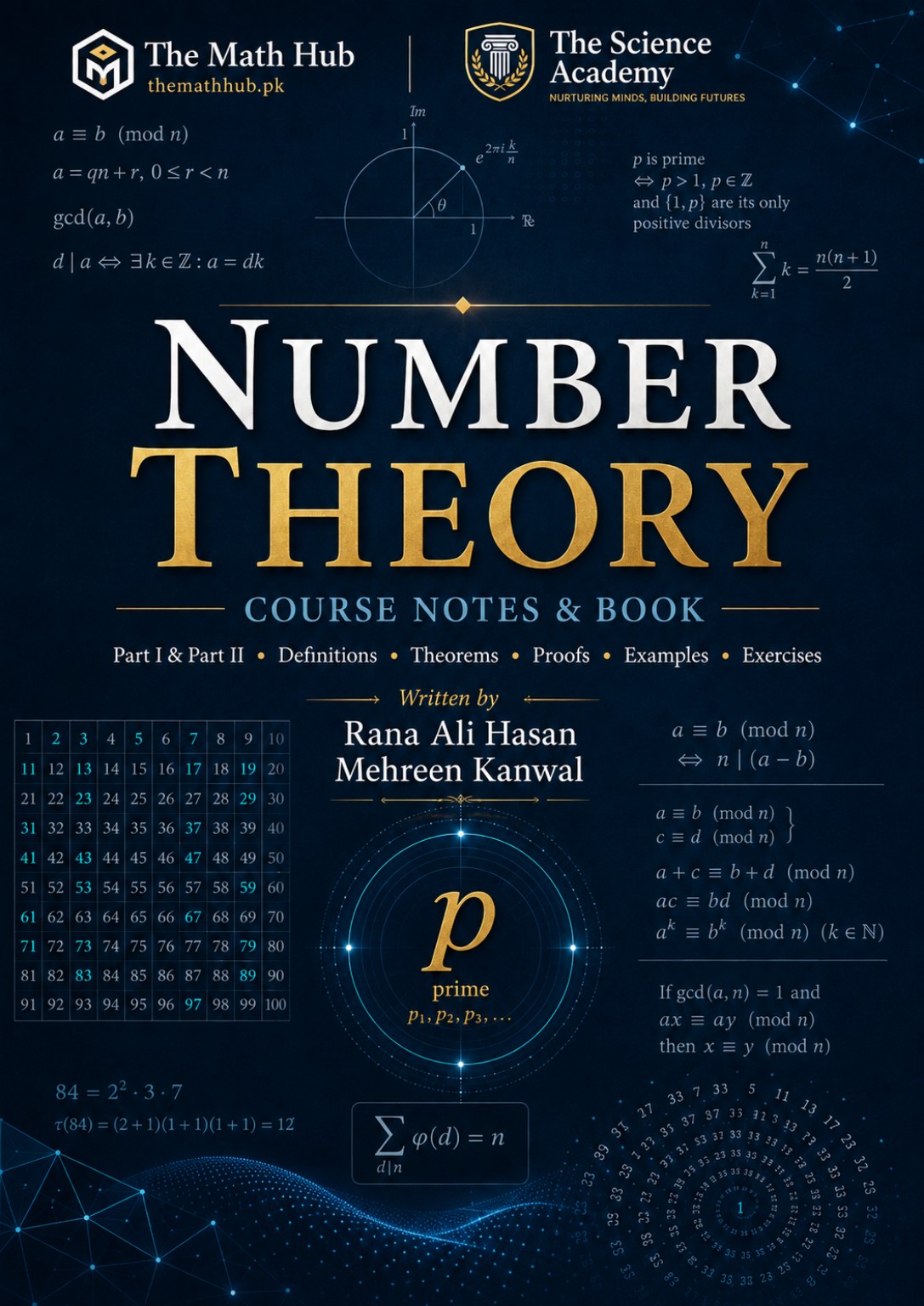
Number Theory complete course notes and book by Mehreen Kanwal and Rana Ali Hasan — The Math Hub
Number Theory Course Notes & Book · English · The Math Hub
About this book

A complete Number Theory learning path

The HTML page is designed to remain useful before the PDF is opened: it exposes the roadmap, proof emphasis, curriculum context, references and student questions in crawlable text.

What this resource covers

Study Number Theory from divisibility and primes to congruences, quadratic reciprocity, Diophantine equations, continued fractions, algebraic number theory, finite fields and cryptographic applications, with proofs, worked examples and exercises. Definitions are stated precisely, theorem hypotheses are kept visible, examples progress from foundational to advanced, and the later chapters label algebraic, computational, cryptographic, elliptic and analytic boundaries honestly.

The verified final-book scale is 254 physical PDF pages with academic pagination 1–228. The resource is independently prepared by The Math Hub and is not official university material.

Why study Number Theory?

Number Theory develops disciplined proof-writing around the integers while supplying the arithmetic behind modular computation, public-key cryptography, finite fields, algorithms and many Diophantine questions. It also gives a coherent route from elementary results to modern research directions.

Purpose and benefits

  • Build exact definitions, theorem use and proof habits.
  • Practice computation alongside reasoning and verification.
  • Recognize how one canonical subject appears under different university course names.
  • Connect undergraduate arithmetic to algebraic, analytic and computational continuations.

Who is it for?

BS Mathematics and ADP/Associate Degree Mathematics students, legacy BSc/MSc learners revising foundations, university Number Theory students, and computing learners who need modular arithmetic, finite fields or cryptographic foundations.

Readiness guidance

Be comfortable with algebra, functions, basic proof ideas and sets. Chapter 1 supplies a proof-tool refresh; Chapters 17–24 are an advanced bridge and are best read after the elementary chapters and relevant abstract algebra.

Learning outcomes

Prove and apply divisibility and prime-factorization results.Solve congruences, CRT systems and Diophantine equations.Compute arithmetic functions, orders, residues and primitive roots.Use continued fractions, Pell methods and primality algorithms.Understand field extensions, algebraic integers, ideals and finite fields.Explain the mathematics of RSA, Diffie–Hellman, ElGamal and ECDH.Read introductory analytic Number Theory statements without overstating proof scope.Move between worked examples, proof tasks and topic exercises.
Course roadmap

Course Contents — 24 chapters

Each entry links to a separate detailed chapter block below. The complete resource serves Number Theory, Number Theory-I / 1 and Number Theory-II / 2 discovery without doorway duplicates.

  1. Chapter 1Foundations and Proof Tools for Number Theory
  2. Chapter 2Divisibility, GCD, LCM and Euclidean Algorithms
  3. Chapter 3Prime Numbers and Unique Factorization
  4. Chapter 4Linear Diophantine Equations
  5. Chapter 5Congruences and Residue Systems
  6. Chapter 6Linear Congruences, Systems and Chinese Remainder Theorem
  7. Chapter 7Fermat, Euler, Wilson and Related Theorems
  8. Chapter 8Arithmetic Functions and Möbius Inversion
  9. Chapter 9Orders, Primitive Roots and Indices
  10. Chapter 10Polynomial and Higher-Degree Congruences
  11. Chapter 11Quadratic Residues and Euler's Criterion
  12. Chapter 12Legendre Symbol, Jacobi Symbol and Quadratic Reciprocity
  13. Chapter 13Special Numbers and Integer Sequences
  14. Chapter 14Nonlinear Diophantine Equations and Sums of Squares
  15. Chapter 15Continued Fractions and Pell's Equation
  16. Chapter 16Primality Testing, Pseudoprimes and Factorization
  17. Chapter 17Polynomial Algebra and Irreducibility
  18. Chapter 18Field Extensions and Algebraic Numbers
  19. Chapter 19Quadratic Fields and Algebraic Integers
  20. Chapter 20Ideals and Prime Decomposition
  21. Chapter 21Computational Number Theory and Finite Fields
  22. Chapter 22Cryptographic Applications of Number Theory
  23. Chapter 23Elliptic Curves over Finite Fields
  24. Chapter 24Analytic Number Theory and Further Directions
Chapter-by-chapter coverage

Detailed Number Theory chapters

These 24 crawlable blocks summarize the supplied course structure with granular subtopics, purpose, benefits, applications and navigation.

Chapter 01

Chapter 1Foundations and Proof Tools for Number Theory

Why this chapter is taught: Builds the proof language and integer foundations needed before divisibility, primes, congruences and Diophantine arguments can be developed rigorously.

What is taught

  • integers and standard number sets
  • mathematical notation and quantified statements
  • parity and elementary integer properties
  • absolute value and inequalities
  • summation and product notation
  • floor and ceiling functions
  • direct proof
  • proof by contrapositive
  • proof by contradiction
  • existence and uniqueness arguments
  • mathematical induction
  • strong induction
  • well-ordering principle
  • least-counterexample method
  • base-b representation of integers
  • proof-writing conventions used throughout Number Theory

Learning outcomes and benefits

  • read and write integer statements precisely
  • choose a suitable proof method
  • use induction and well-ordering correctly
  • work with floor, ceiling and base representations
  • separate examples from proofs and counterexamples

Applications and connections

  • proof-based university mathematics
  • discrete mathematics
  • algorithm correctness
  • inductive number-theoretic arguments
  • later divisibility and prime proofs

Read Foundations and Proof Tools for Number Theory in the complete Number Theory book PDF →

Chapter 02

Chapter 2Divisibility, GCD, LCM and Euclidean Algorithms

Why this chapter is taught: Establishes the arithmetic machinery behind prime factorization, modular inverses, linear congruences and many computational Number Theory algorithms.

What is taught

  • divisibility notation and laws
  • division algorithm
  • quotient and remainder
  • greatest common divisor
  • least common multiple
  • coprime integers
  • Bézout identity
  • linear combinations of integers
  • Euclidean algorithm
  • termination of the Euclidean algorithm
  • extended Euclidean algorithm
  • computing Bézout coefficients
  • Euclid's lemma
  • gcd-lcm relationship
  • divisibility tests
  • algorithmic modular inverse preparation

Learning outcomes and benefits

  • apply the division algorithm
  • compute gcd and lcm
  • use Euclid and extended Euclid
  • find Bézout coefficients
  • prove standard divisibility results
  • recognize coprimality efficiently

Applications and connections

  • modular inverses
  • cryptography
  • Diophantine equations
  • continued fractions
  • computational number theory

Read Divisibility, GCD, LCM and Euclidean Algorithms in the complete Number Theory book PDF →

Chapter 03

Chapter 3Prime Numbers and Unique Factorization

Why this chapter is taught: Prime factorization is the structural backbone of arithmetic and supports divisor functions, modular arithmetic, primality testing and algebraic Number Theory.

What is taught

  • prime and composite integers
  • prime divisors
  • Euclid's theorem on infinitely many primes
  • sieve of Eratosthenes
  • prime factorization
  • Fundamental Theorem of Arithmetic — existence
  • Fundamental Theorem of Arithmetic — uniqueness
  • Euclid's lemma and prime divisibility
  • prime-power decomposition
  • valuation notation
  • gcd and lcm from exponents
  • primes in residue classes — introductory orientation
  • prime gaps — introductory orientation
  • Mersenne primes
  • Fermat primes
  • factorization methods — elementary orientation
  • open problems and conjectures — clearly labeled

Learning outcomes and benefits

  • distinguish primes and composites
  • prove existence and uniqueness of prime factorization
  • use prime exponents computationally
  • apply sieving and basic factorization
  • connect prime structure to later arithmetic functions

Applications and connections

  • public-key cryptography
  • factorization algorithms
  • divisor functions
  • finite fields
  • analytic number theory

Read Prime Numbers and Unique Factorization in the complete Number Theory book PDF →

Chapter 04

Chapter 4Linear Diophantine Equations

Why this chapter is taught: Trains students to solve equations under integer constraints and forms a bridge between divisibility, congruences, continued fractions and computational applications.

What is taught

  • Diophantine equation concept
  • linear equation ax+by=c
  • solvability criterion using gcd
  • Bézout construction of one solution
  • general integer solution
  • parameterization
  • positive and nonnegative solution constraints
  • counting constrained solutions
  • two-coin Frobenius problem
  • Frobenius theorem for coprime two-denomination case
  • equations in more than two variables
  • congruence interpretation of linear Diophantine equations
  • word problems modeled by integer equations
  • verification of integer solutions
  • connection with Euclidean algorithm

Learning outcomes and benefits

  • test solvability
  • construct all integer solutions
  • impose positivity constraints
  • move between Diophantine and congruence forms
  • use gcd reasoning in applications

Applications and connections

  • integer optimization
  • modular arithmetic
  • coding problems
  • coin problems
  • Pell and nonlinear Diophantine preparation

Read Linear Diophantine Equations in the complete Number Theory book PDF →

Chapter 05

Chapter 5Congruences and Residue Systems

Why this chapter is taught: Congruences provide the central language of elementary Number Theory and convert divisibility problems into arithmetic on residue classes.

What is taught

  • congruence modulo n
  • equivalence relation viewpoint
  • residue classes
  • least positive residues
  • least absolute residues
  • complete residue systems
  • reduced residue systems
  • modular addition
  • modular subtraction
  • modular multiplication
  • modular powers
  • cancellation laws and their hypotheses
  • units modulo n
  • modular inverse criterion
  • modular division
  • power cycles
  • repeated squaring
  • divisibility applications of congruences
  • clock arithmetic interpretation

Learning outcomes and benefits

  • compute with congruences
  • choose appropriate residue representatives
  • find and use modular inverses
  • avoid invalid cancellation
  • use repeated squaring
  • interpret units modulo n

Applications and connections

  • cryptography
  • checksums
  • calendar arithmetic
  • primality testing
  • finite cyclic structures

Read Congruences and Residue Systems in the complete Number Theory book PDF →

Chapter 06

Chapter 6Linear Congruences, Systems and Chinese Remainder Theorem

Why this chapter is taught: Provides a complete method for solving modular equations and combining local residue information into a global solution.

What is taught

  • linear congruence ax≡b mod n
  • solvability criterion
  • number of incongruent solutions
  • solution by gcd reduction
  • solution by modular inverse
  • solution by extended Euclidean algorithm
  • systems of congruences
  • pairwise coprime moduli
  • Chinese Remainder Theorem
  • constructive CRT solution
  • CRT uniqueness modulo product
  • generalized CRT
  • compatibility for non-coprime moduli
  • uniqueness modulo lcm
  • mixed systems
  • CRT algorithm
  • reconstruction and remainder problems
  • applications to large modular computations

Learning outcomes and benefits

  • solve linear congruences
  • count solutions
  • solve CRT systems constructively
  • handle non-coprime moduli
  • verify uniqueness modulo a product or lcm

Applications and connections

  • RSA implementations
  • calendar and remainder puzzles
  • parallel modular computation
  • polynomial congruences
  • integer reconstruction

Read Linear Congruences, Systems and Chinese Remainder Theorem in the complete Number Theory book PDF →

Chapter 07

Chapter 7Fermat, Euler, Wilson and Related Theorems

Why this chapter is taught: Collects foundational congruence theorems used in modular exponentiation, primality reasoning and later cryptographic algorithms.

What is taught

  • Fermat's Little Theorem
  • proof using residues and permutations
  • Euler's theorem
  • Euler totient as group size
  • Wilson's theorem
  • Wilson's theorem converse for primality
  • Lagrange theorem for polynomial roots modulo a prime
  • large modular exponent reduction
  • inverse formulas from Fermat and Euler
  • prime modulus versus composite modulus behavior
  • applications to divisibility
  • exponent cycles
  • Carmichael-function orientation
  • limitations of Fermat-style primality tests

Learning outcomes and benefits

  • state hypotheses precisely
  • prove and apply Fermat, Euler and Wilson
  • reduce large powers
  • use inverse formulas
  • recognize where prime-modulus arguments fail

Applications and connections

  • RSA mathematics
  • primality tests
  • modular inverse computation
  • cyclic groups modulo primes
  • contest and examination problems

Read Fermat, Euler, Wilson and Related Theorems in the complete Number Theory book PDF →

Chapter 08

Chapter 8Arithmetic Functions and Möbius Inversion

Why this chapter is taught: Turns prime-factor data into reusable functions and introduces inversion machinery that later reappears in analytic and computational Number Theory.
What is taught

  • arithmetic functions
  • multiplicative functions
  • completely multiplicative functions
  • divisor-counting function tau
  • sum-of-divisors function sigma
  • sigma_k functions
  • Euler phi function
  • phi prime-power formula
  • phi product formula
  • identity sum_{d|n} phi(d)=n
  • Möbius function
  • Möbius function on prime powers
  • Dirichlet convolution
  • identity element under convolution
  • Möbius inversion formula
  • floor and greatest-integer function applications
  • inclusion-exclusion interpretations
  • perfect-number connection
  • average and order-of-growth orientation

Learning outcomes and benefits

  • compute major arithmetic functions
  • prove multiplicativity
  • use Dirichlet convolution
  • apply Möbius inversion
  • translate divisor sums into formulas

Applications and connections

  • counting coprime residues
  • perfect numbers
  • analytic number theory
  • sieve methods
  • cryptographic totients

Read Arithmetic Functions and Möbius Inversion in the complete Number Theory book PDF →

Chapter 09

Chapter 9Orders, Primitive Roots and Indices

Why this chapter is taught: Explains multiplicative periodicity modulo n and prepares students for discrete logarithms, quadratic residues and cryptographic systems.

What is taught

  • order of an integer modulo n
  • basic order theorems
  • order divides group size
  • order of a power
  • cyclic unit groups
  • primitive roots
  • primitive roots modulo primes
  • existence of primitive roots modulo primes — theorem and proof layer
  • generators and Euler phi
  • indices and discrete logarithm notation
  • index laws
  • primitive roots for prime powers — orientation
  • classification of moduli with primitive roots — advanced result
  • higher-degree congruence applications
  • power residues
  • computational search for primitive roots

Learning outcomes and benefits

  • compute orders
  • test generators
  • work with primitive roots
  • use index laws
  • connect cyclic unit groups to modular equations

Applications and connections

  • Diffie–Hellman
  • ElGamal
  • discrete logarithms
  • cyclic codes
  • higher congruences

Read Orders, Primitive Roots and Indices in the complete Number Theory book PDF →

Chapter 10

Chapter 10Polynomial and Higher-Degree Congruences

Why this chapter is taught: Extends linear congruence techniques to polynomial equations and creates the local-to-global machinery needed for advanced modular arithmetic.

What is taught

  • polynomial congruences
  • roots modulo n
  • degree versus number of roots over prime fields
  • Lagrange root bound
  • factor theorem modulo primes
  • repeated roots
  • prime-power moduli
  • lifting solutions
  • Hensel's Lemma — simple-root case
  • constructive Hensel lifting
  • CRT decomposition of polynomial congruences
  • roots modulo composite moduli
  • higher-degree examples
  • failure of field-like behavior over composite moduli
  • solution counting
  • algorithmic root search

Learning outcomes and benefits

  • solve polynomial congruences
  • apply root bounds over prime fields
  • lift simple roots to prime powers
  • combine roots with CRT
  • identify repeated-root complications

Applications and connections

  • coding theory
  • finite fields
  • introductory p-adic methods
  • cryptography
  • computational number theory

Read Polynomial and Higher-Degree Congruences in the complete Number Theory book PDF →

Chapter 11

Chapter 11Quadratic Residues and Euler's Criterion

Why this chapter is taught: Introduces the arithmetic of squares modulo primes, a central topic leading directly to Legendre symbols and quadratic reciprocity.

What is taught

  • quadratic residues
  • quadratic nonresidues
  • squares modulo odd primes
  • count of nonzero quadratic residues
  • residue and nonresidue multiplication rules
  • Euler's criterion
  • Legendre-symbol preparation
  • solvability of x²≡a mod p
  • criterion for x²≡−1 mod p
  • square roots modulo primes
  • examples with residue tables
  • connection with cyclic groups
  • quadratic-character viewpoint
  • composite-modulus warning
  • algorithmic residue testing

Learning outcomes and benefits

  • classify residues and nonresidues
  • apply Euler's criterion
  • solve basic quadratic congruences
  • use multiplication laws
  • connect residues to primitive roots

Applications and connections

  • primality algorithms
  • modular square roots
  • cryptography
  • sum-of-two-squares results
  • reciprocity laws

Read Quadratic Residues and Euler's Criterion in the complete Number Theory book PDF →

Chapter 12

Chapter 12Legendre Symbol, Jacobi Symbol and Quadratic Reciprocity

Why this chapter is taught: Quadratic reciprocity is a flagship theorem of classical Number Theory and gives an efficient method for deciding quadratic residuosity.

What is taught

  • Legendre symbol
  • basic Legendre properties
  • Euler criterion in symbol form
  • Gauss's lemma
  • supplementary law for −1
  • supplementary law for 2
  • quadratic reciprocity
  • lattice-counting proof strategy
  • computing Legendre symbols efficiently
  • Jacobi symbol
  • multiplicativity of Jacobi symbol
  • Jacobi versus actual residuosity
  • reciprocity algorithms
  • quadratic congruences with odd composite moduli
  • CRT combination of square roots
  • worked reciprocity chains
  • common sign and parity mistakes

Learning outcomes and benefits

  • compute Legendre and Jacobi symbols
  • apply supplementary laws
  • use quadratic reciprocity
  • distinguish a Jacobi value from solvability
  • solve quadratic congruences using local factors

Applications and connections

  • modular square roots
  • cryptographic residuosity problems
  • primality testing
  • sums of squares
  • algebraic number theory motivation

Read Legendre Symbol, Jacobi Symbol and Quadratic Reciprocity in the complete Number Theory book PDF →

Chapter 13

Chapter 13Special Numbers and Integer Sequences

Why this chapter is taught: Uses classical special numbers and sequences to connect prime structure, divisors, recurrence relations and historical Number Theory.

What is taught

  • perfect numbers
  • Euclid–Euler theorem for even perfect numbers
  • Mersenne numbers and primes
  • Fermat numbers
  • Fermat-number product identity
  • pairwise coprimality of Fermat numbers
  • amicable-number orientation
  • Fibonacci numbers
  • Lucas numbers
  • Fibonacci addition identities
  • gcd properties of Fibonacci numbers
  • divisibility sequences
  • recurrence sequences modulo n
  • periodicity modulo n
  • prime-generating misconceptions
  • open problems — clearly labeled

Learning outcomes and benefits

  • analyze perfect and Mersenne numbers
  • prove Fermat-number identities
  • use Fibonacci divisibility properties
  • study recurrence sequences modulo n
  • distinguish theorem from open conjecture

Applications and connections

  • recreational number theory
  • recurrence algorithms
  • cryptographic prime searches
  • historical development
  • sequence-based divisibility

Read Special Numbers and Integer Sequences in the complete Number Theory book PDF →

Chapter 14

Chapter 14Nonlinear Diophantine Equations and Sums of Squares

Why this chapter is taught: Develops proof techniques for nonlinear integer equations and shows how congruences, factorization and descent combine in Diophantine analysis.

What is taught

  • nonlinear Diophantine equations
  • Pythagorean triples
  • primitive Pythagorean triples
  • complete parametrization
  • converse parametrization proof
  • Fermat-type equations
  • Fermat n=4 infinite descent
  • sum of two squares
  • prime p≡1 mod 4 as sum of two squares
  • Fermat two-square theorem
  • multiplicative two-square identity
  • representation counting orientation
  • integer points on conics
  • descent method
  • local obstruction viewpoint
  • examples and counterexamples

Learning outcomes and benefits

  • parametrize primitive triples
  • use infinite descent
  • apply modular obstructions
  • prove two-square criteria
  • analyze nonlinear integer equations

Applications and connections

  • Diophantine geometry
  • cryptography
  • integer lattice problems
  • geometry of numbers bridge
  • elliptic-curve motivation

Read Nonlinear Diophantine Equations and Sums of Squares in the complete Number Theory book PDF →

Chapter 15

Chapter 15Continued Fractions and Pell's Equation

Why this chapter is taught: Provides a powerful approximation method and an algorithmic solution theory for Pell-type equations.

What is taught

  • finite simple continued fractions
  • convergents
  • recurrence formulas for convergents
  • determinant identity
  • coprimality of convergents
  • approximation bounds
  • infinite continued fractions
  • irrational numbers and continued fractions
  • quadratic irrationals
  • periodicity theorem — statement and proof roadmap
  • best approximation viewpoint
  • Pell equation x²−Dy²=1
  • negative Pell equation
  • fundamental solution
  • generation of all positive Pell solutions
  • units in quadratic rings
  • Diophantine approximation connection
  • continued-fraction algorithms

Learning outcomes and benefits

  • expand rational and irrational numbers as continued fractions
  • compute convergents
  • prove key identities
  • solve Pell equations
  • connect periodicity with quadratic irrationals

Applications and connections

  • Diophantine approximation
  • quadratic fields
  • cryptanalysis
  • rational approximation
  • Pell-type recurrences

Read Continued Fractions and Pell's Equation in the complete Number Theory book PDF →

Chapter 16

Chapter 16Primality Testing, Pseudoprimes and Factorization

Why this chapter is taught: Connects classical congruence theorems with modern algorithms for distinguishing primes and factoring composites.

What is taught

  • trial division and sqrt(n) bound
  • Fermat primality test
  • Fermat pseudoprimes
  • Carmichael numbers
  • Korselt's criterion
  • Euler pseudoprimes
  • strong pseudoprimes
  • Miller–Rabin test logic
  • witnesses and non-witnesses
  • probabilistic versus deterministic testing
  • Fermat factorization
  • Pollard rho orientation
  • Pollard p-1 orientation
  • factor-base idea
  • complexity awareness
  • primality certificates — orientation
  • cryptographic prime generation
  • limitations and security implications

Learning outcomes and benefits

  • run elementary primality tests
  • recognize pseudoprime behavior
  • use Korselt's criterion
  • understand Miller–Rabin logic
  • apply basic factorization methods

Applications and connections

  • RSA key generation
  • cryptanalysis
  • computer algebra
  • algorithmic number theory
  • security engineering

Read Primality Testing, Pseudoprimes and Factorization in the complete Number Theory book PDF →

Chapter 17

Chapter 17Polynomial Algebra and Irreducibility

Why this chapter is taught: Supplies algebraic tools needed to construct number fields and finite fields and to determine when algebraic elements have irreducible defining polynomials.

What is taught

  • polynomial rings over fields and integers
  • polynomial division algorithm
  • gcd of polynomials
  • Bézout identity for polynomials
  • primitive polynomials
  • content of a polynomial
  • Gauss's lemma for polynomials
  • irreducibility over Z versus Q
  • rational root theorem
  • Eisenstein criterion
  • factor theorem
  • roots and factors
  • symmetric polynomials
  • Vieta relations
  • reduction modulo primes — irreducibility orientation
  • minimal-polynomial preparation

Learning outcomes and benefits

  • divide polynomials
  • compute polynomial gcds
  • apply Gauss and Eisenstein criteria
  • use rational root tests
  • prepare minimal-polynomial arguments

Applications and connections

  • algebraic number theory
  • finite fields
  • coding theory
  • Galois theory
  • elliptic curves

Read Polynomial Algebra and Irreducibility in the complete Number Theory book PDF →

Chapter 18

Chapter 18Field Extensions and Algebraic Numbers

Why this chapter is taught: Moves from elementary arithmetic to algebraic extensions where integer-like arithmetic can be studied beyond the rational numbers.

What is taught

  • field extensions
  • extension notation K/F
  • algebraic and transcendental elements
  • minimal polynomial
  • uniqueness of minimal polynomial
  • evaluation homomorphism
  • kernel generated by minimal polynomial
  • quotient construction F[x]/(m)
  • simple extensions F(α)
  • power bases
  • degree of an extension
  • Tower Law
  • algebraic elements form a field
  • conjugates
  • embeddings
  • field trace
  • field norm
  • additivity of trace
  • multiplicativity of norm
  • discriminant introduction
  • countability of algebraic numbers
  • existence of transcendental numbers

Learning outcomes and benefits

  • classify algebraic and transcendental elements
  • find minimal polynomials
  • construct simple extensions
  • compute degrees
  • use trace and norm

Applications and connections

  • algebraic number theory
  • finite fields
  • Galois theory
  • Diophantine equations
  • cryptographic fields

Read Field Extensions and Algebraic Numbers in the complete Number Theory book PDF →

Chapter 19

Chapter 19Quadratic Fields and Algebraic Integers

Why this chapter is taught: Shows how arithmetic changes in quadratic extensions and motivates ideals as a repair for failure of element-wise unique factorization.

What is taught

  • quadratic number fields Q(√d)
  • squarefree radicand convention
  • conjugation
  • trace in quadratic fields
  • norm in quadratic fields
  • algebraic integers
  • integrality criteria
  • algebraic integers form a ring
  • ring of integers of a quadratic field
  • d mod 4 cases
  • integral bases
  • field discriminant
  • Gaussian integers
  • Euclidean norm in Z[i]
  • units in quadratic rings
  • Pell connection
  • prime versus irreducible
  • failure of unique factorization
  • Z[√−5] example
  • class-number motivation

Learning outcomes and benefits

  • compute trace and norm
  • identify rings of integers in quadratic cases
  • work with Gaussian integers
  • find units
  • recognize unique-factorization failures

Applications and connections

  • Pell equations
  • sum-of-two-squares
  • ideal factorization
  • class groups
  • algebraic cryptography

Read Quadratic Fields and Algebraic Integers in the complete Number Theory book PDF →

Chapter 20

Chapter 20Ideals and Prime Decomposition

Why this chapter is taught: Restores unique factorization at the ideal level and provides the structural language of algebraic Number Theory.

What is taught

  • ideals in rings of integers
  • principal ideals
  • generated ideals
  • ideal sum and product
  • ideal divisibility
  • prime ideals
  • maximal ideals
  • quotient criteria for prime and maximal ideals
  • ideal norm
  • norm of principal ideals
  • factorization of rational primes
  • split primes
  • inert primes
  • ramified primes
  • discriminant criterion orientation
  • unique factorization of ideals — advanced theorem
  • Dedekind-domain prerequisites roadmap
  • Z[√−5] ideal-factorization repair
  • class group introduction
  • class number concept

Learning outcomes and benefits

  • compute basic ideal arithmetic
  • distinguish prime and maximal ideals
  • use ideal norms
  • describe split, inert and ramified behavior
  • understand why ideals repair factorization

Applications and connections

  • class groups
  • algebraic number theory
  • reciprocity
  • Diophantine equations
  • modern cryptographic number fields

Read Ideals and Prime Decomposition in the complete Number Theory book PDF →

Chapter 21

Chapter 21Computational Number Theory and Finite Fields

Why this chapter is taught: Turns theoretical results into algorithms and constructs the finite fields used throughout coding, cryptography and computational algebra.

What is taught

  • binary expansion algorithms
  • fast modular exponentiation
  • extended Euclidean algorithm implementation
  • modular inverse algorithms
  • constructive CRT algorithm
  • complexity awareness
  • finite fields
  • characteristic p
  • order p^n
  • finite integral domain is a field
  • Frobenius identity x^q=x
  • finite multiplicative groups
  • cyclicity of finite multiplicative subgroups
  • irreducible-polynomial construction
  • F_p[x]/(f) finite fields
  • polynomial arithmetic over finite fields
  • root finding orientation
  • factorization over finite fields
  • discrete logarithm computational viewpoint

Learning outcomes and benefits

  • implement core modular algorithms
  • construct finite fields
  • compute in extension fields
  • use Frobenius identities
  • connect algebraic structure to algorithms

Applications and connections

  • computer algebra
  • coding theory
  • cryptography
  • elliptic curves
  • primality and factorization

Read Computational Number Theory and Finite Fields in the complete Number Theory book PDF →

Chapter 22

Chapter 22Cryptographic Applications of Number Theory

Why this chapter is taught: Demonstrates how primes, congruences, finite groups and modular exponentiation underpin public-key cryptographic constructions.

What is taught

  • security goals and mathematical assumptions
  • RSA key generation
  • Euler and Carmichael exponent role
  • RSA encryption and decryption
  • RSA correctness including non-coprime message cases
  • CRT-RSA
  • modular inverse in key generation
  • discrete logarithm problem
  • Diffie–Hellman key exchange
  • Diffie–Hellman correctness
  • ElGamal encryption
  • ElGamal correctness
  • quadratic residuosity orientation
  • prime selection
  • factorization hardness
  • discrete-log hardness
  • implementation versus mathematical security distinction
  • common textbook misconceptions
  • responsible scope — mathematics, not operational security advice

Learning outcomes and benefits

  • explain RSA mathematics
  • derive correctness with CRT, Fermat and Euler reasoning
  • understand Diffie–Hellman and ElGamal structures
  • identify hardness assumptions
  • separate proof from implementation security

Applications and connections

  • public-key cryptography
  • secure communications
  • digital-signature mathematics
  • key exchange
  • computational group theory

Read Cryptographic Applications of Number Theory in the complete Number Theory book PDF →

Chapter 23

Chapter 23Elliptic Curves over Finite Fields

Why this chapter is taught: Introduces one of the most important modern intersections of algebra, geometry and Number Theory.

What is taught

  • elliptic-curve equation
  • nonsingularity criterion
  • discriminant viewpoint
  • point at infinity
  • geometric chord-tangent law
  • algebraic point addition
  • point doubling
  • inverse points
  • identity element
  • derivation of addition formulas
  • finite-field curve points
  • group law — advanced associativity note
  • scalar multiplication
  • double-and-add
  • point order
  • Hasse bound — advanced result
  • ECDH correctness
  • elliptic-curve discrete logarithm problem
  • point counting orientation
  • pairings — further direction
  • elliptic-curve cryptography context

Learning outcomes and benefits

  • test curve nonsingularity
  • add and double points
  • compute scalar multiples
  • understand point order
  • explain the mathematical basis of ECDH

Applications and connections

  • elliptic-curve cryptography
  • Diophantine equations
  • arithmetic geometry
  • finite fields
  • modern number theory

Read Elliptic Curves over Finite Fields in the complete Number Theory book PDF →

Chapter 24

Chapter 24Analytic Number Theory and Further Directions

Why this chapter is taught: Provides a carefully bounded bridge from undergraduate arithmetic to analytic, algebraic and research-level Number Theory.

What is taught

  • prime-counting function π(x)
  • asymptotic notation
  • Dirichlet convolution revisited
  • Dirichlet series
  • Riemann zeta function
  • absolute convergence for Re(s)>1
  • Euler product for zeta
  • Euler product proof
  • divergence of sum of reciprocal primes
  • Prime Number Theorem — statement and proof roadmap
  • Dirichlet characters — introduction
  • orthogonality of characters
  • Dirichlet L-functions
  • Euler products for L-functions
  • primes in arithmetic progressions — Dirichlet theorem statement
  • analytic class-number direction
  • algebraic number theory further study
  • modular forms and elliptic curves — roadmap
  • p-adic numbers — roadmap
  • research directions and prerequisites

Learning outcomes and benefits

  • interpret prime-counting asymptotics
  • work with elementary Dirichlet series and Euler products
  • understand the statement of the Prime Number Theorem
  • recognize L-function structure
  • identify prerequisites for advanced study

Applications and connections

  • prime distribution
  • analytic number theory
  • L-functions
  • cryptographic prime-generation theory
  • research preparation

Read Analytic Number Theory and Further Directions in the complete Number Theory book PDF →

Proof and problem-solving scope

Important theorems, lemmas and proof methods

The landing page describes the genuine proof-oriented scope without inventing exercise totals or claiming full proofs for advanced results whose machinery lies beyond the course.

Results and structures

  • Division Algorithm
  • Bézout Identity
  • Euclid's Lemma
  • Fundamental Theorem of Arithmetic
  • Euclid's theorem on infinitely many primes
  • Chinese Remainder Theorem
  • Fermat's Little Theorem
  • Euler's Theorem
  • Wilson's Theorem
  • Möbius Inversion Formula
  • Lagrange root bound
  • Hensel's Lemma — simple-root case
  • Euler's Criterion
  • Gauss's Lemma
  • Quadratic Reciprocity
  • Euclid–Euler theorem for even perfect numbers
  • Fermat's two-square theorem
  • Pell solution generation via continued fractions
  • Korselt's Criterion
  • Gauss's Lemma for polynomials
  • Eisenstein Criterion
  • Tower Law
  • Frobenius identity
  • finite integral domain theorem
  • RSA correctness
  • Hasse-bound context
  • Euler product for the zeta function
  • Prime Number Theorem — statement and roadmap

Proof methods and worked practice

  • direct proof
  • contrapositive
  • contradiction
  • mathematical induction
  • strong induction
  • well-ordering and least counterexample
  • Bézout and Euclidean descent
  • residue and permutation arguments
  • counting and bijective arguments
  • infinite descent
  • lattice-counting strategy
  • local-to-global CRT reasoning
  • polynomial factor and quotient arguments
  • field and ring homomorphism arguments
  • algorithm correctness and termination proofs
  • proof roadmap where advanced machinery lies beyond the course boundary

Worked examples move from direct arithmetic and modular calculations to proof chains, construction, counterexample analysis and algorithmic verification. Topic exercises are intended to test both computation and proof; the final PDF should remain the authority for exact exercise treatment.

Applications and connections

Where Number Theory leads

Computing and algorithms

Fast modular exponentiation, extended Euclid, CRT reconstruction, primality testing, factorization and finite-field arithmetic translate proofs into reliable algorithms.

Cryptography

Prime selection, modular inverses, Euler/Carmichael exponents, discrete logarithms and elliptic-curve groups explain RSA, Diffie–Hellman, ElGamal and ECDH at the mathematical level.

Algebra and geometry

Polynomial irreducibility, field extensions, quadratic fields, algebraic integers, ideals and elliptic curves connect arithmetic to abstract algebra and Diophantine geometry.

Analysis and further study

Arithmetic functions, Dirichlet series, Euler products, characters and prime-counting ideas provide a bounded route into analytic Number Theory, modular forms and p-adic directions.

How to use this book

  1. Read definitions and notation before attempting the first examples.
  2. Follow every theorem hypothesis and proof transition line by line.
  3. Work from basic examples to standard and advanced problems.
  4. Attempt the topic exercise, then revisit prerequisite chapters when a method is unfamiliar.
  5. Use the HTML roadmap for navigation and the PDF for the complete mathematical treatment.
Discovery and curriculum context

Programme relevance and placement

Every placement below is a discovery card pointing to this one canonical HTML page. The resource is useful for syllabus alignment, not official university notes or endorsement.

Pakistan context

HEC and national curriculum context

HEC Pakistan announced revised Associate, Bachelor and Master Mathematics curricula in March 2025 through the National Curriculum Review Committee, with academics from leading universities contributing to the review. This page uses that material as curriculum context and alignment context for students whose syllabus includes these topics; it is not an official HEC book or official university notes.

Course discovery evidence

Pakistan University / Course Crosswalk

Institution names and course codes below are presented as supplied direct-course evidence for curriculum discovery. Verify the current scheme with each university; no endorsement is implied.

University of the Punjab

Course context: MATH-203 Number Theory, 3 CH

Divisibility, Euclidean and extended Euclidean algorithms, linear Diophantine equations, primes, congruences, CRT, Fermat/Wilson/Lagrange results, pseudoprimes, arithmetic functions, Möbius inversion, order and primitive roots.

Official/source page →

National University of Sciences & Technology (NUST)

Course context: MATH-274 Elementary Number Theory, 3-0, no prerequisite

Divisibility and factorization, congruences, arithmetic functions, quadratic residues, primitive roots and Diophantine equations, with further perfect/Mersenne, Möbius and reciprocity context.

Official/source page →

University of Karachi

Course context: CM-303 Number Theory; M-303 Mathematical Logic and Number Theory; M-695 Computational Number Theory

Number Theory appears in computational, four-year BS and postgraduate Number Theory-I/II course contexts.

Official/source page →

UET Lahore — Faisalabad Campus

Course context: MATH-400 Number Theory, 3 credit hours

Listed in Year 4 / Semester 7 of the BS Mathematics roadmap.

Official/source page →

UET Taxila

Course context: MTH-421 Number Theory, 3 credit hours

Listed as a discipline course by the Department of Mathematical Sciences.

Official/source page →

University of Sargodha

Course context: MATH-5112 Number Theory, 3(3-0)

The Associate Degree Mathematics scheme spans classical Number Theory and points toward algebraic-number-theory ideas; current and legacy BS evidence also uses a Number Theory pathway.

Official/source page →

The Islamia University of Bahawalpur (IUB)

Course context: Math-01201 Number Theory, 3 CH; later Math-01604 Algebraic Number Theory

Number Theory is listed in Semester 2 with an algebraic continuation later in the programme.

Official/source page →

Lahore College for Women University (LCWU)

Course context: MATH-403 Number Theory, 3 CH

The BS scheme lists Number Theory, while MS/PhD pure mathematics lists advanced Number Theory courses.

Official/source page →

Allama Iqbal Open University (AIOU)

Course context: MATH6510 Applied Number Theory, 3(3+0)

Applied Number Theory appears in the BS Mathematics major/elective course tables.

Official/source page →

University of Central Punjab (UCP)

Course context: MT4413 Number Theory, 3 CH

The outline covers induction, divisibility, FTA, Diophantine equations, congruences/CRT, arithmetic functions, primitive roots, reciprocity, triples and sums of squares.

Official/source page →

University of Management and Technology (UMT)

Course context: MA-411 Number Theory and its Application, 3 CH

The undergraduate course-outline index includes a dedicated Number Theory and its Application outline.

Official/source page →

The University of Lahore — Sargodha Campus

Course context: Elementary Number Theory in BS Mathematics Semester IV

Programme evidence also supports later Number Theory-I/II and cryptography-style elective pathways in broader curriculum context.

Official/source page →

Historical, advanced or cautionary evidence

InstitutionHow to present itSource
Quaid-i-Azam UniversityHistorical/postgraduate Number Theory and Algebraic Number Theory evidence; treat as curriculum-history context unless a current course code is reverified.Source →
International Islamic University IslamabadScheme documentation groups Algebra and Number Theory as a discipline family; use exact current titles/codes only after live-scheme verification.Source →
Government College University FaisalabadLegacy/advanced programme evidence includes Algebraic Number Theory and Cryptography; present only as advanced or legacy alignment where current details are not confirmed.Source →

Curated display priority for consistent presentation

This is The Math Hub's curated display order, not an objective national ranking and not a course-specific claim.

Public / major

  1. University of the Punjab
  2. National University of Sciences & Technology (NUST)
  3. Quaid-i-Azam University
  4. COMSATS University Islamabad
  5. University of Engineering & Technology (UET) Lahore
  6. University of Karachi
  7. International Islamic University Islamabad (IIUI)
  8. University of Peshawar
  9. Government College University Lahore
  10. Government College University Faisalabad (GCUF)
  11. Bahauddin Zakariya University (BZU)
  12. University of Sargodha (UOS)
  13. The Islamia University of Bahawalpur (IUB)
  14. University of Engineering & Technology (UET) Taxila
  15. Lahore College for Women University (LCWU)
  16. Allama Iqbal Open University (AIOU)
  17. Abdul Wali Khan University Mardan
  18. BUITEMS
  19. University of Gujrat
  20. University of Narowal
  21. University of Swat
  22. University of Malakand
  23. University of Balochistan
  24. Gomal University
  25. Hazara University
  26. Karakoram International University
  27. University of Azad Jammu & Kashmir

Private

  1. LUMS
  2. The University of Lahore
  3. University of Central Punjab (UCP)
  4. University of Management and Technology (UMT)
  5. Forman Christian College (FCCU)
  6. Superior University
  7. Riphah International University
  8. Minhaj University Lahore
  9. Habib University
  10. Greenwich University
International course-context notes

Open learning benchmarks and UX patterns

These references identify useful structures such as measurable outcomes, proof-writing, exercises and open notes. They are not copied text and do not claim that The Math Hub is objectively better.

Johns Hopkins / Egbert Rijke — Course Notes on Elementary Number Theory

2026 notes with a long proof-oriented structure, history and exercises categorized by skill level.

Visit open resource →

MIT OpenCourseWare 18.781 — Theory of Numbers

Undergraduate lectures, assignments, problem-set solutions and exams covering primes, congruences, reciprocity, Diophantine equations and continued fractions.

Visit open resource →

MIT OpenCourseWare 18.785 — Number Theory I

Graduate open notes and problem sets covering standard algebraic and analytic Number Theory.

Visit open resource →

Mathematics LibreTexts — Elementary Number Theory (Raji)

Crawlable open-textbook structure with proofs, exercises and a bridge toward analytic Number Theory.

Visit open resource →

East Tennessee State University — Elementary Number Theory Class Notes

Separate class notes, examples, exercises and proof materials for a foundational course.

Visit open resource →

IISER Bhopal — MTH 305 Elementary Number Theory

Formal learning objectives and a detailed syllabus covering proof writing, divisibility, modular arithmetic, arithmetic functions, reciprocity and Pell.

Visit open resource →

Uppsala University — Elementary Number Theory 1MA206

Course-context benchmark including Diophantine equations, polynomial congruences, Hensel's lemma, reciprocity, continued fractions and Pell.

Visit open resource →
Further reading

Recommended Reference Books

References are listed for study direction only. The Math Hub page does not reproduce copyrighted textbook passages.

  1. David M. Burton, Elementary Number Theory, McGraw-Hill.
  2. Ivan Niven, Herbert S. Zuckerman and Hugh L. Montgomery, An Introduction to the Theory of Numbers, Wiley.
  3. G. H. Hardy and E. M. Wright, An Introduction to the Theory of Numbers, Oxford University Press.
  4. Kenneth H. Rosen, Elementary Number Theory and Its Applications, Pearson/Addison-Wesley.
  5. Tom M. Apostol, Introduction to Analytic Number Theory, Springer.
  6. Neal Koblitz, A Course in Number Theory and Cryptography, Springer.
  7. Ireland and Rosen, A Classical Introduction to Modern Number Theory, Springer.
  8. John Stillwell, Elements of Number Theory, Springer.
  9. James J. Tattersall, Elementary Number Theory in Nine Chapters, Cambridge University Press.
  10. Thomas Koshy, Elementary Number Theory with Applications, Elsevier/Academic Press.
  11. M. Mushtaq Suhail, Elementary Theory of Number, where prescribed in an official syllabus.
  12. S. M. Hussain, M. Zia-ud-din and S. A. Arif, Elementary Theory of Numbers, The Caravan Book House, Lahore, where prescribed in an official syllabus.

Free and legal further resources

Student questions

Number Theory FAQs

72 visible questions cover course identity, proof practice, core theorems, advanced bridges, programme context, mobile use and the chapter roadmap.

What is Number Theory?

Number Theory is the branch of mathematics centered on integers, divisibility, primes, congruences, Diophantine equations, arithmetic functions and related structures. This Math Hub resource also builds bridges to computational, algebraic, cryptographic, elliptic-curve and analytic directions.

Is Number Theory the same as Number Theory-I?

Not universally. Some universities offer a single course called Number Theory or Elementary Number Theory, while others split material into Number Theory-I and Number Theory-II. This resource uses one canonical Number Theory page and treats I/II as legitimate course-name and search aliases rather than duplicate pages.

Is there a Number Theory-III course in this resource?

No. Number Theory-III is not used as a standard identity for this resource. Advanced chapters are presented as later parts or further directions within the single complete Number Theory book.

Is Elementary Number Theory the same as Number Theory?

Elementary Number Theory usually names the foundational undergraduate portion: divisibility, primes, congruences, arithmetic functions, primitive roots, quadratic residues and Diophantine equations. The complete resource goes beyond that core while preserving the elementary pathway.

What is the difference between Number Theory and Discrete Mathematics?

Discrete Mathematics is a broader field that can include logic, sets, combinatorics, graphs and selected number-theoretic ideas. Number Theory is a dedicated discipline focused on arithmetic properties of integers and related algebraic and analytic structures.

Does the book include proofs?

Yes. The resource is proof-oriented. Important results are developed through formal statements, hypotheses, step-by-step mathematical reasoning and explanatory transitions rather than theorem names alone.

Does the book include worked examples?

Yes. The production structure progresses from basic examples to standard, intermediate and more advanced problems, with expanded mathematical working where a student could reasonably ask how one line follows from the previous line.

Are the exercises solved inside the main book?

The main theory book emphasizes fully solved worked examples and topic-wise practice exercises. Exercise-solution policy should match the final published PDF and must not be overstated on the landing page.

Who is this resource for?

It is intended for BS Mathematics, ADP/Associate Degree Mathematics, legacy BSc/MSc revision, university Number Theory students, and computing students who need modular arithmetic, finite fields or cryptographic foundations.

Is this an official university book?

No. It is an independently prepared The Math Hub learning resource. University curricula are used for topic alignment and course-discovery context, not as an endorsement or claim of official status.

Which course aliases should the page mention?

Use Number Theory as the canonical identity and naturally mention Number Theory-I, Number Theory 1, Number Theory-II, Number Theory 2, Elementary Number Theory, Applied Number Theory, Theory of Numbers and Computational Number Theory where contextually accurate.

Why are prime numbers important?

Prime numbers are the multiplicative building blocks of integers through unique factorization and are fundamental to divisor theory, congruences, primality algorithms and modern cryptography.

What is the Fundamental Theorem of Arithmetic?

It states that every integer greater than 1 can be factored into primes, and that this prime factorization is unique apart from the order of the factors.

What is a linear Diophantine equation?

A linear Diophantine equation is an equation such as ax+by=c for which integer solutions are required. Its solvability is governed by gcd(a,b).

What are congruences?

Congruences express equality modulo an integer. The notation a≡b (mod n) means n divides a-b.

What is the Chinese Remainder Theorem used for?

It combines compatible congruences with different moduli into a single solution class and is useful in modular reconstruction and efficient computation.

What does Fermat's Little Theorem say?

For prime p and an integer a not divisible by p, a^(p-1)≡1 (mod p). Equivalent forms and precise hypotheses should be explained on the page and in the book.

What is Euler's theorem in Number Theory?

If gcd(a,n)=1, then a^phi(n)≡1 (mod n), where phi is Euler's totient function.

What is Wilson's theorem?

An integer p>1 is prime exactly when (p-1)!≡-1 (mod p).

What is the Möbius inversion formula?

It is an inversion principle for divisor sums. If F(n)=sum_{d|n} f(d), then f can be recovered using the Möbius function.

What is a primitive root?

A primitive root modulo n is a residue whose powers generate all units modulo n when such a generator exists.

What is a quadratic residue?

A number a is a quadratic residue modulo p if x²≡a (mod p) has a solution.

What is the Legendre symbol?

The Legendre symbol compactly records whether an integer is a quadratic residue modulo an odd prime.

What is quadratic reciprocity?

Quadratic reciprocity is a central theorem relating the solvability of x²≡p (mod q) and x²≡q (mod p) for distinct odd primes, together with supplementary laws.

What is a Pell equation?

A Pell equation has the form x²-Dy²=1 with nonsquare positive D. Continued fractions provide a systematic method for finding its solutions.

What is a Carmichael number?

A Carmichael number is a composite integer that passes Fermat-style congruence tests for every base coprime to the integer, making it an important pseudoprime class.

How does Number Theory connect to cryptography?

Modular arithmetic, prime factorization, Euler and Fermat theorems, discrete logarithms, finite fields and elliptic curves supply the mathematics behind major public-key constructions.

Does the resource include algebraic Number Theory?

Yes, as an advanced bridge. It covers field extensions, algebraic numbers, quadratic fields, algebraic integers, ideals and prime decomposition while keeping advanced theorems properly bounded by prerequisites.

Does the resource include analytic Number Theory?

Yes, as a further-direction chapter covering prime-counting ideas, Dirichlet series, the zeta function, Euler products and carefully framed statements and roadmaps for deeper results.

Does the resource include elliptic curves?

Yes. It introduces elliptic curves over finite fields, point addition and doubling, scalar multiplication, point order, Hasse-bound context and ECDH mathematics.

How should a student use the book?

Start with definitions and notation, follow each theorem proof line by line, work through easy examples before advanced ones, then attempt the topic exercise and return to earlier prerequisite chapters when needed.

Can computing students use these notes?

Yes. Congruences, algorithms, finite fields, cryptography and elliptic curves are directly relevant to computing, but the canonical identity remains Number Theory rather than a duplicate computing page.

Why is the university crosswalk included?

Course names and scope vary by institution. The crosswalk helps students recognize where the same mathematical material appears without claiming that the resource is an official university publication.

Why is there one canonical page instead of separate Number Theory-I and Number Theory-II pages?

A single canonical page avoids duplicate or doorway-style content while still allowing legitimate course-name variants to appear naturally in headings, syllabus mapping and search-oriented copy.

Should the PDF be the main SEO destination?

No. The HTML resource page should be the principal indexable destination. The PDF and Backup Copy are actions and resources offered from the canonical page.

Why are the author names linked?

Linked author profiles make authorship transparent and connect the resource to stable educator entities on The Math Hub.

What should the mobile version do with long equations and URLs?

The page must never create page-level horizontal overflow. Wide mathematics, code or tables may scroll inside a local container, while body text, cards, author links and buttons must wrap within the viewport.

Should a keyword list be shown publicly?

No. The keyword bank is an editorial search-intent map. It should guide natural headings, descriptions, FAQs and anchor text rather than be dumped into visible content or a meta-keywords tag.

Does structured data guarantee a Google rich result?

No. Structured data can help search engines understand content, but rich-result appearance is not guaranteed. Markup must accurately represent visible content.

What should happen if an unintended homepage gallery was created by previous work?

Remove only the unintended Number Theory or resource-specific gallery, slider, overlay or demo artifact after verifying it was introduced by the implementation. Preserve legitimate existing homepage content and unrelated site-wide components.

What should a student learn in Chapter 1, Foundations and Proof Tools for Number Theory?

Chapter 1 focuses on integers and standard number sets, mathematical notation and quantified statements, parity and elementary integer properties, absolute value and inequalities, summation and product notation and then develops the topic toward the later concepts in the chapter. The visible HTML chapter block summarizes the supplied Number Theory resource.

What should a student learn in Chapter 2, Divisibility, GCD, LCM and Euclidean Algorithms?

Chapter 2 focuses on divisibility notation and laws, the division algorithm, quotient and remainder, greatest common divisor, least common multiple and then develops the topic toward the later concepts in the chapter. The visible HTML chapter block summarizes the supplied Number Theory resource.

What should a student learn in Chapter 3, Prime Numbers and Unique Factorization?

Chapter 3 focuses on prime and composite integers, prime divisors, Euclid's theorem on infinitely many primes, the sieve of Eratosthenes, prime factorization and then develops the topic toward the later concepts in the chapter. The visible HTML chapter block summarizes the supplied Number Theory resource.

What should a student learn in Chapter 4, Linear Diophantine Equations?

Chapter 4 focuses on the Diophantine equation concept, linear equation ax+by=c, the solvability criterion using gcd, Bézout construction of one solution and the general integer solution before developing later concepts in the chapter.

What should a student learn in Chapter 5, Congruences and Residue Systems?

Chapter 5 focuses on congruence modulo n, the equivalence-relation viewpoint, residue classes, least positive residues and least absolute residues before developing later concepts in the chapter.

What should a student learn in Chapter 6, Linear Congruences, Systems and Chinese Remainder Theorem?

Chapter 6 focuses on linear congruences, solvability, numbers of incongruent solutions, gcd reduction and modular-inverse methods before developing constructive CRT and related topics.

What should a student learn in Chapter 7, Fermat, Euler, Wilson and Related Theorems?

Chapter 7 focuses on Fermat's Little Theorem, residue and permutation proofs, Euler's theorem, the totient as group size and Wilson's theorem before developing related results and applications.

What should a student learn in Chapter 8, Arithmetic Functions and Möbius Inversion?

Chapter 8 focuses on arithmetic functions, multiplicative functions, completely multiplicative functions, the divisor-counting function tau and the sum-of-divisors function sigma before developing convolution and inversion.

What should a student learn in Chapter 9, Orders, Primitive Roots and Indices?

Chapter 9 focuses on the order of an integer modulo n, basic order theorems, order dividing group size, order of a power and cyclic unit groups before developing primitive roots and indices.

What should a student learn in Chapter 10, Polynomial and Higher-Degree Congruences?

Chapter 10 focuses on polynomial congruences, roots modulo n, the degree-versus-roots principle over prime fields, the Lagrange root bound and the factor theorem modulo primes before developing lifting and CRT methods.

What should a student learn in Chapter 11, Quadratic Residues and Euler's Criterion?

Chapter 11 focuses on quadratic residues, quadratic nonresidues, squares modulo odd primes, the count of nonzero residues and residue/nonresidue multiplication rules before developing Euler's criterion.

What should a student learn in Chapter 12, Legendre Symbol, Jacobi Symbol and Quadratic Reciprocity?

Chapter 12 focuses on the Legendre symbol, basic properties, Euler's criterion in symbol form, Gauss's lemma and the supplementary law for -1 before developing reciprocity and Jacobi methods.

What should a student learn in Chapter 13, Special Numbers and Integer Sequences?

Chapter 13 focuses on perfect numbers, the Euclid–Euler theorem for even perfect numbers, Mersenne numbers and primes, Fermat numbers and the Fermat-number product identity before developing sequence connections.

What should a student learn in Chapter 14, Nonlinear Diophantine Equations and Sums of Squares?

Chapter 14 focuses on nonlinear Diophantine equations, Pythagorean triples, primitive triples, complete parametrization and the converse parametrization proof before developing descent and sums of squares.

What should a student learn in Chapter 15, Continued Fractions and Pell's Equation?

Chapter 15 focuses on finite simple continued fractions, convergents, recurrence formulas, the determinant identity and coprimality of convergents before developing Pell equations and approximation.

What should a student learn in Chapter 16, Primality Testing, Pseudoprimes and Factorization?

Chapter 16 focuses on trial division and the square-root bound, the Fermat primality test, Fermat pseudoprimes, Carmichael numbers and Korselt's criterion before developing strong tests and factorization.

What should a student learn in Chapter 17, Polynomial Algebra and Irreducibility?

Chapter 17 focuses on polynomial rings over fields and integers, the polynomial division algorithm, polynomial gcds, Bézout identity for polynomials and primitive polynomials before developing irreducibility criteria.

What should a student learn in Chapter 18, Field Extensions and Algebraic Numbers?

Chapter 18 focuses on field extensions, extension notation K/F, algebraic and transcendental elements, minimal polynomials and uniqueness of minimal polynomials before developing quotient and trace/norm methods.

What should a student learn in Chapter 19, Quadratic Fields and Algebraic Integers?

Chapter 19 focuses on quadratic number fields Q(√d), the squarefree-radicand convention, conjugation, trace in quadratic fields and norm in quadratic fields before developing algebraic integers and Gaussian integers.

What should a student learn in Chapter 20, Ideals and Prime Decomposition?

Chapter 20 focuses on ideals in rings of integers, principal ideals, generated ideals, ideal sum and product and ideal divisibility before developing norms, prime decomposition and class-group motivation.

What should a student learn in Chapter 21, Computational Number Theory and Finite Fields?

Chapter 21 focuses on binary expansion algorithms, fast modular exponentiation, extended Euclidean implementation, modular inverse algorithms and constructive CRT before developing finite-field computation.

What should a student learn in Chapter 22, Cryptographic Applications of Number Theory?

Chapter 22 focuses on security goals and mathematical assumptions, RSA key generation, the Euler/Carmichael exponent role, RSA encryption/decryption and RSA correctness including non-coprime messages before developing key exchange.

What should a student learn in Chapter 23, Elliptic Curves over Finite Fields?

Chapter 23 focuses on the elliptic-curve equation, nonsingularity, the discriminant viewpoint, the point at infinity and the geometric chord-tangent law before developing algebraic addition and ECDH context.

What should a student learn in Chapter 24, Analytic Number Theory and Further Directions?

Chapter 24 focuses on the prime-counting function pi(x), asymptotic notation, Dirichlet convolution revisited, Dirichlet series and the Riemann zeta function before developing Euler products and research directions.

Why is Chapter 1, Foundations and Proof Tools for Number Theory, important?

It builds the proof language and integer foundations needed before divisibility, primes, congruences and Diophantine arguments can be developed rigorously.

Why is Chapter 2, Divisibility, GCD, LCM and Euclidean Algorithms, important?

It establishes the arithmetic machinery behind prime factorization, modular inverses, linear congruences and many computational Number Theory algorithms.

Why is Chapter 3, Prime Numbers and Unique Factorization, important?

Prime factorization is the structural backbone of arithmetic and supports divisor functions, modular arithmetic, primality testing and algebraic Number Theory.

Why is Chapter 4, Linear Diophantine Equations, important?

It trains students to solve equations under integer constraints and forms a bridge between divisibility, congruences, continued fractions and computational applications.

Why is Chapter 5, Congruences and Residue Systems, important?

Congruences provide the central language of elementary Number Theory and convert divisibility problems into arithmetic on residue classes.

Why is Chapter 6, Linear Congruences, Systems and Chinese Remainder Theorem, important?

It provides a complete method for solving modular equations and combining local residue information into a global solution.

Why is Chapter 7, Fermat, Euler, Wilson and Related Theorems, important?

It collects foundational congruence theorems used in modular exponentiation, primality reasoning and later cryptographic algorithms.

Why is Chapter 8, Arithmetic Functions and Möbius Inversion, important?

It turns prime-factor data into reusable functions and introduces inversion machinery that later reappears in analytic and computational Number Theory.

Transparent authorship

About the Authors

Owner / publisher identity: The Math Hub. Associated academic brand: The Science Academy — Chak No. 84 NB, Sargodha. Contact: 0301-4058484. No university affiliation, rating, award or official status is claimed here.

Use the complete Number Theory resource

Keep this canonical HTML page as the main destination, then choose the PDF action that fits your study workflow.