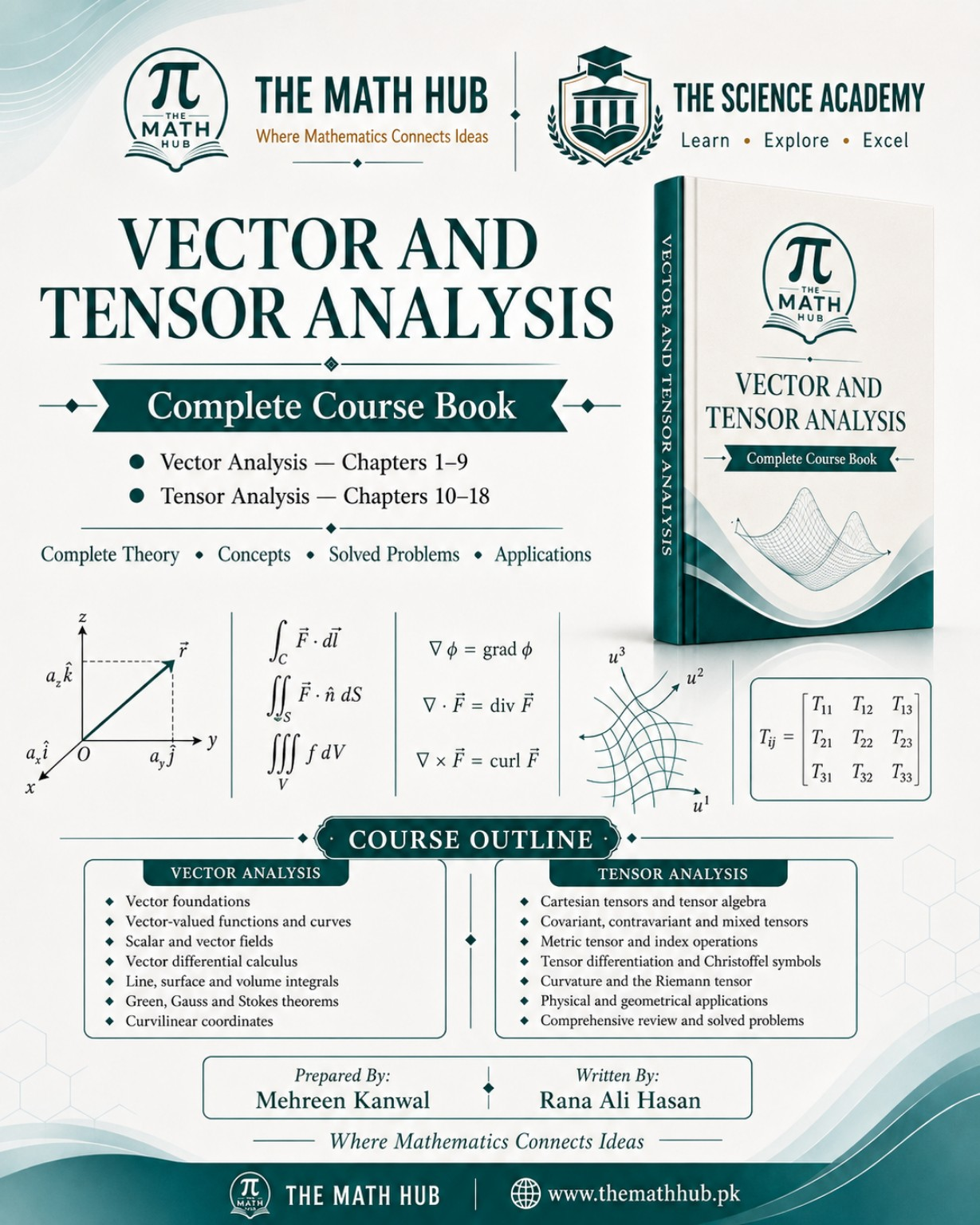
Overview / About This Book
This Vector and Tensor Analysis complete course book is designed as a single, progressive university-level resource that begins with the basic language of vectors and develops toward modern tensor calculus, curvature and physical applications. The first half establishes vector algebra, vector-valued functions, scalar and vector fields, differential identities, line, surface and volume integrals, Green–Gauss–Stokes theorems and orthogonal curvilinear coordinates. The second half introduces Cartesian tensors, tensor algebra, covariant and contravariant components, the metric tensor, Christoffel symbols, covariant differentiation, geodesics, Riemann and Ricci curvature, physical tensors and potential theory.
Students arriving from BS Mathematics, ADP pathways, legacy BSc/MSc revision, mathematical physics, mechanics or differential geometry should land on this one canonical HTML detail page and then choose View PDF, Download PDF or Backup Copy. Programme pages and subject surfaces are discovery aids, not competing copies of the full course-book body.
Why Study Vector and Tensor Analysis?
Vector and tensor methods provide a coordinate-aware yet ultimately geometric language for describing direction, fields, deformation, curvature and physical laws. Vector analysis gives tools such as gradient, divergence, curl and integral theorems. Tensor analysis generalizes these ideas so that laws remain meaningful under coordinate transformations. Together they are used in mechanics, fluid flow, elasticity, electromagnetism, differential geometry, relativity and applied mathematics.
Purpose
- Build concepts from vector foundations to advanced tensor calculus.
- Connect vector algebra, vector calculus and tensor analysis.
- Support university examination preparation without claiming official status.
Benefits
- Strengthen spatial and geometric reasoning.
- Develop fluency with vector and tensor notation.
- Connect differential and integral viewpoints through worked practice.
Who This Resource Is For
- BS Mathematics students.
- ADP / Associate Degree Mathematics students where the course is offered.
- Legacy BSc Mathematics students.
- MSc Mathematics students needing vector/tensor revision.
- Mathematical physics, mechanics and differential geometry students.
- Physics and engineering students needing a structured tensor foundation.
Prerequisites
- Single-variable calculus.
- Partial derivatives and multivariable calculus.
- Basic multiple integrals.
- Elementary matrices and determinants.
- Coordinate geometry and careful index notation.
Learning Outcomes
Perform vector algebra and interpret vector products geometrically.
Use index notation, Einstein summation, Kronecker delta and Levi-Civita symbols.
Analyze vector-valued curves, curvature and torsion.
Compute and interpret gradient, divergence, curl and Laplacian.
Evaluate line, surface and volume integrals.
Apply Green, Gauss and Stokes theorems.
Work in cylindrical, spherical and other orthogonal curvilinear coordinates.
Manipulate Cartesian and general tensors.
Distinguish covariant, contravariant and mixed components.
Compute metrics, inverse metrics and index operations.
Compute Christoffel symbols and covariant derivatives.
Understand Riemann, Ricci and scalar curvature at course-book level.
Interpret inertia, stress, strain and material-property tensors.
Use Laplace/Poisson and Green-identity ideas in potential theory.
Select methods effectively in integrated problems.
Clean Course Contents — 18 Chapters
Detailed Chapter-by-Chapter Coverage
Fundamentals of Vector Algebra
What this chapter covers: This opening chapter develops scalars and vectors, geometric and position-vector representations, components, magnitude, unit vectors, direction ratios, direction cosines, projections, coplanarity and the dot, cross, scalar-triple and vector-triple products.
Granular subtopics
- Scalars, vectors and geometric representation
- Position, equal, opposite and zero vectors
- Cartesian unit vectors i, j, k and components
- Magnitude, unit vectors and direction cosines
- Resolution, projections and angle between vectors
- Linear combinations and coplanarity
- Dot/scalar product and orthogonality
- Cross/vector product and area
- Scalar triple product and volume
- Vector triple product
- Standard vector identities
- Geometric and physical applications
Why this chapter matters
It builds the geometric and algebraic language used by every later vector-calculus and tensor chapter. Fluent component, product and projection skills make later differential and integral operations safer.
Learning outcomes
- Distinguish scalar and vector quantities
- Resolve vectors into components and reconstruct them
- Compute dot, cross and triple products
- Use direction cosines, projections and coplanarity tests
- Apply vector identities in geometric and physical problems
Applications and connections
- Analytical geometry
- Mechanics and force systems
- Kinematics
- Areas and volumes
- Preparation for vector calculus and Cartesian tensors
Definitions, identities and methods
Student question: What is the geometric role of the dot product? It measures the component of one vector along another, so it supports angle, projection, orthogonality and work calculations before the course moves to fields and tensors.
Index Notation and Tensor Preliminaries
What this chapter covers: The second chapter introduces suffix notation, free and dummy indices, the Einstein summation and range conventions, Kronecker delta, Levi-Civita symbol, determinant identities, vector products in index form and orthogonal transformations.
Granular subtopics
- Suffix/index notation
- Free and dummy indices
- Einstein summation and range convention
- Kronecker delta δ_ij
- Delta contraction identities
- Levi-Civita/permutation symbol ε_ijk
- Even and odd permutations
- Determinants in epsilon notation
- Epsilon-delta relations
- Dot, cross and triple products in suffix form
- Proofs of vector identities
- Orthogonal transformation matrices
Why this chapter matters
Index notation compresses long formulas, makes contractions explicit and provides a direct bridge from ordinary vectors to tensor transformation laws.
Learning outcomes
- Identify free and dummy indices correctly
- Apply Einstein summation without index errors
- Contract Kronecker and Levi-Civita symbols
- Rewrite vector operations in index form
- Verify orthogonal transformation properties
Applications and connections
- Compact vector-identity proofs
- Continuum mechanics notation
- Electromagnetism
- Tensor transformation laws
- Differential geometry
Definitions, identities and methods
Student question: Why is index notation useful? It turns repeated component operations into short, checkable expressions and gives students the notation needed for tensor algebra, transformations and covariant calculus.
Vector-Valued Functions and Curves
What this chapter covers: This chapter studies vector-valued functions of a scalar parameter, their limits, derivatives and integrals, and develops parametric space curves through tangent, normal and binormal frames, arc length, curvature, torsion and Frenet–Serret formulae.
Granular subtopics
- Vector-valued functions of a parameter
- Limits and continuity
- Derivatives and product rules
- Higher derivatives and integration
- Parametric curves and position vectors
- Tangent vector and unit tangent
- Arc length and differentiation by arc length
- Principal normal and binormal
- Curvature and radius of curvature
- Osculating plane
- Torsion and Frenet–Serret frame
- Velocity, acceleration and kinematics
Why this chapter matters
It connects vector algebra with motion and geometry. The differential geometry of curves supplies the kinematic interpretation needed in mechanics and later surface and tensor work.
Learning outcomes
- Differentiate and integrate vector functions
- Parametrize curves and compute arc length
- Find tangent, normal and binormal vectors
- Calculate curvature and torsion
- Resolve acceleration into tangential and normal components
Applications and connections
- Particle motion
- Space curves
- Mechanics
- Trajectory analysis
- Differential geometry
Definitions, identities and methods
Student question: How are curvature and torsion used? Curvature measures bending while torsion measures departure from planarity, giving a local description of a space curve and its motion.
Scalar and Vector Fields
What this chapter covers: Chapter 4 develops scalar and vector point functions, level curves and surfaces, directional derivatives, gradient, divergence, curl, the del operator, Laplacian, harmonic functions and conservative, irrotational and solenoidal fields.
Granular subtopics
- Scalar point functions and scalar fields
- Vector point functions and vector fields
- Level curves and level surfaces
- Directional derivative
- Gradient and maximum directional derivative
- Normal to a level surface
- Divergence and source/sink interpretation
- Curl and local rotation
- Del/nabla operator
- Laplacian and harmonic functions
- Irrotational, solenoidal and conservative fields
- Scalar and vector potentials
Why this chapter matters
It introduces the local differential operators that describe change, source strength and rotation in fields. These ideas are central to fluid mechanics, electromagnetism, potential theory and mathematical physics.
Learning outcomes
- Compute directional derivatives and gradients
- Interpret divergence and curl physically
- Identify harmonic, conservative, irrotational and solenoidal fields
- Compute Laplacians
- Find or test scalar and vector potentials
Applications and connections
- Heat flow
- Electrostatics
- Fluid flow
- Gravitation
- Electromagnetism
Definitions, identities and methods
Student question: What does divergence measure? It describes the local source or sink strength of a vector field; curl instead describes local rotational tendency, while the gradient describes the direction of greatest scalar-field increase.
Vector Differential Identities
What this chapter covers: This chapter turns grad, div and curl into a working differential calculus through product rules, directional operators, divergence and curl identities, curl-curl, the vector Laplacian and index-notation proofs.
Granular subtopics
- Linearity of gradient, divergence and curl
- Gradient product rules
- Divergence of scalar times vector
- Curl of scalar times vector
- Divergence and curl of cross products
- Gradient of a dot product
- Directional operator A·∇
- Divergence of a curl
- Curl of a gradient
- Curl of curl
- Vector Laplacian
- Symmetric–antisymmetric contraction proofs
Why this chapter matters
These identities simplify field equations, support theorem proofs and prepare the notation used by tensor differential calculus.
Learning outcomes
- Select the correct product identity
- Prove core identities by components or index notation
- Rewrite curl-curl expressions
- Use vector Laplacians safely
- Recognize identities that vanish for structural reasons
Applications and connections
- Maxwell equations
- Fluid identities
- Potential theory
- Elasticity
- Mathematical physics
Definitions, identities and methods
Student question: Why does the divergence of a curl vanish in the standard smooth setting? The component expression contracts a symmetric pair of derivatives with an antisymmetric Levi-Civita symbol, so the terms cancel.
Line Integrals and Conservative Fields
What this chapter covers: Chapter 6 moves from local differential information to accumulation along oriented curves through scalar and vector line integrals, work, circulation, path dependence, conservative fields, potential functions and the fundamental theorem for line integrals.
Granular subtopics
- Oriented and piecewise smooth curves
- Scalar and arc-length line integrals
- Vector line integrals and work
- Circulation
- Parametric evaluation
- Orientation reversal
- Closed-curve integrals
- Path dependence and independence
- Conservative vector fields
- Potential functions
- Exact differentials
- Simply connected domains and criteria
Why this chapter matters
It establishes the link between local fields, potentials and path-independent work, and prepares students to choose Green's or Stokes' theorem.
Learning outcomes
- Parametrize and orient curves
- Evaluate scalar and vector line integrals
- Compute work and circulation
- Test path independence
- Recover and use potential functions
Applications and connections
- Work done by force fields
- Circulation in fluids
- Electrostatic potentials
- Conservative mechanics
- Green and Stokes theorem preparation
Definitions, identities and methods
Student question: When is a vector field conservative? In an appropriate domain, a field is conservative when it is the gradient of a potential; then line integrals depend only on endpoints rather than on the path.
Surface and Volume Integrals
What this chapter covers: This chapter develops parametric surfaces, tangent and normal vectors, orientation, scalar surface integrals, flux, closed surfaces, double and triple integrals, volume elements, density applications, Jacobians and change of variables.
Granular subtopics
- Parametric surfaces
- Surface tangent vectors
- Normal vectors and orientation
- Surface area elements
- Scalar surface integrals
- Surface-area computation
- Vector surface integrals
- Flux integrals and closed surfaces
- Double and triple integrals
- Volume elements
- Mass, density and centroid-type applications
- Jacobian and coordinate changes
Why this chapter matters
It supplies the geometric integration machinery needed for Gauss and Stokes theorems and for physical conservation laws over surfaces and volumes.
Learning outcomes
- Parametrize surfaces
- Construct oriented area vectors
- Evaluate scalar surface and flux integrals
- Set up triple integrals
- Apply Jacobians under coordinate changes
Applications and connections
- Fluid flux
- Mass and density
- Surface area
- Charge distributions
- Conservation laws
Definitions, identities and methods
Student question: How is a flux integral different from a scalar surface integral? A scalar surface integral accumulates a scalar over area, while flux measures how a vector field crosses an oriented surface through a normal component.
Integral Theorems of Vector Analysis
What this chapter covers: Chapter 8 develops Green's theorem in circulation and flux forms, the Gauss divergence theorem, Stokes' theorem, orientation conventions, boundary relationships, verification problems and theorem-selection strategy.
Granular subtopics
- Green's theorem in circulation form
- Green's theorem in flux form
- Area applications of Green's theorem
- Gauss divergence theorem
- Outward normal convention
- Surface–volume conversion
- Stokes' theorem
- Right-hand orientation
- Line–surface conversion
- Boundary orientation
- Green–Gauss–Stokes relationships
- Verification and derived identities
Why this chapter matters
These theorems unify local differential operators with global integrals over boundaries and regions, making them foundational tools in applied mathematics and mathematical physics.
Learning outcomes
- State hypotheses and orientations correctly
- Apply Green's theorem
- Apply Gauss divergence theorem
- Apply Stokes' theorem
- Choose the most efficient theorem for an integral
Applications and connections
- Conservation laws
- Electromagnetism
- Fluid mechanics
- Potential theory
- Surface/volume conversion
Definitions, identities and methods
Student question: What is the difference between Green, Gauss and Stokes? Green links a planar boundary curve with a region, Gauss links closed-surface flux with volume divergence, and Stokes links boundary circulation with surface curl.
Orthogonal Curvilinear Coordinate Systems
What this chapter covers: Chapter 9 develops general coordinate transformations, coordinate curves and surfaces, basis vectors, orthogonality, scale factors and Lamé coefficients, followed by displacement, area, volume, Jacobian, gradient, divergence, curl and Laplacian formulas in useful coordinate systems.
Granular subtopics
- General coordinate transformations
- Coordinate curves and coordinate surfaces
- Coordinate basis and unit vectors
- Orthogonal coordinates
- Scale factors/Lamé coefficients
- Differential displacement and arc length
- Surface-area and volume elements
- Jacobian in orthogonal coordinates
- Gradient, divergence and curl
- Laplacian in orthogonal coordinates
- Cylindrical and spherical coordinates
- Specialized orthogonal systems
Why this chapter matters
Coordinates adapted to geometry and symmetry can turn difficult field and integration problems into tractable ones and prepare the student for metric tensors.
Learning outcomes
- Derive and use scale factors
- Construct line, area and volume elements
- Write grad, div, curl and Laplacian in orthogonal systems
- Work in cylindrical and spherical coordinates
- Recognize when specialized coordinates are useful
Applications and connections
- Axially symmetric PDEs
- Electrostatics
- Fluid mechanics
- Spherical geometry
- Tensor metrics in non-Cartesian coordinates
Definitions, identities and methods
Student question: What are curvilinear coordinates? They are coordinate systems adapted to non-Cartesian geometry; their scale factors keep displacement, area, volume and differential operators mathematically consistent.
Introduction to Cartesian Tensors
What this chapter covers: The first tensor-analysis chapter motivates tensors by connecting scalars, vectors, matrices and higher-order objects with Cartesian transformations, orthogonal matrices, tensor transformation laws, dyadics, invariance and isotropic tensors.
Granular subtopics
- Motivation for tensors
- Scalars, vectors, matrices and tensors
- Cartesian coordinate transformations
- Orthogonal transformation matrices
- Tensor transformation law
- Tensor order and rank
- Zero-, first- and second-order tensors
- Higher-order tensors and components
- Dyadic products
- Tensor fields and invariance
- Isotropic tensors
- Quadratic forms and linear maps
Why this chapter matters
It introduces tensors as coordinate-independent objects represented by transforming components, bridging familiar vectors and matrices with general tensor analysis.
Learning outcomes
- Distinguish a tensor from an arbitrary array
- Apply the Cartesian tensor transformation law
- Classify tensors by order
- Construct dyadics
- Interpret second-order tensors geometrically and physically
Applications and connections
- Stress and strain
- Moment of inertia
- Anisotropic material properties
- Electromagnetism
- Continuum mechanics
Definitions, identities and methods
Student question: Is a tensor just a matrix? No. A matrix is a component array in selected bases; a tensor is the underlying object whose components obey a precise transformation law when the basis changes.
Algebra of Tensors
What this chapter covers: Chapter 11 develops tensor addition, scalar and outer products, inner products, single and double contraction, the contraction and quotient theorems, symmetry and skew symmetry, invariants, eigenvalues, principal directions and spectral decomposition.
Granular subtopics
- Tensor addition and subtraction
- Scalar multiplication
- Outer/tensor product
- Inner products
- Single and double contraction
- Contraction theorem
- Quotient law/theorem
- Symmetric and skew-symmetric tensors
- Symmetric–skew decomposition
- Trace, determinant and invariants
- Eigenvalues and principal directions
- Spectral and isotropic decompositions
Why this chapter matters
It develops the algebraic tools needed to manipulate and interpret tensors before differentiation and curvature are introduced.
Learning outcomes
- Perform tensor products and contractions
- Apply the quotient law
- Decompose tensors into symmetric and skew parts
- Compute invariants and principal directions
- Use spectral and isotropic decompositions
Applications and connections
- Principal stress analysis
- Inertia tensors
- Constitutive laws
- Anisotropic diffusion
- Continuum mechanics
Definitions, identities and methods
Student question: What is tensor contraction? It sums over a paired index structure and lowers tensor order; trace and many tensor inner products are familiar examples.
Covariant, Contravariant and Mixed Tensors
What this chapter covers: This chapter develops general coordinate transformations, coordinate and reciprocal bases, covariant and contravariant vector components, mixed tensors, type (p,q) notation, higher-order transformation laws and invariant scalar products.
Granular subtopics
- General coordinate transformations
- Coordinate basis vectors
- Reciprocal and dual bases
- Contravariant vector components
- Covariant vector components
- Transformation laws
- Mixed tensors
- Type (p,q) notation
- Higher-order component transformation
- Contraction of mixed tensors
- Invariant scalar products
- Direct/inverse Jacobian matrices
Why this chapter matters
It explains how components transform in general coordinates and why upper and lower indices carry geometric meaning.
Learning outcomes
- Construct reciprocal bases
- Transform covariant and contravariant components
- Read mixed tensor types
- Contract indices correctly
- Distinguish coordinate components from physical components
Applications and connections
- Curvilinear mechanics
- Differential geometry
- General relativity notation
- Continuum mechanics
- Coordinate-invariant formulations
Definitions, identities and methods
Student question: What is the difference between covariant and contravariant components? Their transformation laws are reciprocal to one another, and the metric tensor provides the conversion between the two types.
Metric Tensor and Index Operations
What this chapter covers: Chapter 13 introduces the line element and fundamental quadratic form, metric tensor g_ij, inverse metric g^ij, lengths, angles, raising and lowering indices, metric determinants, volume elements and induced metrics on surfaces.
Granular subtopics
- Line element
- Fundamental quadratic form
- Metric tensor g_ij
- Inverse metric g^ij
- Metric as an inner-product matrix
- Length and angle
- Raising and lowering indices
- Associated tensors
- Metric determinant
- Jacobian and volume element
- Cylindrical and spherical metrics
- Induced metric and sphere area
Why this chapter matters
The metric converts geometric measurement into tensor form and supplies the machinery for index operations, volume elements and Christoffel symbols.
Learning outcomes
- Derive a metric from coordinate transformations
- Compute inverse metrics
- Raise and lower indices
- Obtain volume elements from determinants
- Interpret induced and nonorthogonal metrics
Applications and connections
- Differential geometry
- Curvilinear integration
- Relativity
- Surface geometry
- Tensor calculus
Definitions, identities and methods
Student question: What is a metric tensor? It encodes lengths and angles in coordinates, converts between upper and lower indices and determines volume elements through its determinant.
Tensor Differentiation and Christoffel Symbols
What this chapter covers: Chapter 14 explains why ordinary component differentiation is not tensorial in changing bases, then develops basis derivatives, Christoffel symbols of both kinds, metric compatibility, covariant derivatives, tensor divergence, Laplace–Beltrami, geodesics and an introductory Lie derivative.
Granular subtopics
- Why ordinary component differentiation is not tensorial
- Derivatives of basis vectors
- Connection coefficients
- Christoffel symbols of first and second kind
- Calculation from the metric
- Levi-Civita symmetry and metric compatibility
- Covariant derivative of scalars, vectors and covectors
- Covariant derivative of mixed tensors
- One correction term per index
- Tensor divergence and Laplace–Beltrami
- Absolute differentiation and parallel transport
- Geodesic equation and Lie derivative
Why this chapter matters
It defines differentiation that remains geometrically meaningful when bases vary from point to point and prepares the machinery of curvature.
Learning outcomes
- Compute Christoffel symbols from a metric
- Differentiate vectors and tensors covariantly
- Apply metric compatibility
- Derive geodesic equations
- Distinguish covariant and Lie derivatives at an introductory level
Applications and connections
- Geodesic motion
- Differential geometry
- General relativity
- Curvilinear continuum mechanics
- Surface calculations
Definitions, identities and methods
Student question: Why are Christoffel symbols needed? In curvilinear or general coordinates, basis vectors change from point to point; the connection terms correct component derivatives for that basis variation.
Curvature and the Riemann Tensor
What this chapter covers: Chapter 15 develops parallel transport and path dependence, the commutator of covariant derivatives, Riemann curvature, tensor symmetries, Bianchi identities, flat-space criteria, Ricci tensor, scalar curvature, Einstein tensor and geodesic deviation.
Granular subtopics
- Parallel transport and path dependence
- Commutator of covariant derivatives
- Riemann curvature tensor
- Riemann sign convention and components
- Antisymmetry and pair symmetry
- First Bianchi identity
- Independent curvature components
- Flat-space criterion
- Ricci tensor
- Ricci scalar and Einstein tensor
- Contracted Bianchi identity
- Gaussian curvature and geodesic deviation
Why this chapter matters
It measures intrinsic curvature and connects tensor differentiation with the geometry of spaces and surfaces.
Learning outcomes
- Compute basic curvature components
- Use Riemann tensor symmetries
- Form Ricci and scalar curvature
- Recognize flat and constant-curvature cases
- Interpret geodesic deviation
Applications and connections
- Differential geometry
- General relativity foundations
- Surface geometry
- Geodesic stability
- Continuum geometry
Definitions, identities and methods
Student question: What does the Riemann curvature tensor measure? It records intrinsic curvature through the failure of parallel transport and covariant derivatives to behave as they do in flat space.
Physical and Geometrical Applications of Tensors
What this chapter covers: This application chapter interprets inertia, stress, traction, strain, elasticity, stiffness, compliance, conductivity, diffusion, permittivity, piezoelectric and Maxwell stress tensors in mechanics, materials and electromagnetism.
Granular subtopics
- Moment of inertia and products of inertia
- Principal moments and axes
- Diagonalization of inertia tensor
- Stress tensor and Cauchy traction
- Normal and shear stress
- Principal stresses
- Strain tensor
- Elasticity, stiffness and compliance
- Strain-energy density
- Conductivity, diffusion and permittivity
- Piezoelectric third-order tensor
- Maxwell stress tensor
Why this chapter matters
It shows why tensor analysis matters by translating coordinate-independent mathematics into mechanics, materials, electromagnetism and engineering applications.
Learning outcomes
- Construct and interpret inertia and stress tensors
- Find principal values and directions
- Relate stress, strain, stiffness and compliance
- Model anisotropic transport and dielectric response
- Recognize higher-order material tensors
Applications and connections
- Solid mechanics
- Elasticity
- Continuum mechanics
- Materials science
- Electromagnetism and optics
Definitions, identities and methods
Student question: Where are tensors used in physics and engineering? They describe quantities whose components depend on direction and coordinate choice, such as stress, strain, inertia, conductivity and electromagnetic traction.
Potential Theory and Further Applications
What this chapter covers: Chapter 17 combines vector calculus and field theory through scalar and vector potentials, Laplace and Poisson equations, harmonic functions, Green's identities, boundary conditions, Green functions and Helmholtz decomposition.
Granular subtopics
- Scalar and vector potentials
- Laplace equation
- Poisson equation
- Radial solutions
- Harmonic functions
- Mean-value and maximum-principle ideas
- Green's first and second identities
- Dirichlet and Neumann conditions
- Robin/mixed boundary conditions
- Uniqueness and fundamental solutions
- Green functions and integral representation
- Helmholtz decomposition and gauge freedom
Why this chapter matters
It combines field operators, boundary conditions and integral identities into methods used throughout mathematical physics.
Learning outcomes
- Distinguish Laplace and Poisson problems
- Test harmonicity
- Use Green identities
- Understand Green-function representation conceptually
- Connect scalar/vector potentials with physical fields
Applications and connections
- Electrostatics
- Gravitation
- Steady heat flow
- Potential fluid flow
- Boundary-value problems
Definitions, identities and methods
Student question: What is potential theory? It studies potentials and field equations such as Laplace and Poisson equations, together with boundary-value tools for representing and analysing physical fields.
Comprehensive Review and Examination Practice
What this chapter covers: The final chapter integrates vector algebra, index notation, curves, field operators, integrals, Green–Gauss–Stokes, curvilinear coordinates, tensor algebra, metrics, covariant derivatives, curvature, physical tensors and potential theory through mixed practice.
Granular subtopics
- Vector algebra master review
- Index notation master review
- Vector functions and curves
- Field operators and identities
- Line, surface and volume integrals
- Green, Gauss and Stokes selection
- Curvilinear-coordinate review
- Cartesian tensor review
- Tensor algebra review
- Covariant/contravariant review
- Metric, Christoffel and curvature review
- Integrated proof and examination practice
Why this chapter matters
It integrates the full course so students can identify which concept, theorem or tensor tool is appropriate in unfamiliar problems.
Learning outcomes
- Select methods efficiently
- Connect vector and tensor formulations
- Solve mixed multi-step problems
- Check notation and sign conventions
- Prepare systematically for examinations and advanced study
Applications and connections
- Exam preparation
- Research-method foundations
- Mathematical physics revision
- Advanced differential geometry preparation
- Continuum mechanics preparation
Definitions, identities and methods
Student question: How should a student revise for an exam? Review definitions and notation first, then practise identity and theorem selection, coordinate formulas, tensor transformations, metric/Christoffel calculations and application problems.
Important Definitions, Identities, Theorems and Methods
Applications / Connections
How to Use This Book
- New learners should proceed in chapter order because index notation, field operators, curvilinear coordinates, metrics and covariant derivatives depend on earlier notation.
- Revision students can use the chapter index to jump to a topic, review definitions and formulas, study worked examples and then attempt topic-wise exercises.
- Students moving into differential geometry or mathematical physics should pay special attention to Chapters 9–17.
- For examination practice, classify the problem first, state the relevant conditions and then select the identity, theorem or tensor method.
Programme Relevance
This independent resource is surfaced from BS Mathematics, relevant ADP/Associate Degree pathways, legacy BSc/MSc revision, the Mathematics Library, Vector Analysis / Vector Calculus and Tensor Analysis subject discovery, and related Multivariable Calculus, Differential Geometry, Mechanics, Mathematical Physics and PDE resources. These are navigation aids pointing to one canonical HTML detail page—not separate full-resource pages.
Pakistan University / Course Crosswalk
The examples below establish course identity and topic alignment only. They are not endorsements, rankings, affiliations or claims that this independently prepared resource is official university material. Course codes, semester placement and depth vary by institution; the university's current scheme remains authoritative.
| University / pathway | Course identity | Relevant alignment | Evidence |
|---|---|---|---|
| University of the Punjab | MATH-304 Vector and Tensor Analysis; current BS structures also use Tensor Analysis | Published outlines cover vector integration, Green/Gauss/Stokes, curvilinear coordinates, tensor transformations, covariant/contravariant/mixed tensors, metric tensor and curvature. | Official/source document ↗ |
| University of the Punjab — current BS Mathematics | MATH-308 Tensor Analysis | The modern outline extends through specialized curvilinear systems, covariant derivatives, Lie derivatives, Riemann curvature, Ricci tensor and Ricci scalar. | Official/source document ↗ |
| University of the Punjab — BS Mathematics with Computer Science | MATH-307 Tensor Analysis | The Fall-2025 structure lists Tensor Analysis and recommends Chorlton, Spiegel, Joshi, Grinfeld and Nguyen-Schäfer/Schmidt. | Official/source document ↗ |
| University of Sargodha | Vector & Tensor Analysis, 3 credits | Course descriptions include vector algebra, grad/div/curl, Green/Gauss/Stokes, curvilinear coordinates, metric tensor, Christoffel symbols and Riemann curvature. | Official/source document ↗ |
| University of Sargodha — Associate Degree pathway | MATH-5103 Vector & Tensor Analysis, 3(3-0) | An Associate Degree scheme demonstrates relevant ADP discovery where the local programme offers the subject. | Official/source document ↗ |
| The Islamia University of Bahawalpur | Math-01401 Vector and Tensor Analysis, 3 credits | The outline covers 3-D vectors, summation convention, delta/epsilon symbols, vector integration, integral theorems, curvilinear coordinates and tensor applications. | Official/source document ↗ |
| University of Poonch Rawalakot | MAT-6312 Vector and Tensor Analysis, 3(3-0) | The Fall-2025 BS scheme includes the course with Calculus-II as prerequisite and a vector/tensor outline. | Official/source document ↗ |
| Government College University Faisalabad | MTH-505 Vector & Tensor Analysis | Published scheme evidence includes curvilinear coordinates, line/surface/volume integrals, Green/Gauss/Stokes, Cartesian tensors, contraction and tensor differential operators. | Official/source document ↗ |
| University of Management and Technology | Vector and Tensor Analysis in BS Mathematics; related elective context | Programme pages expose the combined course identity in BS and ADP/BS continuation discovery. | Official/source document ↗ |
| The University of Lahore | Vector and Tensor Analysis, 3 credits | The BS Mathematics programme page includes the subject as an active university-level course identity. | Official/source document ↗ |
Recommended Reference Books
These books are references and alignment sources, not text to copy. Commercial works are linked to publisher or catalogue contexts where possible, and no pirated scans or copied publisher exercises are offered.
F. Chorlton — Vector and Tensor Methods
Classical vector/tensor methods and coordinate foundations.
Publisher or catalogue context ↗M. R. Spiegel — Vector Analysis: An Introduction to Tensor Analysis
Problem-oriented vector analysis and introductory tensors.
Publisher or catalogue context ↗A. W. Joshi — Matrices and Tensors in Physics
Tensor algebra, metric ideas, covariant differentiation, applications and curvature-oriented material.
Publisher or catalogue context ↗Pavel Grinfeld — Introduction to Tensor Analysis and the Calculus of Moving Surfaces
Modern geometric tensor calculus, covariant differentiation, surfaces and curvature.
Publisher or catalogue context ↗Hung Nguyen-Schäfer and Jan-Philip Schmidt — Tensor Analysis and Elementary Differential Geometry for Physicists and Engineers
Worked applications in engineering, physics and differential geometry.
Publisher or catalogue context ↗D. E. Bourne and P. C. Kendall — Vector Analysis and Cartesian Tensors
Vector algebra/calculus, curvilinear coordinates, integral theorems, potential theory and Cartesian tensors.
Publisher or catalogue context ↗Prof. Dr. Nawazish Ali Shah — Vector and Tensor Analysis
Pakistan-oriented course coverage and exercise style.
Publisher or catalogue context ↗G. D. Smith — Vector Analysis
Vector analysis and integral-theorem reference.
Publisher or catalogue context ↗E. C. Young — Vector and Tensor Analysis
Supplementary vector and tensor analysis reference.
Publisher or catalogue context ↗Hwei P. Hsu — Applied Vector Analysis
Applied vector analysis and problem-solving reference.
Publisher or catalogue context ↗J. H. Heinbockel — Introduction to Tensor Calculus and Continuum Mechanics
Open text for index notation, tensor calculus, curvature and continuum mechanics.
Publisher or catalogue context ↗Michael Corral — Vector Calculus
Open vector-calculus text with extensive exercises and selected answers/hints.
Publisher or catalogue context ↗UBC CLP authors — CLP-4 Vector Calculus
University-hosted open vector-calculus text and practice.
Publisher or catalogue context ↗H. Jeffreys — Cartesian Tensors
Classic supplementary Cartesian tensor reference.
Publisher or catalogue context ↗Free / Legal Further Resources
Frequently Asked Questions
These human-readable FAQs cover the course identity, prerequisites, vector-calculus foundations, tensor concepts, applications, access and all 18 chapter families. They are provided for student usefulness; no rich-result appearance is promised.
What is Vector and Tensor Analysis?
Vector and Tensor Analysis is the study of vectors, vector fields and tensors together with the algebraic, differential and integral operations used to describe geometry, physical fields and coordinate-independent mathematical laws.
What is the difference between Vector Analysis and Tensor Analysis?
Vector Analysis studies vector algebra, vector-valued functions, field operators and vector integrals. Tensor Analysis generalizes these ideas to higher-order objects whose components transform according to tensor laws.
Is Vector Calculus the same as Vector Analysis?
They overlap strongly. Vector Calculus usually emphasizes gradient, divergence, curl and line, surface and volume integrals, while Vector Analysis may also include broader vector algebra, curves, identities and coordinate systems.
What is a tensor in simple terms?
A tensor is a mathematical object whose components change in a precise way when coordinates change, while the underlying geometric or physical quantity remains the same.
What background is needed before studying this book?
A working knowledge of calculus, partial derivatives, multiple integrals, elementary matrices and basic coordinate geometry is helpful. The book starts its vector material from foundations before moving into advanced tensor calculus.
Does this resource start from basic concepts?
Yes. It begins with scalars, vectors, components and vector products, then develops vector calculus and integral theorems before introducing tensors, metrics, Christoffel symbols and curvature.
Does the book include solved problems?
Yes. The current audited source record describes 188 worked-example blocks. That figure should be read as a current-source fact and re-audited if the final PDF is revised.
Does the book include exercises?
Yes. The current audited source record describes 96 topic-wise exercise blocks across the 18 chapters. These are practice exercises in addition to the worked examples.
How many chapters are in the book?
The current complete course book contains 18 chapters: Chapters 1–9 develop Vector Analysis and Chapters 10–18 develop Tensor Analysis, applications, potential theory and comprehensive review.
How many pages are in the current PDF?
The current owner PDF is described as 237 A4 pages. If the PDF is revised later, the page count should be re-audited before it is displayed as a fixed public fact.
Is this an official university textbook?
No. It is an independently prepared The Math Hub learning resource. University curricula are used only for course-name, topic-alignment and discovery context, not as an endorsement or claim of official status.
Can BS Mathematics students use these notes?
Yes. Vector/Tensor Analysis or Tensor Analysis appears in multiple BS Mathematics curricula in Pakistan, although exact course codes and depth vary by university.
Can ADP Mathematics students use this resource?
Yes where the local Associate Degree programme offers Vector and Tensor Analysis or a related elective. The same canonical resource should be surfaced without creating a duplicate SEO page.
Can legacy BSc or MSc students use this book?
Yes. The coverage is broad enough for legacy BSc/MSc revision and for students moving into mathematical physics, mechanics or differential geometry, subject to their institution's syllabus.
What are gradient, divergence and curl used for?
Gradient measures directional change of a scalar field, divergence measures local source/sink strength of a vector field, and curl measures local rotational tendency.
Why are Green, Gauss and Stokes theorems important?
They relate local differential operators to global boundary integrals and allow difficult line, surface or volume integrals to be transformed into more convenient forms.
What are curvilinear coordinates?
They are coordinate systems adapted to non-Cartesian geometry. The book covers general orthogonal coordinates and important systems such as cylindrical and spherical coordinates, with further specialized systems.
What is Einstein summation convention?
It is a compact notation in which a repeated index in a term is summed over its allowed range, reducing long component expressions to concise tensor formulas.
What is the Kronecker delta?
The Kronecker delta δ_ij equals 1 when i=j and 0 otherwise. It acts like the identity tensor in Cartesian index notation and is central to contraction identities.
What is the Levi-Civita symbol?
The Levi-Civita symbol ε_ijk encodes orientation and permutations. It provides compact formulas for cross products, determinants and many vector identities.
What is a Cartesian tensor?
A Cartesian tensor is an object whose components obey the tensor transformation law under Cartesian orthogonal coordinate transformations.
What is tensor contraction?
Contraction sums over one upper/lower or paired index structure, reducing tensor order. Trace and many inner products are examples of contractions.
What is the quotient theorem for tensors?
The quotient theorem provides a way to establish that an array is a tensor when its contraction with arbitrary tensors transforms as a tensor under suitable conditions.
What is the difference between covariant and contravariant components?
Contravariant components transform oppositely to the basis vectors, while covariant components transform with the reciprocal law. The metric tensor converts between them.
What is the metric tensor?
The metric tensor encodes lengths, angles and the line element in a coordinate system. It also raises and lowers indices and determines volume elements through its determinant.
What are Christoffel symbols?
Christoffel symbols describe how coordinate basis vectors change from point to point. They appear in covariant derivatives and geodesic equations.
What is a covariant derivative?
A covariant derivative corrects ordinary component derivatives for changes in the basis, producing a geometrically meaningful derivative of vectors and tensors in general coordinates.
What is a geodesic?
A geodesic is a locally straight or extremal-length path in a curved coordinate/metric setting. Its equation is expressed using Christoffel symbols.
What is the Riemann curvature tensor?
The Riemann tensor measures intrinsic curvature and the failure of covariant derivatives to commute. It also governs effects such as geodesic deviation.
What are the Ricci tensor and Ricci scalar?
They are contractions of the Riemann tensor. The Ricci tensor summarizes part of curvature information, and the Ricci scalar is a further scalar contraction.
Does the book discuss physical tensors?
Yes. It includes moment of inertia, stress, strain, stiffness/compliance, conductivity, diffusion, permittivity, piezoelectric and electromagnetic stress examples.
What is potential theory?
Potential theory studies scalar/vector potentials and equations such as Laplace and Poisson equations, including harmonic functions, Green identities, Green functions and Helmholtz decomposition.
How should I study Vector and Tensor Analysis for an exam?
Master definitions and notation first, then practise vector identities and field operators, integral theorem selection, coordinate-system formulas, tensor transformations, metric/Christoffel calculations and curvature/application problems.
Which course names may overlap with this resource?
Common overlapping titles include Vector and Tensor Analysis, Vector Analysis, Tensor Analysis, Vector Calculus, Tensor Calculus, Cartesian Tensors and parts of Mathematical Methods or Differential Geometry.
Does the book cover modern Tensor Analysis topics?
Yes. In addition to classical tensor algebra, it reaches covariant differentiation, geodesics, introductory Lie derivatives, Riemann curvature, Ricci curvature and physical applications.
Is Vector and Tensor Analysis the same as Vector Calculus?
Vector Calculus is a major part of the subject, especially gradient, divergence, curl and integral theorems. Vector and Tensor Analysis goes further by introducing tensor transformation laws, covariant/contravariant components, metrics, Christoffel symbols, covariant differentiation and curvature.
What should I study before Vector and Tensor Analysis?
Students benefit from multivariable calculus, basic linear algebra, coordinate geometry, differentiation/integration and familiarity with vectors. The resource still introduces the required notation from a basic level.
Why is index notation useful?
Index notation compresses long vector/tensor formulas, makes contractions explicit and provides a systematic way to prove identities using the Kronecker delta and Levi-Civita symbol.
Is a tensor just a matrix?
No. A matrix is an array of components relative to chosen bases. A tensor is a geometric or algebraic object whose components follow a specific transformation law when the coordinates or basis change.
Why are Christoffel symbols needed?
In curvilinear or general coordinates, basis vectors change from point to point. Christoffel symbols encode that basis variation and appear in covariant derivatives and geodesic equations.
What is the difference between partial and covariant differentiation?
Partial differentiation differentiates components directly. Covariant differentiation adds connection terms so the derivative of a tensor transforms tensorially in general coordinates.
What does the Riemann curvature tensor measure?
It measures intrinsic curvature through the failure of covariant derivatives and parallel transport to commute in the same way they do in flat space.
Does this book cover both Vector Analysis and Tensor Analysis?
Yes. Chapters 1–9 develop Vector Analysis and Chapters 10–18 develop Tensor Analysis, curvature, applications and integrated review.
Are Green, Gauss and Stokes theorems all included?
Yes. The course includes line, surface and volume integrals and develops Green's theorem, Gauss's divergence theorem and Stokes's theorem with applications and worked examples.
Does the resource include curvilinear coordinate systems?
Yes. It covers general orthogonal curvilinear coordinates and major systems such as cylindrical and spherical coordinates, with additional specialized coordinate systems where included in the final PDF.
Can engineering and physics students use this book?
Yes. The mathematical development supports applications in mechanics, continuum mechanics, stress/strain analysis, electromagnetism, material tensors and introductory relativity, while remaining a mathematics course book.
Is the resource official university material?
No. It is an independent The Math Hub educational resource. University curricula are used only to verify course identity, topic overlap and programme relevance.
Where can I download the PDF?
Use the View PDF or Download PDF buttons on this canonical The Math Hub resource page. A verified Backup Copy is also provided as an alternate access path.
Why does the page repeat the download buttons?
The action cluster appears at several useful points so students on mobile or long chapter pages can access the book without scrolling back to the top.
Are the authors linked to profiles?
Yes. Mehreen Kanwal and Rana Ali Hasan appear as blue, underlined, clickable names linked to their canonical The Math Hub educator profiles.
What should a student understand in Fundamentals of Vector Algebra?
This chapter develops dot product, cross product, scalar triple product, vector triple product and related methods as part of the basic-to-advanced progression of the complete course.
Why is Fundamentals of Vector Algebra important in this course?
It builds the geometric and algebraic language used by every later vector-calculus and tensor chapter. Students need fluent component, product and projection skills before differential and integral operators can be used safely.
What should a student understand in Index Notation and Tensor Preliminaries?
This chapter develops Einstein summation, Kronecker delta, Levi-Civita symbol, free index and related methods as the compact language of tensor analysis.
Why is Index Notation and Tensor Preliminaries important in this course?
It introduces efficient notation for tensor algebra, vector-identity proofs and the bridge from ordinary vectors to tensor transformation laws.
What should a student understand in Vector-Valued Functions and Curves?
This chapter develops unit tangent, arc length, curvature, principal normal and related methods for the geometry and kinematics of space curves.
Why are Vector-Valued Functions and Curves important in this course?
They connect vector algebra with motion and geometry and give the kinematic interpretation needed in mechanics and later surface and tensor work.
What should a student understand in Scalar and Vector Fields?
This chapter develops gradient, divergence, curl, Laplacian and related methods for describing local change, source strength and rotation in fields.
Why are Scalar and Vector Fields important in this course?
They introduce the local differential operators central to fluid mechanics, electromagnetism, potential theory and mathematical physics.
What should a student understand in Vector Differential Identities?
This chapter develops curl of gradient, divergence of curl, curl-curl identity, vector Laplacian and related methods for simplifying differential expressions.
Why are Vector Differential Identities important in this course?
They turn grad, div and curl into a working calculus and support theorem proofs, field-equation simplification and tensor formulations.
What should a student understand in Line Integrals and Conservative Fields?
This chapter develops line integral, work integral, circulation, path independence and related methods for integrating fields along curves.
Why are Line Integrals and Conservative Fields important in this course?
They move from local differential information to accumulation along curves and establish the link between conservative fields, potentials and path-independent work.
What should a student understand in Surface and Volume Integrals?
This chapter develops surface element, flux, orientation, volume integral and related methods for integration over two- and three-dimensional objects.
Why are Surface and Volume Integrals important in this course?
They provide the machinery needed for Gauss and Stokes theorems and for physical conservation laws.
What should a student understand in Integral Theorems of Vector Analysis?
This chapter develops Green theorem, Gauss divergence theorem, Stokes theorem, boundary orientation and theorem-selection methods.
Why are Integral Theorems of Vector Analysis important in this course?
They unify local differential operators with global integrals over boundaries and regions and are foundational in applied mathematics and mathematical physics.
What should a student understand in Orthogonal Curvilinear Coordinate Systems?
This chapter develops scale factors, Lamé coefficients, orthogonal coordinates, cylindrical coordinates and related differential-operator methods.
Why are Orthogonal Curvilinear Coordinate Systems important in this course?
They provide coordinates adapted to geometry and symmetry and prepare students for metric tensors and non-Cartesian calculations.
What should a student understand in Introduction to Cartesian Tensors?
This chapter develops Cartesian tensors, tensor rank/order, dyadics, transformation laws and the bridge from vectors and matrices to tensor analysis.
Why is Introduction to Cartesian Tensors important in this course?
It introduces tensors as coordinate-independent objects represented by transforming components and connects them with physical quantities.
What should a student understand in Algebra of Tensors?
This chapter develops tensor products, contractions, the quotient theorem, symmetric tensors and related algebraic methods.
Why is Algebra of Tensors important in this course?
It develops the tools needed to manipulate and interpret tensors before differentiation and curvature are introduced.
What should a student understand in Covariant, Contravariant and Mixed Tensors?
This chapter develops covariant, contravariant and mixed components, reciprocal bases, transformation laws and type (p,q) notation.
Why are Covariant, Contravariant and Mixed Tensors important in this course?
They explain how tensor components transform in general coordinates and why upper and lower indices carry geometric meaning.
What should a student understand in Metric Tensor and Index Operations?
This chapter develops metric tensor, inverse metric, line element, raising/lowering indices and related geometric measurement methods.
Why are Metric Tensor and Index Operations important in this course?
The metric provides the machinery for geometric measurement, index conversion, volume elements and Christoffel symbols.
What should a student understand in Tensor Differentiation and Christoffel Symbols?
This chapter develops Christoffel symbols, covariant derivative, metric compatibility, absolute derivative, geodesics and an introductory Lie derivative.
Why are Tensor Differentiation and Christoffel Symbols important in this course?
They define differentiation that remains geometrically meaningful when bases vary and prepare the machinery of curvature.
What should a student understand in Curvature and the Riemann Tensor?
This chapter develops Riemann tensor, Ricci tensor, scalar curvature, Einstein tensor and related curvature methods.
Why are Curvature and the Riemann Tensor important in this course?
They measure intrinsic curvature and connect tensor differentiation with the geometry of spaces and surfaces.
What should a student understand in Physical and Geometrical Applications of Tensors?
This chapter develops inertia, stress, strain, stiffness and related physical tensor methods.
Why are Physical and Geometrical Applications of Tensors important in this course?
They translate coordinate-independent mathematics into mechanics, materials, electromagnetism and engineering applications.
What should a student understand in Potential Theory and Further Applications?
This chapter develops Laplace and Poisson equations, harmonic functions, Green identities and related boundary-value methods.
Why is Potential Theory and Further Applications important in this course?
It combines vector calculus and field theory into methods used throughout mathematical physics.
What should a student understand in Comprehensive Review and Examination Practice?
This chapter develops method selection, integrated problem solving, notation consistency, theorem selection and examination practice.
Why is Comprehensive Review and Examination Practice important in this course?
It integrates the full course so students can identify which concept, theorem or tensor tool is appropriate in unfamiliar problems.
About the Authors
This complete course book was prepared and written for The Math Hub learning community by , both identified on their canonical educator profiles. No university affiliation, award, rating, review or official-university status is being claimed here.