Overview / About These Solutions
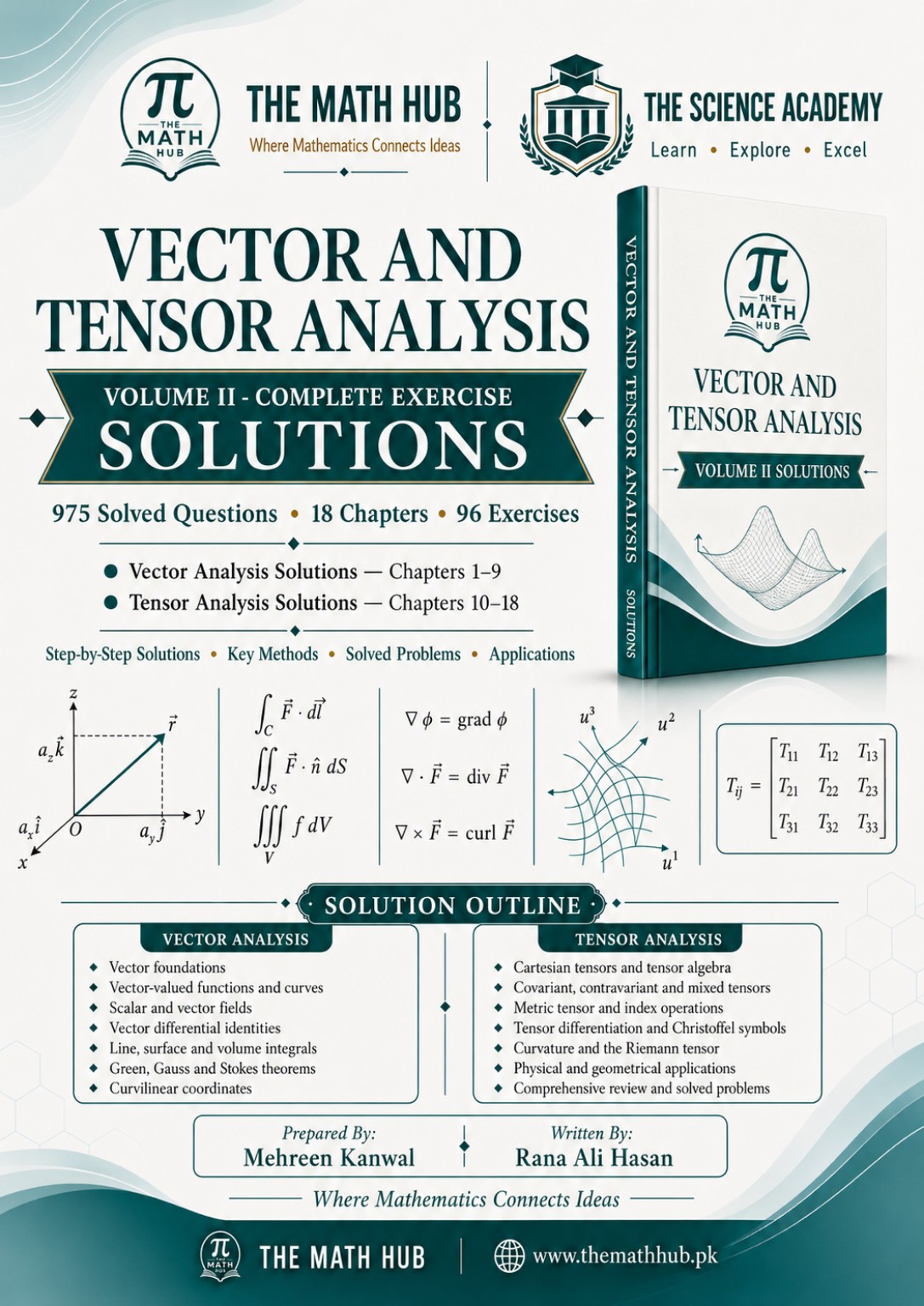
Vector and Tensor Analysis — Volume II Complete Exercise Solutions is a structured university-level solution companion, not a bare PDF link and not a second theory page. It follows the same academic sequence as The Math Hub's existing Vector and Tensor Analysis course book and gives students a separate place to check their exercise work after studying the underlying theory.
The verified current solution source contains 975 questions in 96 exercises across 18 chapters. Chapters 1–9 develop vector analysis; Chapters 10–18 develop tensor analysis, curvature, physical applications and potential theory.
A Separate Companion to the Existing Course Book
The existing Vector and Tensor Analysis complete course book remains the primary theory resource. It teaches definitions, formulas, proofs and worked examples; Volume II is the dedicated exercise-solution companion. The two canonical pages cross-link clearly without duplicating the same full SEO body.
Recommended Course Book — Study This Before the Solutions
Vector and Tensor Analysis — Complete Course Book, Solved Examples & Exercises
Read the relevant theory, definitions, formulas, proofs and worked examples in the course book first; then attempt the exercise independently before opening the corresponding Volume-II solution.
Why Use a Separate Solution Companion?
Practice after theory
- Read the complete course book first.
- Attempt each exercise without looking at the answer.
- Compare the method and intermediate steps, not only the final result.
One canonical solution destination
- Find the exact 18-chapter and 96-exercise map in HTML.
- Use one Volume II PDF and one Backup Copy action.
- Keep programme and library discovery cards linked to this HTML page.
Who This Resource Is For
- BS Mathematics students where Vector and Tensor Analysis, Vector Analysis or Tensor Analysis is part of the programme.
- ADP / Associate Degree Mathematics students where the subject is offered or is an elective.
- Legacy BSc Mathematics students revising Vector Analysis or Vector and Tensor Analysis.
- MSc Mathematics students needing contextual tensor-analysis revision and problem practice.
- Mathematical physics, mechanics and differential geometry learners.
- Physics and engineering students needing a structured tensor foundation where applicable.
How to Use the Solutions
- Open the complete course book and read the relevant section.
- Identify the governing definition, theorem, identity or coordinate formula.
- Attempt the problem independently and show intermediate work.
- Open the corresponding Volume-II solution and compare the method.
- Rework the problem without looking at the solution, then use the mixed-practice chapter for revision.
Learning Outcomes
Identify the governing definition, identity, theorem or transformation rule.
Translate statements into correct vector, index and tensor notation.
Expand algebra, differentiation, integration, substitutions and contractions.
Check results against invariance, dimensions, symmetry and orientation.
Select Green, Gauss, Stokes or a coordinate system efficiently.
Connect vector calculus with Cartesian and general tensor methods.
Interpret metric, Christoffel, curvature, stress and strain calculations.
Use step-by-step solutions to prepare for university examinations.
Recognize when a course title or syllabus overlaps only partially.
Rework a solution independently rather than memorizing final answers.
Clean Course Contents — 18 Chapters
Every entry below is a visible HTML anchor to a separate detailed chapter block. The first nine chapters are the Vector Analysis sequence; the last nine are the Tensor Analysis sequence and integrated applications.
Complete 96-Exercise Map
Question counts are shown for every exercise. No chapter-specific PDF is claimed; all exercise actions use the complete Volume II solutions PDF above.
Chapter 1: Fundamentals of Vector Algebra
72 questions- Exercise 1.1Scalars, Vectors and Geometric Representation12 questions
- Exercise 1.2Components, Magnitude and Direction Cosines12 questions
- Exercise 1.3Vector Operations, Bases and Resolution10 questions
- Exercise 1.4Dot Product, Angles and Projections12 questions
- Exercise 1.5Cross Product and Geometric Applications12 questions
- Exercise 1.6Triple Products and Fundamental Vector Identities14 questions
Chapter 2: Index Notation and Tensor Preliminaries
62 questions- Exercise 2.1Suffix Notation and Einstein Summation Convention12 questions
- Exercise 2.2Kronecker Delta12 questions
- Exercise 2.3Levi-Civita Symbol and Determinants12 questions
- Exercise 2.4Vector Operations in Index Notation12 questions
- Exercise 2.5Orthogonal Transformations and Component Laws14 questions
Chapter 3: Vector-Valued Functions and Curves
72 questions- Exercise 3.1Vector Functions, Limits and Continuity10 questions
- Exercise 3.2Differentiation and Integration of Vector Functions12 questions
- Exercise 3.3Parametric Curves, Tangents and Arc Length12 questions
- Exercise 3.4Curvature, Principal Normal and Osculating Plane12 questions
- Exercise 3.5Binormal, Torsion and Frenet-Serret Formulae12 questions
- Exercise 3.6Velocity, Acceleration and Particle Kinematics14 questions
Chapter 4: Scalar and Vector Fields
72 questions- Exercise 4.1Scalar Fields, Vector Fields and Directional Derivatives10 questions
- Exercise 4.2Gradient and Level Surfaces12 questions
- Exercise 4.3Divergence and Sources12 questions
- Exercise 4.4Curl and Local Rotation12 questions
- Exercise 4.5Laplacian, Harmonic Functions and Poisson-Type Fields12 questions
- Exercise 4.6Conservative, Irrotational and Solenoidal Fields; Potentials14 questions
Chapter 5: Vector Differential Identities
62 questions- Exercise 5.1Product Rules for Gradient, Divergence and Curl12 questions
- Exercise 5.2Gradient Identities and Derivatives of Dot Products12 questions
- Exercise 5.3Divergence and Curl Identities12 questions
- Exercise 5.4Curl of Curl and the Vector Laplacian12 questions
- Exercise 5.5Index-Notation Proofs and Applications14 questions
Chapter 6: Line Integrals and Conservative Fields
74 questions- Exercise 6.1Oriented Curves and Scalar Line Integrals12 questions
- Exercise 6.2Vector Line Integrals and Work12 questions
- Exercise 6.3Circulation, Closed Curves and Orientation12 questions
- Exercise 6.4Path Independence and Conservative Fields12 questions
- Exercise 6.5Fundamental Theorem for Line Integrals12 questions
- Exercise 6.6Exact Differentials, Simply Connected Domains and Applications14 questions
Chapter 7: Surface and Volume Integrals
74 questions- Exercise 7.1Parametric Surfaces and Surface Elements12 questions
- Exercise 7.2Scalar Surface Integrals and Surface Area12 questions
- Exercise 7.3Flux Integrals of Vector Fields12 questions
- Exercise 7.4Orientation and Closed Surfaces12 questions
- Exercise 7.5Double, Triple and Volume Integrals12 questions
- Exercise 7.6Jacobians, Change of Variables and Physical Applications14 questions
Chapter 8: Integral Theorems of Vector Analysis
72 questions- Exercise 8.1Green's Theorem in the Plane14 questions
- Exercise 8.2Gauss Divergence Theorem14 questions
- Exercise 8.3Stokes' Theorem14 questions
- Exercise 8.4Boundary Orientation and the Unified Theorem Viewpoint14 questions
- Exercise 8.5Verification, Applications and Derived Identities16 questions
Chapter 9: Orthogonal Curvilinear Coordinate Systems
82 questions- Exercise 9.1General Curvilinear Coordinates and Scale Factors12 questions
- Exercise 9.2Differential Length, Area, Volume and Jacobian12 questions
- Exercise 9.3Grad, Div, Curl and Laplacian in Orthogonal Coordinates12 questions
- Exercise 9.4Cylindrical Coordinates15 questions
- Exercise 9.5Spherical Polar Coordinates16 questions
- Exercise 9.6Additional Orthogonal Systems and Coordinate Selection15 questions
Chapter 10: Introduction to Cartesian Tensors
45 questions- Exercise 10.1Tensor Motivation and Order10 questions
- Exercise 10.2Cartesian Transformation Laws10 questions
- Exercise 10.3Dyadics and Tensor Fields9 questions
- Exercise 10.4Special Cartesian Tensors9 questions
- Exercise 10.5Interpreting Second-Order Tensors7 questions
Chapter 11: Algebra of Tensors
38 questions- Exercise 11.1Basic Tensor Operations6 questions
- Exercise 11.2Contraction and Quotient Law8 questions
- Exercise 11.3Symmetry and Skew-Symmetry8 questions
- Exercise 11.4Invariants and Principal Directions8 questions
- Exercise 11.5Isotropy and Projection Tensors8 questions
Chapter 12: Covariant, Contravariant and Mixed Tensors
33 questions- Exercise 12.1General Coordinate Bases6 questions
- Exercise 12.2Reciprocal Bases and Components6 questions
- Exercise 12.3Vector and Covector Transformations7 questions
- Exercise 12.4Mixed Tensors and Tensor Type7 questions
- Exercise 12.5Physical and Coordinate Components7 questions
Chapter 13: Metric Tensor and Index Operations
34 questions- Exercise 13.1Line Element and Metric Tensor7 questions
- Exercise 13.2Inverse Metric and Index Operations7 questions
- Exercise 13.3Metric Determinant and Measure6 questions
- Exercise 13.4Standard Curvilinear Metrics7 questions
- Exercise 13.5Nonorthogonal and Induced Metrics7 questions
Chapter 14: Tensor Differentiation and Christoffel Symbols
35 questions- Exercise 14.1Basis Derivatives and Connections6 questions
- Exercise 14.2Christoffel Symbols from the Metric6 questions
- Exercise 14.3Covariant Derivatives of Basic Tensor Types6 questions
- Exercise 14.4General Tensor Differentiation8 questions
- Exercise 14.5Absolute Differentiation, Geodesics and Lie Derivatives9 questions
Chapter 15: Curvature and the Riemann Tensor
31 questions- Exercise 15.1Curvature from Covariant Derivatives6 questions
- Exercise 15.2Riemann Tensor and Its Symmetries6 questions
- Exercise 15.3Ricci, Scalar and Einstein Curvature6 questions
- Exercise 15.4Bianchi Identities and Constant Curvature7 questions
- Exercise 15.5Geodesic Deviation and Two-Dimensional Curvature6 questions
Chapter 16: Physical and Geometrical Applications of Tensors
31 questions- Exercise 16.1Moment of Inertia Tensor6 questions
- Exercise 16.2Stress Tensor and Traction6 questions
- Exercise 16.3Strain, Elasticity and Energy6 questions
- Exercise 16.4Material Response Tensors7 questions
- Exercise 16.5Electromagnetic and Principal-Direction Applications6 questions
Chapter 17: Potential Theory and Further Applications
31 questions- Exercise 17.1Scalar Potentials, Laplace and Poisson Equations6 questions
- Exercise 17.2Harmonic Functions6 questions
- Exercise 17.3Green Identities and Boundary Conditions6 questions
- Exercise 17.4Green Functions6 questions
- Exercise 17.5Helmholtz Decomposition and Physical Potentials7 questions
Chapter 18: Comprehensive Review and Examination Practice
55 questions- Exercise 18.1Vector Analysis Review9 questions
- Exercise 18.2Tensor Analysis Review10 questions
- Exercise 18.3Integrated Problems10 questions
- Exercise 18.4Theorem and Method Selection6 questions
- Exercise 18.5Final Mixed Practice Set20 questions
Chapter-by-Chapter Solution Coverage
Each block explains what students solve, why the chapter matters, the solution skills developed and the applications connected with the exercises.
Chapter 1 — Fundamentals of Vector Algebra
Verified solution scale: 72 questions across 6 exercises.
What is solved
- scalar and vector classification
- free vectors
- position and displacement vectors
- Cartesian components
- magnitude and unit vectors
- direction cosines
- vector addition and subtraction
- linear combinations
- basis and resolution
- dot product
- angles and orthogonality
- projections
- cross product
- areas and normals
- scalar triple product
- vector triple product
- coplanarity
- standard vector identities
Why this chapter matters
Establishes the computational language used everywhere else: components, products, projections and geometric vector identities.
Learning outcomes / solution skills
- identify the governing definitions, identities or transformation rules in Fundamentals of Vector Algebra
- translate the problem statement into correct vector/index/tensor notation
- expand intermediate algebra, differentiation, integration or contraction steps where the exercise requires them
- verify the final result against definitions, invariance, dimensions, symmetry or boundary/orientation conditions as appropriate
- connect the completed exercise with the next conceptual layer of the course
Applications and connections
- geometry
- mechanics
- kinematics
- computer graphics
- engineering vectors
Step-by-step solution scope: Identify the governing definition, identity, theorem, transformation rule or coordinate formula; translate the statement into correct notation; show the required algebra, differentiation, integration, substitution or contraction; then check definitions, invariance, dimensions, symmetry and boundary/orientation conditions as appropriate.
Chapter 2 — Index Notation and Tensor Preliminaries
Verified solution scale: 62 questions across 5 exercises.
What is solved
- Einstein summation convention
- free and dummy indices
- index consistency
- Kronecker delta
- delta contractions
- Levi-Civita symbol
- epsilon-delta identities
- determinants in index notation
- dot and cross products in indices
- orthogonal matrices
- component transformations
- invariance and scalar contractions
Why this chapter matters
Introduces compact index notation and the Kronecker/Levi-Civita tools needed for efficient tensor algebra and transformation proofs.
Learning outcomes / solution skills
- identify the governing definitions, identities or transformation rules in Index Notation and Tensor Preliminaries
- translate the problem statement into correct vector/index/tensor notation
- expand intermediate algebra, differentiation, integration or contraction steps where the exercise requires them
- verify the final result against definitions, invariance, dimensions, symmetry or boundary/orientation conditions as appropriate
- connect the completed exercise with the next conceptual layer of the course
Applications and connections
- tensor calculus
- continuum mechanics
- electromagnetism
- coordinate transformations
- symbolic computation
Step-by-step solution scope: Identify the governing definition, identity, theorem, transformation rule or coordinate formula; translate the statement into correct notation; show the required algebra, differentiation, integration, substitution or contraction; then check definitions, invariance, dimensions, symmetry and boundary/orientation conditions as appropriate.
Chapter 3 — Vector-Valued Functions and Curves
Verified solution scale: 72 questions across 6 exercises.
What is solved
- vector limits
- vector continuity
- vector differentiation
- vector integration
- parametric curves
- tangent vectors
- arc length
- unit tangent
- curvature
- principal normal
- osculating plane
- binormal
- torsion
- Frenet-Serret equations
- velocity
- acceleration
- tangential and normal acceleration
Why this chapter matters
Connects vector functions with differential geometry of curves and particle motion, preparing the geometric intuition needed for later tensor work.
Learning outcomes / solution skills
- identify the governing definitions, identities or transformation rules in Vector-Valued Functions and Curves
- translate the problem statement into correct vector/index/tensor notation
- expand intermediate algebra, differentiation, integration or contraction steps where the exercise requires them
- verify the final result against definitions, invariance, dimensions, symmetry or boundary/orientation conditions as appropriate
- connect the completed exercise with the next conceptual layer of the course
Applications and connections
- differential geometry
- particle kinematics
- robotics trajectories
- mechanics
- space curves
Step-by-step solution scope: Identify the governing definition, identity, theorem, transformation rule or coordinate formula; translate the statement into correct notation; show the required algebra, differentiation, integration, substitution or contraction; then check definitions, invariance, dimensions, symmetry and boundary/orientation conditions as appropriate.
Chapter 4 — Scalar and Vector Fields
Verified solution scale: 72 questions across 6 exercises.
What is solved
- scalar fields
- vector fields
- directional derivatives
- gradient
- level curves and surfaces
- normal direction
- divergence
- source and sink interpretation
- curl
- local rotation
- Laplacian
- harmonic functions
- Poisson equations
- conservative fields
- irrotational fields
- solenoidal fields
- scalar and vector potentials
Why this chapter matters
Builds the differential-operator toolkit—grad, div, curl and Laplacian—and links fields with potentials and physical interpretation.
Learning outcomes / solution skills
- identify the governing definitions, identities or transformation rules in Scalar and Vector Fields
- translate the problem statement into correct vector/index/tensor notation
- expand intermediate algebra, differentiation, integration or contraction steps where the exercise requires them
- verify the final result against definitions, invariance, dimensions, symmetry or boundary/orientation conditions as appropriate
- connect the completed exercise with the next conceptual layer of the course
Applications and connections
- electromagnetism
- fluid flow
- heat flow
- potential theory
- continuum mechanics
Step-by-step solution scope: Identify the governing definition, identity, theorem, transformation rule or coordinate formula; translate the statement into correct notation; show the required algebra, differentiation, integration, substitution or contraction; then check definitions, invariance, dimensions, symmetry and boundary/orientation conditions as appropriate.
Chapter 5 — Vector Differential Identities
Verified solution scale: 62 questions across 5 exercises.
What is solved
- gradient product rules
- divergence product rules
- curl product rules
- dot-product derivative identities
- divergence identities
- curl identities
- curl of curl
- vector Laplacian
- index-notation proofs
- Levi-Civita contractions
- compatibility identities
- componentwise verification
Why this chapter matters
Trains students to prove and use vector differential identities in both vector notation and index notation.
Learning outcomes / solution skills
- identify the governing definitions, identities or transformation rules in Vector Differential Identities
- translate the problem statement into correct vector/index/tensor notation
- expand intermediate algebra, differentiation, integration or contraction steps where the exercise requires them
- verify the final result against definitions, invariance, dimensions, symmetry or boundary/orientation conditions as appropriate
- connect the completed exercise with the next conceptual layer of the course
Applications and connections
- field equations
- electromagnetism
- fluid mechanics
- PDE identities
- tensor calculus
Step-by-step solution scope: Identify the governing definition, identity, theorem, transformation rule or coordinate formula; translate the statement into correct notation; show the required algebra, differentiation, integration, substitution or contraction; then check definitions, invariance, dimensions, symmetry and boundary/orientation conditions as appropriate.
Chapter 6 — Line Integrals and Conservative Fields
Verified solution scale: 74 questions across 6 exercises.
What is solved
- oriented curves
- scalar line integrals
- arc-length weighting
- vector line integrals
- work
- circulation
- closed curves
- orientation reversal
- path independence
- conservative fields
- potential functions
- fundamental theorem for line integrals
- exact differentials
- simply connected domains
Why this chapter matters
Develops integration along curves, work and circulation, then connects path independence with scalar potentials.
Learning outcomes / solution skills
- identify the governing definitions, identities or transformation rules in Line Integrals and Conservative Fields
- translate the problem statement into correct vector/index/tensor notation
- expand intermediate algebra, differentiation, integration or contraction steps where the exercise requires them
- verify the final result against definitions, invariance, dimensions, symmetry or boundary/orientation conditions as appropriate
- connect the completed exercise with the next conceptual layer of the course
Applications and connections
- work and energy
- electrostatic potential
- fluid circulation
- mechanics
- conservative force fields
Step-by-step solution scope: Identify the governing definition, identity, theorem, transformation rule or coordinate formula; translate the statement into correct notation; show the required algebra, differentiation, integration, substitution or contraction; then check definitions, invariance, dimensions, symmetry and boundary/orientation conditions as appropriate.
Chapter 7 — Surface and Volume Integrals
Verified solution scale: 74 questions across 6 exercises.
What is solved
- parametric surfaces
- surface tangent vectors
- normal vectors
- surface element
- surface area
- scalar surface integrals
- flux
- orientation
- closed surfaces
- double integrals
- triple integrals
- volume integrals
- Jacobians
- change of variables
- centroids and physical moments
Why this chapter matters
Extends integration to surfaces and volumes and develops the Jacobian/change-of-variables methods required in physical applications.
Learning outcomes / solution skills
- identify the governing definitions, identities or transformation rules in Surface and Volume Integrals
- translate the problem statement into correct vector/index/tensor notation
- expand intermediate algebra, differentiation, integration or contraction steps where the exercise requires them
- verify the final result against definitions, invariance, dimensions, symmetry or boundary/orientation conditions as appropriate
- connect the completed exercise with the next conceptual layer of the course
Applications and connections
- flux calculations
- mass and charge integrals
- centroids
- continuum mechanics
- change of coordinates
Step-by-step solution scope: Identify the governing definition, identity, theorem, transformation rule or coordinate formula; translate the statement into correct notation; show the required algebra, differentiation, integration, substitution or contraction; then check definitions, invariance, dimensions, symmetry and boundary/orientation conditions as appropriate.
Chapter 8 — Integral Theorems of Vector Analysis
Verified solution scale: 72 questions across 5 exercises.
What is solved
- Green's theorem
- circulation form
- flux form
- Gauss divergence theorem
- Stokes' theorem
- boundary orientation
- surface orientation
- theorem hypotheses
- conversion between line/surface/volume integrals
- verification on explicit regions
- derived vector identities
- unified boundary viewpoint
Why this chapter matters
Unifies local differential operators with global boundary integrals through Green, Gauss and Stokes theorems.
Learning outcomes / solution skills
- identify the governing definitions, identities or transformation rules in Integral Theorems of Vector Analysis
- translate the problem statement into correct vector/index/tensor notation
- expand intermediate algebra, differentiation, integration or contraction steps where the exercise requires them
- verify the final result against definitions, invariance, dimensions, symmetry or boundary/orientation conditions as appropriate
- connect the completed exercise with the next conceptual layer of the course
Applications and connections
- electromagnetism
- fluid mechanics
- conservation laws
- PDE boundary methods
- continuum mechanics
Step-by-step solution scope: Identify the governing definition, identity, theorem, transformation rule or coordinate formula; translate the statement into correct notation; show the required algebra, differentiation, integration, substitution or contraction; then check definitions, invariance, dimensions, symmetry and boundary/orientation conditions as appropriate.
Chapter 9 — Orthogonal Curvilinear Coordinate Systems
Verified solution scale: 82 questions across 6 exercises.
What is solved
- curvilinear coordinates
- coordinate basis vectors
- scale factors
- orthogonality
- line element
- area element
- volume element
- Jacobian
- gradient in orthogonal coordinates
- divergence in orthogonal coordinates
- curl in orthogonal coordinates
- Laplacian in orthogonal coordinates
- cylindrical coordinates
- spherical polar coordinates
- coordinate selection
Why this chapter matters
Moves vector calculus beyond Cartesian coordinates by deriving scale factors, metric-style elements and operators in orthogonal systems.
Learning outcomes / solution skills
- identify the governing definitions, identities or transformation rules in Orthogonal Curvilinear Coordinate Systems
- translate the problem statement into correct vector/index/tensor notation
- expand intermediate algebra, differentiation, integration or contraction steps where the exercise requires them
- verify the final result against definitions, invariance, dimensions, symmetry or boundary/orientation conditions as appropriate
- connect the completed exercise with the next conceptual layer of the course
Applications and connections
- cylindrical/spherical physical systems
- PDEs
- electromagnetism
- fluid mechanics
- differential geometry
Step-by-step solution scope: Identify the governing definition, identity, theorem, transformation rule or coordinate formula; translate the statement into correct notation; show the required algebra, differentiation, integration, substitution or contraction; then check definitions, invariance, dimensions, symmetry and boundary/orientation conditions as appropriate.
Chapter 10 — Introduction to Cartesian Tensors
Verified solution scale: 45 questions across 5 exercises.
What is solved
- tensor motivation
- tensor order and rank terminology
- Cartesian tensors
- orthogonal transformations
- transformation law
- scalars and vectors as tensors
- second-order tensors
- dyadics
- tensor fields
- identity tensor
- isotropic tensors
- symmetric and skew tensors
- physical interpretation of tensor components
Why this chapter matters
Introduces tensors as coordinate-transforming objects and establishes the Cartesian tensor language used in mechanics, physics and geometry.
Learning outcomes / solution skills
- identify the governing definitions, identities or transformation rules in Introduction to Cartesian Tensors
- translate the problem statement into correct vector/index/tensor notation
- expand intermediate algebra, differentiation, integration or contraction steps where the exercise requires them
- verify the final result against definitions, invariance, dimensions, symmetry or boundary/orientation conditions as appropriate
- connect the completed exercise with the next conceptual layer of the course
Applications and connections
- stress and strain
- inertia
- anisotropic media
- material science
- mathematical physics
Step-by-step solution scope: Identify the governing definition, identity, theorem, transformation rule or coordinate formula; translate the statement into correct notation; show the required algebra, differentiation, integration, substitution or contraction; then check definitions, invariance, dimensions, symmetry and boundary/orientation conditions as appropriate.
Chapter 11 — Algebra of Tensors
Verified solution scale: 38 questions across 5 exercises.
What is solved
- tensor addition
- scalar multiplication
- tensor product
- contraction
- quotient law
- symmetrization
- skew-symmetrization
- tensor invariants
- eigenvalues
- eigenvectors
- principal directions
- isotropic tensors
- projection tensors
- coordinate-independent scalar contractions
Why this chapter matters
Builds the algebraic operations that preserve tensor meaning, including contraction, symmetry, invariants and principal directions.
Learning outcomes / solution skills
- identify the governing definitions, identities or transformation rules in Algebra of Tensors
- translate the problem statement into correct vector/index/tensor notation
- expand intermediate algebra, differentiation, integration or contraction steps where the exercise requires them
- verify the final result against definitions, invariance, dimensions, symmetry or boundary/orientation conditions as appropriate
- connect the completed exercise with the next conceptual layer of the course
Applications and connections
- principal stresses
- invariants
- spectral decomposition
- continuum mechanics
- material modelling
Step-by-step solution scope: Identify the governing definition, identity, theorem, transformation rule or coordinate formula; translate the statement into correct notation; show the required algebra, differentiation, integration, substitution or contraction; then check definitions, invariance, dimensions, symmetry and boundary/orientation conditions as appropriate.
Chapter 12 — Covariant, Contravariant and Mixed Tensors
Verified solution scale: 33 questions across 5 exercises.
What is solved
- general coordinate bases
- covariant basis
- contravariant basis
- reciprocal bases
- covariant components
- contravariant components
- vector transformation law
- covector transformation law
- mixed tensors
- tensor type
- index positions
- physical versus coordinate components
Why this chapter matters
Explains how vectors, covectors and mixed tensors behave in general coordinates and why index position matters.
Learning outcomes / solution skills
- identify the governing definitions, identities or transformation rules in Covariant, Contravariant and Mixed Tensors
- translate the problem statement into correct vector/index/tensor notation
- expand intermediate algebra, differentiation, integration or contraction steps where the exercise requires them
- verify the final result against definitions, invariance, dimensions, symmetry or boundary/orientation conditions as appropriate
- connect the completed exercise with the next conceptual layer of the course
Applications and connections
- differential geometry
- general relativity
- curvilinear mechanics
- continuum mechanics
- field theory
Step-by-step solution scope: Identify the governing definition, identity, theorem, transformation rule or coordinate formula; translate the statement into correct notation; show the required algebra, differentiation, integration, substitution or contraction; then check definitions, invariance, dimensions, symmetry and boundary/orientation conditions as appropriate.
Chapter 13 — Metric Tensor and Index Operations
Verified solution scale: 34 questions across 5 exercises.
What is solved
- line element
- metric tensor
- inverse metric
- raising indices
- lowering indices
- metric determinant
- volume measure
- cylindrical metric
- spherical metric
- orthogonal metrics
- nonorthogonal metrics
- induced metrics
- quadratic forms
- norms and inner products
Why this chapter matters
Introduces the metric as the bridge between geometry, measurement and index manipulation in general coordinates.
Learning outcomes / solution skills
- identify the governing definitions, identities or transformation rules in Metric Tensor and Index Operations
- translate the problem statement into correct vector/index/tensor notation
- expand intermediate algebra, differentiation, integration or contraction steps where the exercise requires them
- verify the final result against definitions, invariance, dimensions, symmetry or boundary/orientation conditions as appropriate
- connect the completed exercise with the next conceptual layer of the course
Applications and connections
- geometry
- general relativity
- curvilinear coordinates
- surface theory
- continuum mechanics
Step-by-step solution scope: Identify the governing definition, identity, theorem, transformation rule or coordinate formula; translate the statement into correct notation; show the required algebra, differentiation, integration, substitution or contraction; then check definitions, invariance, dimensions, symmetry and boundary/orientation conditions as appropriate.
Chapter 14 — Tensor Differentiation and Christoffel Symbols
Verified solution scale: 35 questions across 5 exercises.
What is solved
- basis derivatives
- connection coefficients
- Christoffel symbols
- metric formula for Christoffel symbols
- covariant derivative of scalars
- covariant derivative of vectors
- covariant derivative of covectors
- covariant derivative of general tensors
- absolute differentiation
- parallel transport
- geodesic equations
- Lie derivative context
Why this chapter matters
Develops differentiation that remains tensorial when coordinate bases vary, leading naturally to Christoffel symbols and geodesics.
Learning outcomes / solution skills
- identify the governing definitions, identities or transformation rules in Tensor Differentiation and Christoffel Symbols
- translate the problem statement into correct vector/index/tensor notation
- expand intermediate algebra, differentiation, integration or contraction steps where the exercise requires them
- verify the final result against definitions, invariance, dimensions, symmetry or boundary/orientation conditions as appropriate
- connect the completed exercise with the next conceptual layer of the course
Applications and connections
- geodesics
- parallel transport
- general relativity
- differential geometry
- covariant field equations
Step-by-step solution scope: Identify the governing definition, identity, theorem, transformation rule or coordinate formula; translate the statement into correct notation; show the required algebra, differentiation, integration, substitution or contraction; then check definitions, invariance, dimensions, symmetry and boundary/orientation conditions as appropriate.
Chapter 15 — Curvature and the Riemann Tensor
Verified solution scale: 31 questions across 5 exercises.
What is solved
- noncommuting covariant derivatives
- Riemann curvature tensor
- Riemann tensor symmetries
- Ricci tensor
- scalar curvature
- Einstein tensor
- Bianchi identities
- constant curvature
- sectional and Gaussian curvature context
- geodesic deviation
- two-dimensional curvature
- flatness tests
Why this chapter matters
Builds intrinsic curvature from covariant derivatives and connects Riemann, Ricci and scalar curvature with geodesic deviation.
Learning outcomes / solution skills
- identify the governing definitions, identities or transformation rules in Curvature and the Riemann Tensor
- translate the problem statement into correct vector/index/tensor notation
- expand intermediate algebra, differentiation, integration or contraction steps where the exercise requires them
- verify the final result against definitions, invariance, dimensions, symmetry or boundary/orientation conditions as appropriate
- connect the completed exercise with the next conceptual layer of the course
Applications and connections
- Riemannian geometry
- general relativity
- surface curvature
- geodesic deviation
- gravitational models
Step-by-step solution scope: Identify the governing definition, identity, theorem, transformation rule or coordinate formula; translate the statement into correct notation; show the required algebra, differentiation, integration, substitution or contraction; then check definitions, invariance, dimensions, symmetry and boundary/orientation conditions as appropriate.
Chapter 16 — Physical and Geometrical Applications of Tensors
Verified solution scale: 31 questions across 5 exercises.
What is solved
- moment of inertia tensor
- principal moments
- stress tensor
- traction vector
- stress transformation
- strain tensor
- elasticity tensor
- strain energy
- conductivity tensors
- diffusion tensors
- permittivity tensors
- electromagnetic stress
- principal directions
- material anisotropy and isotropy
Why this chapter matters
Applies tensor methods to inertia, stress, strain, constitutive response and field-based physical models.
Learning outcomes / solution skills
- identify the governing definitions, identities or transformation rules in Physical and Geometrical Applications of Tensors
- translate the problem statement into correct vector/index/tensor notation
- expand intermediate algebra, differentiation, integration or contraction steps where the exercise requires them
- verify the final result against definitions, invariance, dimensions, symmetry or boundary/orientation conditions as appropriate
- connect the completed exercise with the next conceptual layer of the course
Applications and connections
- solid mechanics
- elasticity
- electromagnetism
- material science
- transport processes
Step-by-step solution scope: Identify the governing definition, identity, theorem, transformation rule or coordinate formula; translate the statement into correct notation; show the required algebra, differentiation, integration, substitution or contraction; then check definitions, invariance, dimensions, symmetry and boundary/orientation conditions as appropriate.
Chapter 17 — Potential Theory and Further Applications
Verified solution scale: 31 questions across 5 exercises.
What is solved
- scalar potentials
- Laplace equation
- Poisson equation
- radial potentials
- harmonic functions
- maximum and mean-value principles context
- Green identities
- Dirichlet and Neumann boundary conditions
- Green functions
- fundamental solutions
- Helmholtz decomposition
- gauge freedom
- gravitational and electrostatic potentials
Why this chapter matters
Connects vector/tensor methods with Laplace–Poisson problems, Green identities, Green functions and Helmholtz decomposition.
Learning outcomes / solution skills
- identify the governing definitions, identities or transformation rules in Potential Theory and Further Applications
- translate the problem statement into correct vector/index/tensor notation
- expand intermediate algebra, differentiation, integration or contraction steps where the exercise requires them
- verify the final result against definitions, invariance, dimensions, symmetry or boundary/orientation conditions as appropriate
- connect the completed exercise with the next conceptual layer of the course
Applications and connections
- electrostatics
- gravitation
- steady heat flow
- fluid potential flow
- boundary-value problems
Step-by-step solution scope: Identify the governing definition, identity, theorem, transformation rule or coordinate formula; translate the statement into correct notation; show the required algebra, differentiation, integration, substitution or contraction; then check definitions, invariance, dimensions, symmetry and boundary/orientation conditions as appropriate.
Chapter 18 — Comprehensive Review and Examination Practice
Verified solution scale: 55 questions across 5 exercises.
What is solved
- vector-analysis formula review
- tensor-analysis formula review
- mixed vector-tensor problems
- theorem selection
- method selection
- coordinate-system selection
- integral-theorem choice
- index versus vector notation
- exam strategy
- proof structure
- multi-stage computations
- synthesis of vector and tensor analysis
Why this chapter matters
Integrates the full course into exam-oriented, mixed-method problem solving and theorem-selection practice.
Learning outcomes / solution skills
- identify the governing definitions, identities or transformation rules in Comprehensive Review and Examination Practice
- translate the problem statement into correct vector/index/tensor notation
- expand intermediate algebra, differentiation, integration or contraction steps where the exercise requires them
- verify the final result against definitions, invariance, dimensions, symmetry or boundary/orientation conditions as appropriate
- connect the completed exercise with the next conceptual layer of the course
Applications and connections
- university examinations
- mixed applied mathematics problems
- mathematical physics
- mechanics
- differential geometry
Step-by-step solution scope: Identify the governing definition, identity, theorem, transformation rule or coordinate formula; translate the statement into correct notation; show the required algebra, differentiation, integration, substitution or contraction; then check definitions, invariance, dimensions, symmetry and boundary/orientation conditions as appropriate.
Important Identities, Methods and Patterns
Applications / Connections
Programme Relevance and Internal Placement
This is one canonical solution HTML page. Programme, subject and library surfaces are discovery aids and must not clone the full academic body or bypass the canonical page for the raw PDF.
Pakistan University / Course Crosswalk
The entries below establish course identity and topic alignment only. They are not endorsements, rankings, affiliations or claims that this independently prepared resource is official university material. Course codes, semester placement and depth vary by institution; the university's current scheme remains authoritative.
| University / pathway | Course identity | Relevant alignment | Evidence |
|---|---|---|---|
| University of the Punjab | MATH-304 Vector and Tensor Analysis — BS Mathematics Semester V | Official course listing and related evidence cover curvilinear coordinates, vector integrals, tensor concepts and Christoffel-symbol type work. | Official/source document ↗ |
| University of Sargodha | MATH-6204 Vector & Tensor Analysis | Official course material includes vector operators, curvilinear coordinates, Green/Gauss/Stokes, Cartesian tensors, metric tensor, Christoffel symbols and Riemann-curvature applications. | Official/source document ↗ |
| Government College University Faisalabad (GCUF) | MTH-505 Vector & Tensor Analysis | The published BS Mathematics scheme includes curvilinear coordinates, integral theorems, Cartesian tensors, contraction, symmetry and isotropic tensors. | Official/source document ↗ |
| UET Lahore | MATH-302 Vector and Tensor Analysis | The Mathematics programme lists Vector and Tensor Analysis in Year 3 / Semester 5. | Official/source document ↗ |
| University of Karachi | M-653 Tensor Analysis | The Applied Mathematics course list includes Tensor Analysis as a major or optional course identity. | Official/source document ↗ |
| University of Azad Jammu & Kashmir | Associate Degree / Introduction to Vector Analysis | Associate Degree curriculum evidence supports vector-analysis discovery context; it does not establish that all 18 chapters are prescribed. | Official/source document ↗ |
| Higher Education Commission Pakistan | Revised Mathematics curricula — 2025 national context | National curriculum context only. Universities retain flexibility in detailed course design; this page does not claim a universal standalone Vector and Tensor Analysis requirement. | Official/source document ↗ |
Show the wider discovery order
- University of the Punjab
- University of Sargodha
- Government College University Faisalabad
- UET Lahore
- University of Karachi
- The University of Azad Jammu & Kashmir
- Quaid-i-Azam University — only with a directly verified mapping
- NUST — only for directly verified vector/tensor-calculus overlap
- COMSATS University Islamabad — only after direct course verification
- Other institutions — only with a verified curriculum or programme source
Recommended Reference Books
These books are references and course-alignment sources, not text to copy. Commercial works are linked to publisher, bibliographic or stable catalogue contexts; no pirated scans or copied publisher exercises are offered.
D. E. Bourne and P. C. Kendall — Vector Analysis and Cartesian Tensors, 3rd ed.
A strong undergraduate reference for Cartesian vector analysis, integral theorems and Cartesian tensors.
Publisher or catalogue context ↗Murray R. Spiegel and Seymour Lipschutz — Schaum's Outline of Vector Analysis, 2nd ed.
Problem-oriented vector/scalar algebra, grad-div-curl, vector integration, curvilinear coordinates and tensor analysis.
Publisher or catalogue context ↗Prof. Dr. Nawazish Ali Shah — Vector and Tensor Analysis
Pakistan-course-aligned bibliographic reference listed in university curricula.
Publisher or catalogue context ↗Pavel Grinfeld — Introduction to Tensor Analysis and the Calculus of Moving Surfaces
Coordinate changes, covariant differentiation, Levi-Civita notation, curvature and exercises.
Publisher or catalogue context ↗Hung Nguyen-Schäfer and Jan-Philip Schmidt — Tensor Analysis and Elementary Differential Geometry
Step-by-step tensor analysis and differential geometry with physical and engineering applications.
Publisher or catalogue context ↗Louis Brand — Vector and Tensor Analysis
Classical vector/tensor development with theorem-based methods, applications and problems.
Publisher or catalogue context ↗Frank Chorlton — Vector and Tensor Methods
Bibliographic access point for a long-used vector/tensor text cited by course outlines.
Publisher or catalogue context ↗A. W. Joshi — Matrices and Tensors in Physics
Physics-oriented tensor reference for matrix/tensor notation and applications.
Publisher or catalogue context ↗Dover vector/tensor mathematics backlist
Publisher catalogue for additional legitimate vector and tensor reference options.
Publisher or catalogue context ↗Free / Legal Further Resources
Frequently Asked Questions
These visible FAQs answer the course identity, responsible use, access, programme relevance and chapter-level search intents for this separate solution companion. They do not promise FAQ rich-result appearance.
What is Vector and Tensor Analysis Volume II?
It is The Math Hub's exercise-solution companion for the Vector and Tensor Analysis course book. It follows the same 18-chapter sequence and provides solutions to 975 topic-wise questions.
Is Volume II a second theory textbook?
No. The primary theory resource is the existing Vector and Tensor Analysis complete course book. Volume II is the dedicated solution companion and should link back to that book prominently.
How many questions are solved in this resource?
The current solution source contains 975 questions arranged under 96 exercises across 18 chapters.
Which topics are covered?
Coverage starts with vector algebra and vector calculus, continues through line/surface/volume integration, Green-Gauss-Stokes theorems and curvilinear coordinates, and then develops Cartesian tensors, general-coordinate tensors, metrics, Christoffel symbols, curvature and applications.
Does the resource include tensor calculus as well as vector analysis?
Yes. The first part develops vector analysis; the later chapters develop Cartesian and general tensors, metric operations, covariant differentiation, curvature and physical applications.
What should I study before opening the solutions?
Use the complete Vector and Tensor Analysis course book first. Read the relevant theory and examples, attempt the exercise independently, and then compare your method with Volume II.
Is the complete course book linked on the solution page?
Yes. The solution page should visibly provide a 'Study the Complete Course Book' link to https://themathhub.pk/university/mathematics/vector-and-tensor-analysis/notes/ before the external reference-book list.
Are the solution PDF and the course-book PDF the same file?
No. They are separate resources with different roles. The course book teaches theory and worked examples; Volume II is the exercise-solution companion.
Are Rana Ali Hasan and Mehreen Kanwal linked as authors?
They must be. Both names should be visible crawlable HTML links to their canonical educator profiles and should use the same Person @ids in structured data where supported.
Is this an official university publication?
No. It is an independently prepared The Math Hub learning resource. University curricula are used only as course-identity and topic-alignment context.
Can BS Mathematics students use it?
Yes, where their programme includes Vector and Tensor Analysis, Vector Analysis, Tensor Analysis or substantially overlapping topics.
Can ADP or Associate Degree students use it?
Yes, particularly for vector-analysis components and where tensor analysis is offered. Programme placement must not imply that every ADP programme prescribes the same syllabus.
Can MSc or legacy BSc students use it?
Yes, as a revision and problem-practice resource where vector/tensor analysis appears in their course sequence.
What is the difference between vector analysis and tensor analysis?
Vector analysis studies vectors, fields, vector differential operators and integral theorems. Tensor analysis generalizes transformation laws and multilinear structure to objects with multiple indices and general coordinate systems.
Why is Einstein summation notation important?
It compresses repeated-index sums and makes tensor identities and coordinate transformation laws easier to express and manipulate.
What is the Kronecker delta used for?
It acts as the identity tensor in index notation and is used to simplify contractions and component relations.
What is the Levi-Civita symbol used for?
It encodes orientation and antisymmetry and provides an efficient index representation of determinants and cross products.
Why are Green, Gauss and Stokes theorems important?
They convert one type of integral into another and connect local differential information with global boundary information.
Why study curvilinear coordinates?
Many physical and geometric problems have cylindrical, spherical or other coordinate symmetry; curvilinear coordinates make those problems easier to formulate and solve.
What is a metric tensor?
The metric tensor encodes lengths, angles and the line element in a coordinate system and provides the mechanism for raising and lowering indices.
What are Christoffel symbols?
They are connection coefficients that describe how coordinate basis vectors vary and appear in covariant differentiation and geodesic equations.
What does the Riemann curvature tensor measure?
It encodes intrinsic curvature through the non-commutation of covariant derivatives and leads to Ricci and scalar curvature.
Does the book cover stress and strain tensors?
Yes. The applications section includes stress, strain, inertia and other physical response tensors.
Does it include potential theory?
Yes. The later chapters include Laplace and Poisson equations, harmonic functions, Green identities, Green functions and Helmholtz-decomposition context.
How should I use the solutions for exam preparation?
Attempt each exercise first, write the governing definition or theorem, carry out the calculation independently, and then compare intermediate steps and the final result with the solution.
Should I memorize every formula?
No. Memorize the core definitions and identities, but also understand how they are derived and when each theorem or coordinate formula applies.
Does the landing page need all 18 chapters in visible HTML?
Yes. The canonical solution page should show the complete 18-chapter roadmap and separate detailed chapter blocks rather than a short generic list.
Should programme cards link directly to the PDF?
No. Programme and library discovery cards should point to the canonical HTML solution page. The PDF and Backup Copy actions belong inside that page.
Why is a canonical HTML page needed if the PDF already exists?
The HTML page gives students context, chapter structure, author information, companion-book links, FAQs and crawlable internal navigation while keeping the PDF as the downloadable learning asset.
Should the keyword bank be printed visibly?
No. It is an editorial/search-intent bank used naturally in headings, summaries, FAQs, image text and internal anchors. It must not be dumped as keyword-stuffed page copy.
What does Chapter 1, Fundamentals of Vector Algebra, contain?
Chapter 1 contains 72 solved questions across 6 exercises. Its exercise sequence runs from Scalars, Vectors and Geometric Representation to Triple Products and Fundamental Vector Identities.
Why is Chapter 1, Fundamentals of Vector Algebra, important?
Establishes the computational language used everywhere else: components, products, projections and geometric vector identities.
What does Chapter 2, Index Notation and Tensor Preliminaries, contain?
Chapter 2 contains 62 solved questions across 5 exercises. Its exercise sequence runs from Suffix Notation and Einstein Summation Convention to Orthogonal Transformations and Component Laws.
Why is Chapter 2, Index Notation and Tensor Preliminaries, important?
Introduces compact index notation and the Kronecker/Levi-Civita tools needed for efficient tensor algebra and transformation proofs.
What does Chapter 3, Vector-Valued Functions and Curves, contain?
Chapter 3 contains 72 solved questions across 6 exercises. Its exercise sequence runs from Vector Functions, Limits and Continuity to Velocity, Acceleration and Particle Kinematics.
Why is Chapter 3, Vector-Valued Functions and Curves, important?
Connects vector functions with differential geometry of curves and particle motion, preparing the geometric intuition needed for later tensor work.
What does Chapter 4, Scalar and Vector Fields, contain?
Chapter 4 contains 72 solved questions across 6 exercises. Its exercise sequence runs from Scalar Fields, Vector Fields and Directional Derivatives to Conservative, Irrotational and Solenoidal Fields; Potentials.
Why is Chapter 4, Scalar and Vector Fields, important?
Builds the differential-operator toolkit—grad, div, curl and Laplacian—and links fields with potentials and physical interpretation.
What does Chapter 5, Vector Differential Identities, contain?
Chapter 5 contains 62 solved questions across 5 exercises. Its exercise sequence runs from Product Rules for Gradient, Divergence and Curl to Index-Notation Proofs and Applications.
Why is Chapter 5, Vector Differential Identities, important?
Trains students to prove and use vector differential identities in both vector notation and index notation.
What does Chapter 6, Line Integrals and Conservative Fields, contain?
Chapter 6 contains 74 solved questions across 6 exercises. Its exercise sequence runs from Oriented Curves and Scalar Line Integrals to Exact Differentials, Simply Connected Domains and Applications.
Why is Chapter 6, Line Integrals and Conservative Fields, important?
Develops integration along curves, work and circulation, then connects path independence with scalar potentials.
What does Chapter 7, Surface and Volume Integrals, contain?
Chapter 7 contains 74 solved questions across 6 exercises. Its exercise sequence runs from Parametric Surfaces and Surface Elements to Jacobians, Change of Variables and Physical Applications.
Why is Chapter 7, Surface and Volume Integrals, important?
Extends integration to surfaces and volumes and develops the Jacobian/change-of-variables methods required in physical applications.
What does Chapter 8, Integral Theorems of Vector Analysis, contain?
Chapter 8 contains 72 solved questions across 5 exercises. Its exercise sequence runs from Green's Theorem in the Plane to Verification, Applications and Derived Identities.
Why is Chapter 8, Integral Theorems of Vector Analysis, important?
Unifies local differential operators with global boundary integrals through Green, Gauss and Stokes theorems.
What does Chapter 9, Orthogonal Curvilinear Coordinate Systems, contain?
Chapter 9 contains 82 solved questions across 6 exercises. Its exercise sequence runs from General Curvilinear Coordinates and Scale Factors to Additional Orthogonal Systems and Coordinate Selection.
Why is Chapter 9, Orthogonal Curvilinear Coordinate Systems, important?
Moves vector calculus beyond Cartesian coordinates by deriving scale factors, metric-style elements and operators in orthogonal systems.
What does Chapter 10, Introduction to Cartesian Tensors, contain?
Chapter 10 contains 45 solved questions across 5 exercises. Its exercise sequence runs from Tensor Motivation and Order to Interpreting Second-Order Tensors.
Why is Chapter 10, Introduction to Cartesian Tensors, important?
Introduces tensors as coordinate-transforming objects and establishes the Cartesian tensor language used in mechanics, physics and geometry.
What does Chapter 11, Algebra of Tensors, contain?
Chapter 11 contains 38 solved questions across 5 exercises. Its exercise sequence runs from Basic Tensor Operations to Isotropy and Projection Tensors.
Why is Chapter 11, Algebra of Tensors, important?
Builds the algebraic operations that preserve tensor meaning, including contraction, symmetry, invariants and principal directions.
What does Chapter 12, Covariant, Contravariant and Mixed Tensors, contain?
Chapter 12 contains 33 solved questions across 5 exercises. Its exercise sequence runs from General Coordinate Bases to Physical and Coordinate Components.
Why is Chapter 12, Covariant, Contravariant and Mixed Tensors, important?
Explains how vectors, covectors and mixed tensors behave in general coordinates and why index position matters.
What does Chapter 13, Metric Tensor and Index Operations, contain?
Chapter 13 contains 34 solved questions across 5 exercises. Its exercise sequence runs from Line Element and Metric Tensor to Nonorthogonal and Induced Metrics.
Why is Chapter 13, Metric Tensor and Index Operations, important?
Introduces the metric as the bridge between geometry, measurement and index manipulation in general coordinates.
What does Chapter 14, Tensor Differentiation and Christoffel Symbols, contain?
Chapter 14 contains 35 solved questions across 5 exercises. Its exercise sequence runs from Basis Derivatives and Connections to Absolute Differentiation, Geodesics and Lie Derivatives.
Why is Chapter 14, Tensor Differentiation and Christoffel Symbols, important?
Develops differentiation that remains tensorial when coordinate bases vary, leading naturally to Christoffel symbols and geodesics.
What does Chapter 15, Curvature and the Riemann Tensor, contain?
Chapter 15 contains 31 solved questions across 5 exercises. Its exercise sequence runs from Curvature from Covariant Derivatives to Geodesic Deviation and Two-Dimensional Curvature.
Why is Chapter 15, Curvature and the Riemann Tensor, important?
Builds intrinsic curvature from covariant derivatives and connects Riemann, Ricci and scalar curvature with geodesic deviation.
What does Chapter 16, Physical and Geometrical Applications of Tensors, contain?
Chapter 16 contains 31 solved questions across 5 exercises. Its exercise sequence runs from Moment of Inertia Tensor to Electromagnetic and Principal-Direction Applications.
Why is Chapter 16, Physical and Geometrical Applications of Tensors, important?
Applies tensor methods to inertia, stress, strain, constitutive response and field-based physical models.
What does Chapter 17, Potential Theory and Further Applications, contain?
Chapter 17 contains 31 solved questions across 5 exercises. Its exercise sequence runs from Scalar Potentials, Laplace and Poisson Equations to Helmholtz Decomposition and Physical Potentials.
Why is Chapter 17, Potential Theory and Further Applications, important?
Connects vector/tensor methods with Laplace–Poisson problems, Green identities, Green functions and Helmholtz decomposition.
What does Chapter 18, Comprehensive Review and Examination Practice, contain?
Chapter 18 contains 55 solved questions across 5 exercises. Its exercise sequence runs from Vector Analysis Review to Final Mixed Practice Set.
Why is Chapter 18, Comprehensive Review and Examination Practice, important?
Integrates the full course into exam-oriented, mixed-method problem solving and theorem-selection practice.
About the Authors
This solution companion was prepared for The Math Hub by . The linked profiles are the canonical sources for available biographies. No university affiliation, award, rating, review or official-university status is claimed here.