Analyse functions, domains, ranges and graph transformations
CourseCalculus ILevelUniversity / UndergraduateResourceNotes, solutions & exercisesChapters6
Course identity
What is Calculus I?
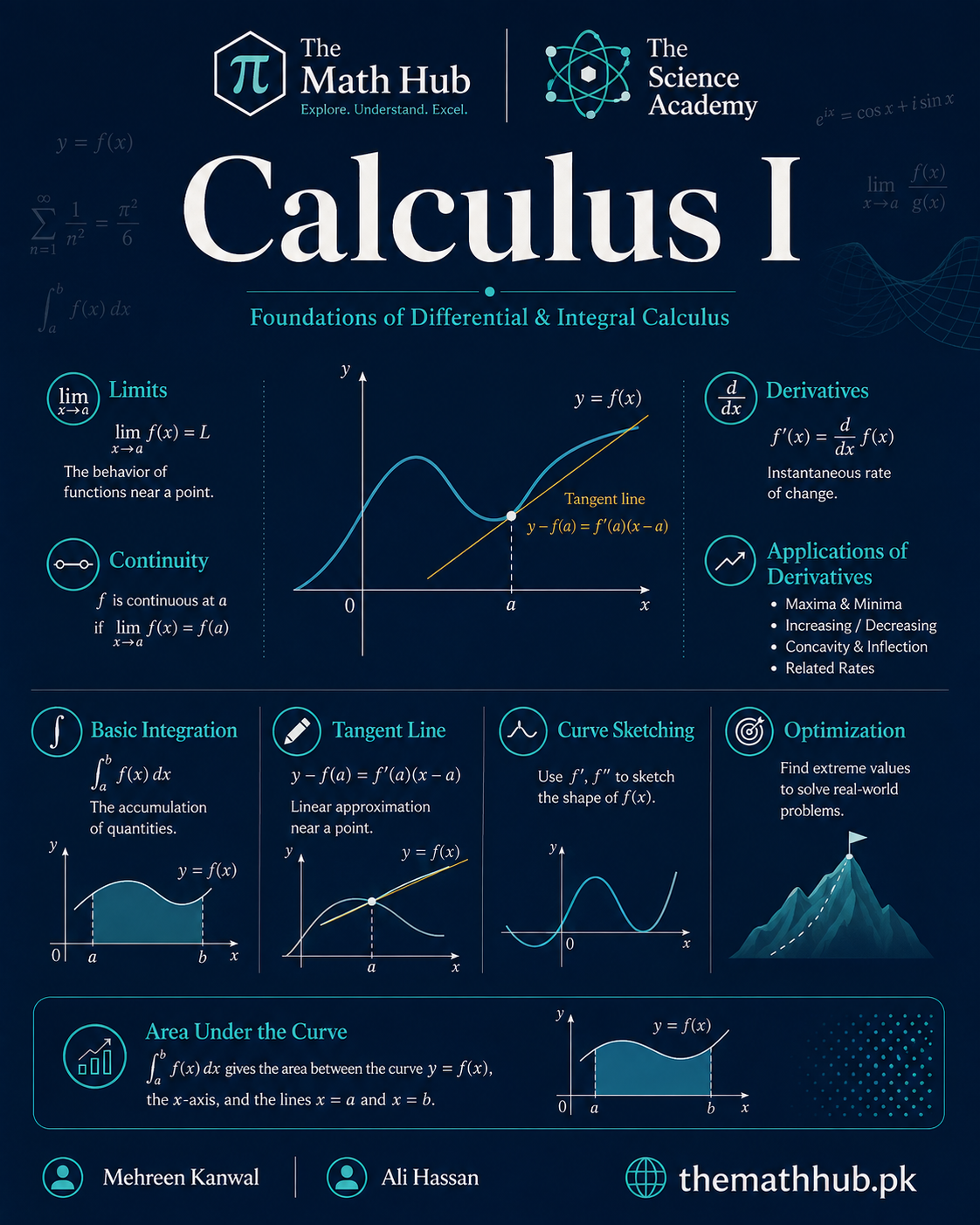
Calculus I builds the language of change and accumulation. Limits make instantaneous change precise, derivatives model rates and optimization, and integrals measure accumulated quantities, area and volume. These ideas support later analysis, differential equations, physics, engineering, computing, economics and data science.
Also known as: Calculus 1 · Calculus-I · Single Variable Calculus · Differential and Integral Calculus · Calculus and Analytical Geometry. Exact titles, codes, semester placement and topic boundaries vary by university and programme.
Open the complete Calculus I resourceView / Download PDFBackup Access
Purpose and relevance
Why do we study Calculus I?
Calculus I builds the language of change and accumulation. Limits make instantaneous change precise, derivatives model rates and optimization, and integrals measure accumulated quantities, area and volume. These ideas support later analysis, differential equations, physics, engineering, computing, economics and data science.
Who should use these notes?
- BS Mathematics and AD / ADP Mathematics students
- BSc Mathematics learners and university-affiliated degree-college students
- Physics, engineering, computing and other quantitative-programme learners
- Students preparing for midterms, finals or foundation revision
Learning outcomes
What students will learn
The course develops conceptual understanding, symbolic fluency, graphical reasoning, modelling and university-level problem solving.
Evaluate limits and determine continuity
Differentiate algebraic, trigonometric, exponential and logarithmic functions
Apply derivatives to motion, related rates, optimization and curve sketching
Interpret definite integrals and use the Fundamental Theorem of Calculus
Model area, volume, work, average value and other accumulated quantities
Complete course contents
Calculus I chapter-by-chapter notes
Open each chapter to review its purpose and complete topic coverage.
Chapter 01Functions and Graphs
Builds the function language needed throughout calculus and connects symbolic rules with graphical behaviour.
Topics covered
- Relations, functions, domain, codomain and range
- One-to-one, onto and inverse functions
- Composite, piecewise and absolute-value functions
- Polynomial, rational, algebraic, trigonometric, exponential and logarithmic functions
- Transformations, symmetry, intercepts and graph interpretation
Why this chapter matters: Builds the function language needed throughout calculus and connects symbolic rules with graphical behaviour. Use the notes to connect definitions and formulas with worked examples, graphical meaning and practice exercises.
Chapter 02Limits and Continuity
Introduces the limiting process that defines derivatives, integrals and rigorous local behaviour.
Topics covered
- Finite, one-sided, infinite and limits at infinity
- Limit laws, factoring, rationalisation and the Squeeze Theorem
- Vertical and horizontal asymptotes
- Epsilon–delta meaning of a limit
- Continuity at a point and on an interval
- Removable, jump and infinite discontinuities
- Intermediate Value Theorem
Why this chapter matters: Introduces the limiting process that defines derivatives, integrals and rigorous local behaviour. Use the notes to connect definitions and formulas with worked examples, graphical meaning and practice exercises.
Chapter 03Derivatives
Develops the derivative as a limit, slope and instantaneous rate of change, then builds an efficient differentiation toolkit.
Topics covered
- Difference quotient and first principles
- Power, product, quotient and chain rules
- Trigonometric, exponential and logarithmic derivatives
- Implicit and logarithmic differentiation
- Higher-order derivatives
- Velocity, acceleration, related rates and linearisation
Why this chapter matters: Develops the derivative as a limit, slope and instantaneous rate of change, then builds an efficient differentiation toolkit. Use the notes to connect definitions and formulas with worked examples, graphical meaning and practice exercises.
Chapter 04Applications of Derivatives
Uses first and second derivatives to explain shape, change and optimal decisions.
Topics covered
- Critical numbers and absolute/local extrema
- Rolle’s and Mean Value Theorems
- Increasing/decreasing intervals
- Concavity and inflection points
- First and second derivative tests
- Curve sketching, L’Hôpital’s Rule, optimization and Newton’s Method
Why this chapter matters: Uses first and second derivatives to explain shape, change and optimal decisions. Use the notes to connect definitions and formulas with worked examples, graphical meaning and practice exercises.
Chapter 05Integrals and the Fundamental Theorem
Connects antiderivatives with accumulated change and explains why differentiation and integration are inverse processes.
Topics covered
- Antiderivatives and indefinite integrals
- Definite integral and signed area
- Riemann sums and sigma notation
- Fundamental Theorem of Calculus
- Net Change Theorem
- u-substitution and basic numerical interpretation
Why this chapter matters: Connects antiderivatives with accumulated change and explains why differentiation and integration are inverse processes. Use the notes to connect definitions and formulas with worked examples, graphical meaning and practice exercises.
Chapter 06Applications of Definite Integrals
Turns integral models into geometric and physical quantities.
Topics covered
- Area under and between curves
- Average value of a function
- Volumes by slicing, disks, washers and shells
- Arc length and surfaces of revolution
- Work and fluid force
- Centroids, moments and centre of mass
Why this chapter matters: Turns integral models into geometric and physical quantities. Use the notes to connect definitions and formulas with worked examples, graphical meaning and practice exercises.
Get the complete Calculus I bookView / Download PDFBackup Access
Learning journey
How the ideas progress
Functions→Limits→Continuity→Derivatives→Derivative Applications→Antiderivatives→Definite Integrals→Fundamental Theorem→Integration Applications
Study decisions
How to study and prepare
Start with definitions and visual meaning, reproduce worked examples without looking, then solve mixed exercises. For a midterm or final, classify each problem before choosing a method and write the conditions that justify the method.
Important questions and practice
- Relations, functions, domain, codomain and range
- One-to-one, onto and inverse functions
- Composite, piecewise and absolute-value functions
- Polynomial, rational, algebraic, trigonometric, exponential and logarithmic functions
- Transformations, symmetry, intercepts and graph interpretation
- Finite, one-sided, infinite and limits at infinity
- Limit laws, factoring, rationalisation and the Squeeze Theorem
- Vertical and horizontal asymptotes
- Epsilon–delta meaning of a limit
- Continuity at a point and on an interval
The resource supports conceptual questions, short questions, long problems, review and university exam preparation. It does not claim unavailable past papers or unsupported answer keys.
Skills developed
From technique to modelling
- Mathematical notation and logical reasoning
- Algebraic and graphical interpretation
- Method selection and multi-step problem solving
- Approximation, estimation and error awareness
- Quantitative modelling for mathematics, physics, engineering and computing
Pakistan university relevance
Programme and institutional context
Calculus course titles, codes, semester placement and topic boundaries vary by university and programme. Students should compare this resource with their current departmental scheme of studies.
Punjab public universities and institutions
University of the PunjabGovernment College University LahoreUniversity of EducationUniversity of Engineering and Technology LahoreLahore College for Women UniversityInformation Technology UniversityUniversity of Home EconomicsThe Islamia University of BahawalpurGovernment Sadiq College Women UniversityThal University BhakkarGhazi UniversityGovernment College University FaisalabadGovernment College Women University FaisalabadUniversity of GujratUniversity of JhangUniversity of KamaliaUniversity of LayyahBahauddin Zakariya UniversityThe Women University MultanMuhammad Nawaz Sharif University of Engineering and TechnologyEmerson University MultanBaba Guru Nanak UniversityUniversity of NarowalUniversity of OkaraKhwaja Fareed University of Engineering and Information TechnologyFatima Jinnah Women UniversityRawalpindi Women UniversityUniversity of ChakwalKohsar University MurreeUniversity of SargodhaUniversity of MianwaliUniversity of SahiwalGovernment College Women University SialkotUniversity of Engineering and Technology Taxila
Punjab private / non-public institutions
The University of FaisalabadGIFT UniversityUniversity of ChenabUniversity of SialkotGrand Asian UniversitySuperior UniversityAli Institute of EducationQarshi UniversityMinhaj UniversityForman Christian CollegeUniversity of Central PunjabLahore School of EconomicsInstitute of Management and SciencesUniversity of Management and TechnologyNational College of Business Administration and EconomicsImperial CollegeUniversity of LahoreLahore Leads UniversityBeaconhouse National UniversityHajvery UniversityUniversity of South AsiaLahore Institute of Science and TechnologyLahore Garrison UniversityNUR International UniversityGreen International UniversityRashid Latif Khan UniversityInstitute of Southern PunjabTIMES Institute / TIMES UniversityMultan University of Science and TechnologyNamal UniversitySouth Punjab Institute of Science and TechnologyGhazi National Institute of Engineering and SciencesHITEC UniversityUniversity of Wah
Course-name examples and important distinction
Relevant researched course naming includes Calculus-I/II/III, Single Variable Calculus, Calculus and Analytical Geometry, Multivariable Calculus and Vector Calculus at institutions such as the University of the Punjab, University of Sargodha, University of Gujrat, UCP, UMT, GCUF, COMSATS, IUB, Virtual University and UET Taxila.
These examples establish subject relevance, not an exact universal syllabus. In particular, Virtual University MTH301 uses a different content model from this traditional Calculus II resource.
University-affiliated and degree-college students
These notes may support learners in degree colleges across Punjab, including Faisalabad, Gujranwala, Gujrat, Jhang, Lahore, Mianwali, Multan, Rawalpindi, Sahiwal, Sargodha, Sialkot and other districts. They do not imply that every college offers the same course.
ADP and BS learners can use the full sequence; legacy BSc learners can connect it with Calculus and Analytic Geometry, while MSc learners should use it as foundation and vector-calculus revision.
Recommended references
International and Pakistani calculus books
Thomas’ Calculus — 15th Edition
Authors: Joel R. Hass, Christopher E. Heil, Przemyslaw Bogacki and Maurice D. Weir
Useful for: Complete university calculus sequence and rigorous worked examples.
Official book page ↗Calculus / Calculus: Early Transcendentals — 9th Edition
Authors: James Stewart, Daniel K. Clegg and Saleem Watson
Useful for: Conceptual explanations, modelling and extensive practice.
Official book page ↗Calculus — 12th Edition
Authors: Howard Anton, Irl C. Bivens and Stephen Davis
Useful for: Clear methods and a broad range of applications.
Official book page ↗Calculus — 12th Edition
Authors: Ron Larson and Bruce H. Edwards
Useful for: Structured examples and problem practice.
Official book page ↗Calculus & Its Applications — 15th Edition
Authors: Larry J. Goldstein, David C. Lay, David I. Schneider, Nakhle H. Asmar and William E. Tavernetti
Useful for: Applied calculus and quantitative modelling.
Official book page ↗Pakistani / local references
- S. M. Yusuf and Muhammad Amin: Calculus with Analytic Geometry
- Zia Ul Haq: Calculus and Analytical Geometry
No pirated commercial-book PDFs are offered.
Free & legal learning resources
- OpenStax Calculus Volume 1 — Gilbert Strang and Edwin “Jed” Herman
- OpenStax Calculus Volume 2 — Gilbert Strang and Edwin “Jed” Herman
- OpenStax Calculus Volume 3 — Gilbert Strang and Edwin “Jed” Herman
Other useful legal learning resources include MIT OpenCourseWare, Khan Academy, Paul’s Online Math Notes, Mathematics LibreTexts, UBC CLP, Active Calculus, Whitman Calculus, Michael Corral Vector Calculus and Math Insight.
Student questions
Calculus I FAQs
What is Calculus I?
Calculus I is the first university course in single-variable calculus, covering functions, limits, continuity, derivatives, integrals and their applications.
Is Calculus I the same as Single Variable Calculus?
It is a common name for the foundational part of single-variable calculus, although exact titles and boundaries vary by institution.
Do I need previous calculus knowledge?
No. Strong algebra, functions, graphs and trigonometry are the main preparation.
What is a limit?
A limit describes the value a function approaches as its input approaches a point or grows without bound.
What does continuity mean?
A function is continuous at a point when it is defined there, its limit exists there, and the limit equals the function value.
What is a derivative?
A derivative measures instantaneous rate of change and the slope of a tangent line.
When is the Chain Rule used?
It differentiates composite functions by multiplying the outer derivative by the inner derivative.
What are critical points?
They are domain points where the derivative is zero or does not exist and are candidates for extrema.
What is the Fundamental Theorem of Calculus?
It connects definite integration and differentiation, allowing accumulated change to be evaluated using antiderivatives.
Definite versus indefinite integral?
An indefinite integral is a family of antiderivatives; a definite integral is a number representing signed accumulation over an interval.
How is area between curves found?
Integrate the upper function minus the lower function, splitting the interval when their order changes.
Which volume method should I use?
Choose disks/washers for slices perpendicular to the axis and shells for slices parallel to it.
Are solved examples and exercises included?
Yes. The complete notes are structured around theory, formulas, worked examples and practice material.
Are these official university notes?
No. They are independent The Math Hub resources; compare topics with your current departmental scheme.
What comes after Calculus I?
Calculus II normally develops advanced integration, sequences, series, parametric equations and polar calculus.
Study the complete Calculus I notesView / Download PDFBackup Access