Yes — this is the current Punjab Board Class 12 / 2nd Year Mathematics area for the new 2026–27 PECTAA course. It covers the verified 11-unit structure, with notes, solutions, PDFs where available and connected online MCQ practice.
Punjab Boards Covered
These 2nd Year / Class 12 Mathematics resources follow the current Punjab / PECTAA 11-unit structure for FSc Part-II, ICS Part-II and HSSC-II students across Punjab BISE boards including Lahore, Gujranwala, Faisalabad, Multan, Rawalpindi, Sargodha, Bahawalpur, D.G. Khan and Sahiwal. Students can use the available current-book unit resources, PDF notes, mathematics solutions, online MCQs, objective mock tests and complete-book resources already published on The Math Hub.
This is the dedicated Punjab / PECTAA Class 12 Mathematics page for Second Year / FSc Part-II / ICS Part-II / HSSC-II, presenting the current 11-unit structure and any genuine resources attached to it.
Current / New Mathematics Book & Syllabus
This page follows the existing verified Punjab / PECTAA Class 12 Mathematics structure with 11 separately labelled units. The current textbook structure, notes, solutions and practice destinations remain separate from unrelated board or older-book sequences.
Study Second Year Mathematics: notes → solutions → practice
Use the exact current The Math Hub routes below. Board-specific MCQ or Mock Test links are shown only where a corresponding live destination exists.
Current 2nd Year unit structure
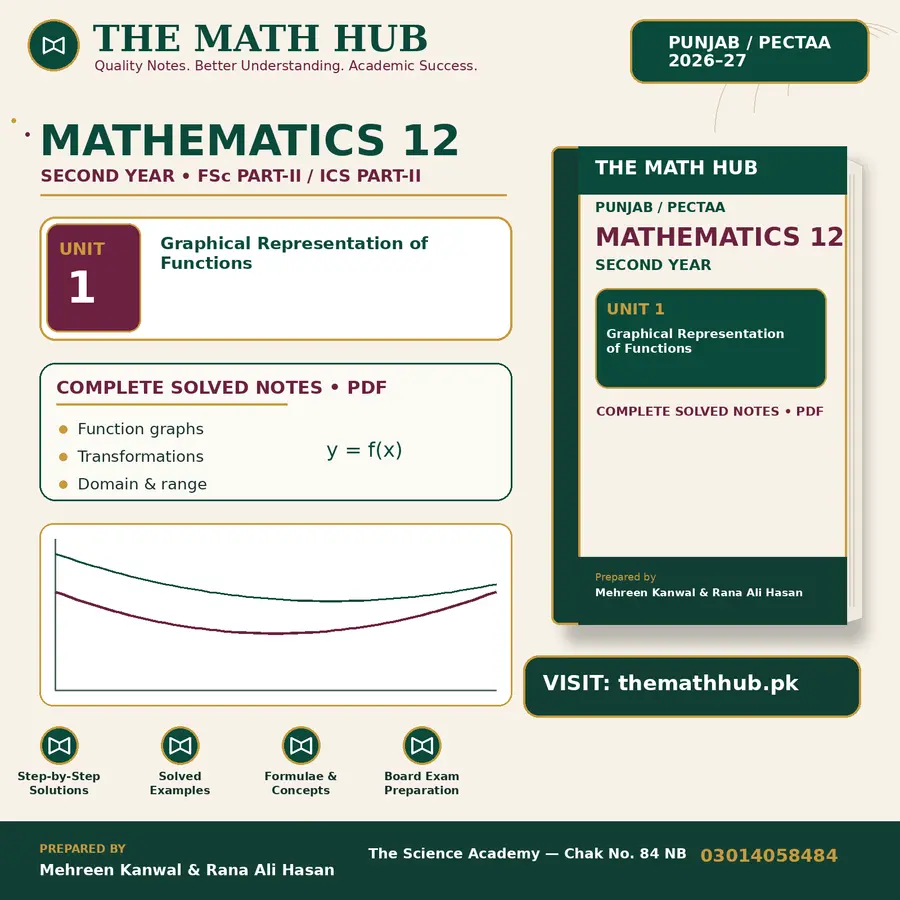
Read, transform and analyse functions through equations, graphs, domains and ranges.
Exercise and question index
Unit 01 — Graphical Representation of Functions
Use the published notes for the worked material available in this unit. The current textbook remains the authority for exercise numbering.
In this R2 index, sub-parts stay grouped under their printed main-question number.
These exercise rows are attached to this unit card as crawlable HTML. Each row gives the supplied exercise label and a concise study/method synopsis.
Exercise 1.1 — Graphical Representation of Functions
Practise sketching and interpreting function graphs, including quadratic curves, transformations, domain and range.
Exercise 1.2 — Graphical Representation of Functions
Use graph features and transformations to analyse algebraic, exponential, logarithmic and hyperbolic functions.
Exercise 1.3 — Graphical Representation of Functions
Read graph behaviour and apply inverse-function, domain-range and transformation methods where required.
Exercise 1.4 — Graphical Representation of Functions
Interpret graphs of exponential and logarithmic relationships while respecting admissible domains and ranges.
Exercise 1.5 — Graphical Representation of Functions
Apply graphical reasoning to function models and explain intercepts, shape, asymptotic behaviour and real-life meaning.
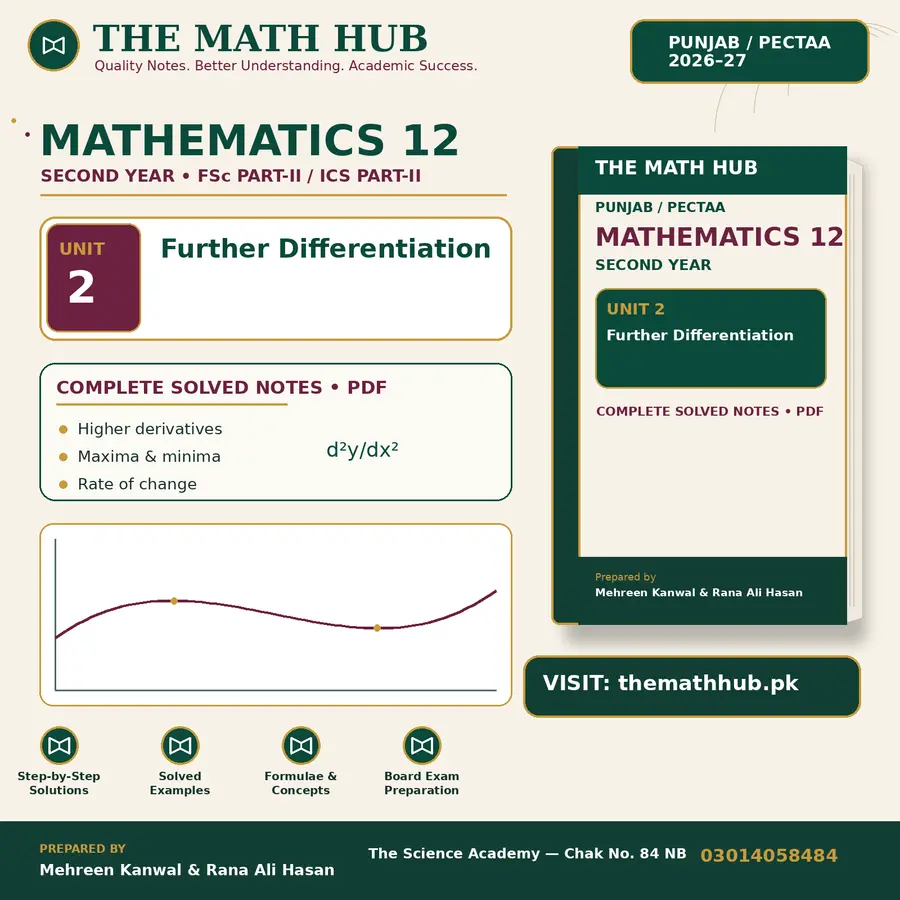
Use derivatives to describe rate of change, tangents, extrema and mathematical models.
Exercise and question index
Unit 02 — Further Differentiation
Use the published notes for the worked material available in this unit. The current textbook remains the authority for exercise numbering.
In this R2 index, sub-parts stay grouped under their printed main-question number.
These exercise rows are attached to this unit card as crawlable HTML. Each row gives the supplied exercise label and a concise study/method synopsis.
Exercise 2.1 — Trigonometric, Chain, Parametric and Implicit Differentiation
Differentiate trigonometric, composite, parametric and implicitly defined functions using the appropriate rules.
Exercise 2.2 — Exponential and Logarithmic Differentiation
Find derivatives of exponential, logarithmic and variable-base expressions with chain and logarithmic differentiation.
Exercise 2.3 — Tangents, Normals and Higher Derivatives
Use gradients to form tangent and normal equations and calculate second or higher derivatives.
Exercise 2.4 — Increasing/Decreasing Functions and Extrema
Use critical points and derivative signs to determine increasing or decreasing intervals and local extrema.
Exercise 2.5 — Local Linear Approximation
Approximate nearby function values with tangent-line linearisation and assess the quality of the estimate.
Exercise 2.6 — Differentials, Approximate Change and Error
Use differentials to estimate changes, propagated error and measurement-based approximations.
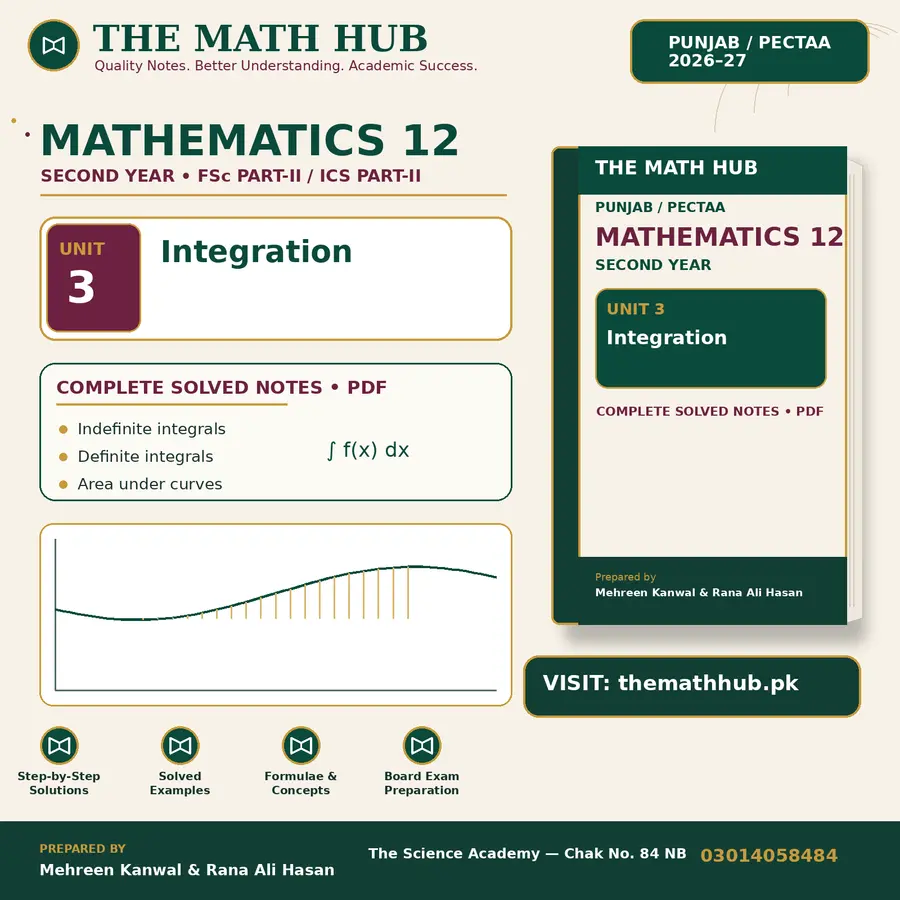
Use antiderivatives, definite integrals and area or accumulation interpretations.
Exercise and question index
Unit 03 — Integration
Use the published notes for the worked material available in this unit. The current textbook remains the authority for exercise numbering.
In this R2 index, sub-parts stay grouped under their printed main-question number.
These exercise rows are attached to this unit card as crawlable HTML. Each row gives the supplied exercise label and a concise study/method synopsis.
Exercise 3.1 — Basic Antiderivatives and Standard Integrals
Find antiderivatives from standard integral forms and verify the constant of integration.
Exercise 3.2 — Method of Substitution or Change of Variable
Simplify integrals by selecting a suitable inner expression and changing the variable systematically.
Exercise 3.3 — Integration by Parts
Evaluate products and related integrals by selecting suitable factors and applying integration by parts.
Exercise 3.4 — Integration by Using Partial Fractions
Decompose rational functions into suitable fractions before integrating their algebraic components.
Exercise 3.5 — The Definite Integral
Evaluate definite integrals with limits and interpret accumulated signed area using the fundamental theorem.
Exercise 3.6 — Application of Definite Integrals: Area, Surplus and Volume
Set up definite integrals to calculate areas, surplus quantities and volumes generated by curves.
Exercise 3.7 — Applying Integration to Real-Life Problems
Translate rate, accumulation and modelling situations into integrals and interpret the resulting units.
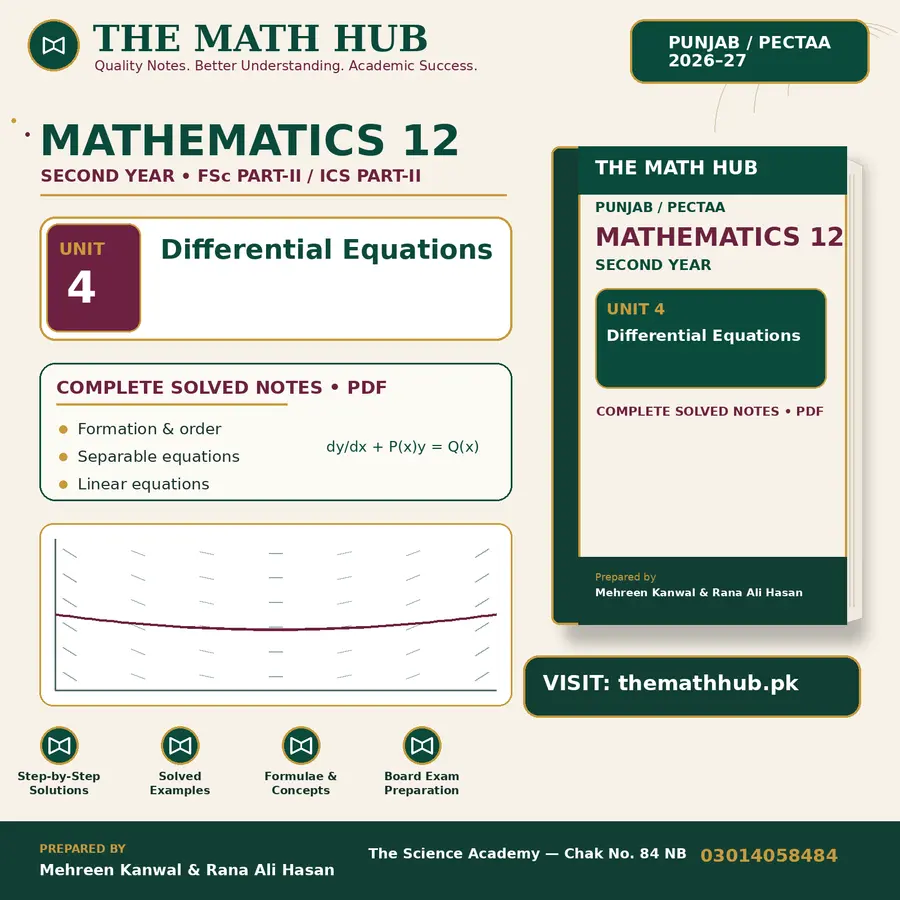
Model change with differential equations and study the methods appropriate to each equation type.
Exercise and question index
Unit 04 — Differential Equations
Use the published notes for the worked material available in this unit. The current textbook remains the authority for exercise numbering.
In this R2 index, sub-parts stay grouped under their printed main-question number.
These exercise rows are attached to this unit card as crawlable HTML. Each row gives the supplied exercise label and a concise study/method synopsis.
Exercise 4.1 — Order, Degree and Mathematical Models
Identify order and degree and form or interpret first-order differential-equation models.
Exercise 4.2 — Separable and Homogeneous Differential Equations
Solve separable and homogeneous first-order equations using substitutions, integration and suitable constants.
Exercise 4.3 — Applications of First Order Differential Equations in Real-Life Problems
Model growth, decay and other real-life situations with first-order differential equations and initial conditions.
Use coordinates and equations to reason about lines, curves and geometric loci.
Exercise and question index
Unit 05 — Analytical Geometry
Use the published notes for the worked material available in this unit. The current textbook remains the authority for exercise numbering.
In this R2 index, sub-parts stay grouped under their printed main-question number.
These exercise rows are attached to this unit card as crawlable HTML. Each row gives the supplied exercise label and a concise study/method synopsis.
Exercise 5.1 — Analytical Geometry exercise 5.1 — formula/line/triangle geometry focus; verify printed subtitle
Use coordinate formulas for lines, slopes, midpoints, triangles and related analytical-geometry conditions.
Exercise 5.2 — Analytical Geometry exercise 5.2 — verify printed subtitle
Apply analytical-geometry methods to the printed exercise subtitle, checking formulas, coordinates and geometric conditions.
Exercise 5.3 — Analytical Geometry exercise 5.3 — verify printed subtitle
Work through the printed subtitle with line, angle, area, concurrency or related coordinate methods as applicable.
Classify and analyse conic sections through their equations, geometry and standard forms.
Exercise and question index
Unit 06 — Conic Section
Use the published notes for the worked material available in this unit. The current textbook remains the authority for exercise numbering.
In this R2 index, sub-parts stay grouped under their printed main-question number.
These exercise rows are attached to this unit card as crawlable HTML. Each row gives the supplied exercise label and a concise study/method synopsis.
Exercise 6.1 — Conic Section exercise 6.1 — verify printed subtitle
Identify the relevant conic and use its standard equation and geometric parameters to solve the exercise.
Exercise 6.2 — Conic Section exercise 6.2 — verify printed subtitle
Apply the printed subtitle with standard forms, coordinate conditions and focus-directrix or tangent methods as applicable.
Exercise 6.3 — Conic Section exercise 6.3 — verify printed subtitle
Analyse the specified conic using vertices, foci, eccentricity, directrix or translated equations where required.
Exercise 6.4 — Conic Section exercise 6.4 — verify printed subtitle
Use conic-section geometry and standard-form algebra to interpret the printed exercise and obtain its parameters.
Exercise 6.5 — Conic Section exercise 6.5 — verify printed subtitle
Solve the printed conic problems by selecting the correct equation, parameter relationships and geometric interpretation.
Exercise 6.6 — Conic Section exercise 6.6 — verify printed subtitle
Apply conic models to the printed exercise context, checking symmetry, coordinates and standard parameters.
Translate one-dimensional motion into position, velocity and acceleration relationships.
Exercise and question index
Unit 07 — Kinematics of Motion in a Straight Line
Use the published notes for the worked material available in this unit. The current textbook remains the authority for exercise numbering.
In this R2 index, sub-parts stay grouped under their printed main-question number.
These exercise rows are attached to this unit card as crawlable HTML. Each row gives the supplied exercise label and a concise study/method synopsis.
Exercise 7.1 — Kinematics of Motion in a Straight Line — complete detailed exercise
Relate position, distance, displacement, speed, velocity and acceleration using derivatives, integration and piecewise motion analysis.
Approximate roots or solutions, keeping the method and its limitations visible.
Exercise and question index
Unit 08 — Numerical Solutions of Nonlinear Equations
Use the published notes for the worked material available in this unit. The current textbook remains the authority for exercise numbering.
In this R2 index, sub-parts stay grouped under their printed main-question number.
These exercise rows are attached to this unit card as crawlable HTML. Each row gives the supplied exercise label and a concise study/method synopsis.
Exercise 8.1 — Graphical Solution of Nonlinear Equations
Locate roots of nonlinear equations through graph intersections, sign changes and suitable bracketing intervals.
Exercise 8.2 — Bisection, Regula-Falsi and Newton-Raphson Methods
Approximate nonlinear roots with bisection, Regula-Falsi and Newton-Raphson iterations to the required accuracy.
Exercise 8.3 — Trapezoidal Rule
Approximate an integral or area by dividing the interval into subintervals and applying the trapezoidal rule.
Exercise 8.4 — Real-Life Applications of Nonlinear Equations
Form and solve nonlinear models for practical situations using root bracketing and iterative approximation.
Interpret trigonometric graphs, identities and equations across periodic domains.
Exercise and question index
Unit 09 — Inverse Trigonometric Functions
Use the published notes for the worked material available in this unit. The current textbook remains the authority for exercise numbering.
In this R2 index, sub-parts stay grouped under their printed main-question number.
These exercise rows are attached to this unit card as crawlable HTML. Each row gives the supplied exercise label and a concise study/method synopsis.
Exercise 9.1 — Principal Values, Domains and Basic Identities
Find principal inverse-trigonometric values and determine domains, ranges and identities using exact-value reasoning.
Exercise 9.2 — Sum and Difference Formulas for Inverse Trigonometric Functions
Apply inverse-trigonometric sum and difference formulas with principal-range and triangle-method checks.
Interpret trigonometric graphs, identities and equations across periodic domains.
Exercise and question index
Unit 10 — Solution of Trigonometric Equations
Use the published notes for the worked material available in this unit. The current textbook remains the authority for exercise numbering.
In this R2 index, sub-parts stay grouped under their printed main-question number.
These exercise rows are attached to this unit card as crawlable HTML. Each row gives the supplied exercise label and a concise study/method synopsis.
Exercise 10.1 — Solve the Trigonometric Equations
Solve trigonometric equations with identities, factoring or substitution and report principal or general solutions.
Exercise 10.2 — Graphical Solution of Trigonometric Equations
Solve trigonometric equations graphically by interpreting intersections, periods and domain restrictions.
Represent magnitude, direction, position and geometric relationships with vector methods.
Exercise and question index
Unit 11 — Vector Valued Functions
Use the published notes for the worked material available in this unit. The current textbook remains the authority for exercise numbering.
In this R2 index, sub-parts stay grouped under their printed main-question number.
These exercise rows are attached to this unit card as crawlable HTML. Each row gives the supplied exercise label and a concise study/method synopsis.
Exercise 11.1 — Vector-Valued Functions
Describe vector-valued functions, component domains and two- or three-dimensional paths parametrically.
Exercise 11.2 — First Derivatives of Vector-Valued Functions
Differentiate vector-valued functions component by component and interpret the resulting vector.
Exercise 11.3 — Velocity and Acceleration
Obtain velocity and acceleration from a vector-valued position function and interpret the motion.
Current textbook structure verified 18 August 2026. Smart/reduced exam guidance does not replace the full curriculum.
Published books, notes and solutions
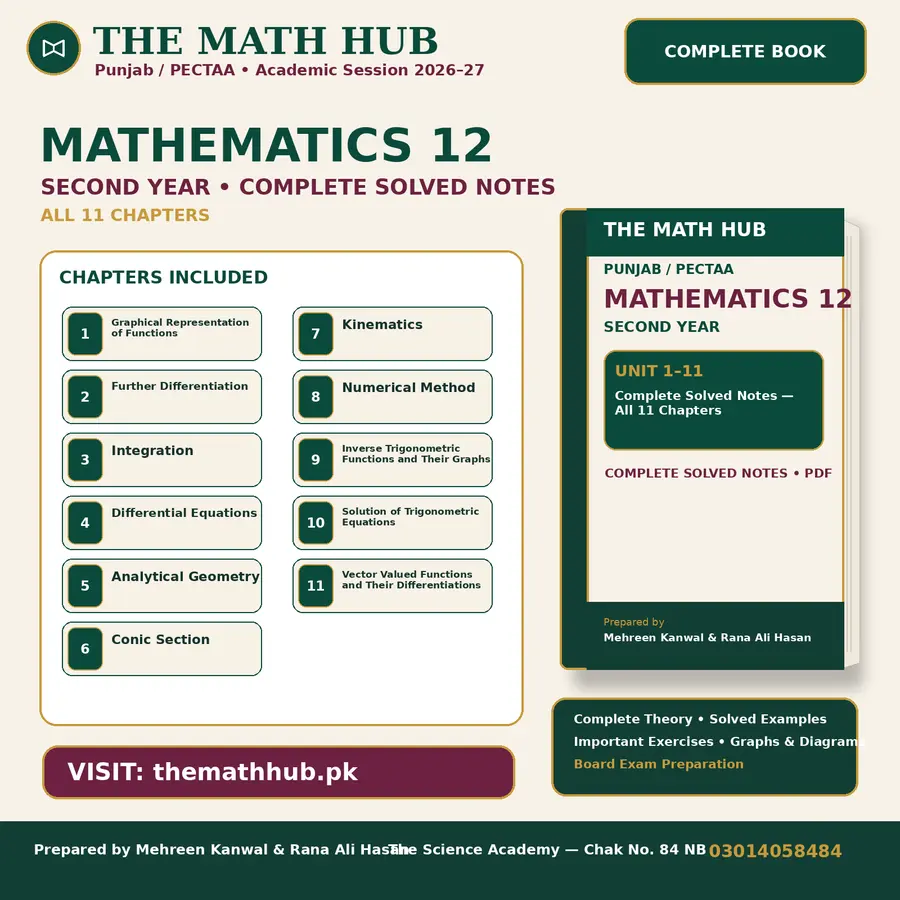
Complete Solved Notes Book — Units 1–11
Complete Solved Notes Book