11th Class Math Notes Punjab Board 2026
This is the Class 11 / 1st Year Punjab Mathematics page. It lists all 14 current units with crawlable titles, supplied posters and genuine resource links. Use View for online reading and Download PDF only where a download destination is available.
Punjab Boards Covered
These 1st Year / Class 11 Mathematics resources follow the current Punjab / PECTAA structure for FSc Part-I, ICS Part-I and HSSC-I students across Punjab BISE boards including Lahore, Gujranwala, Faisalabad, Multan, Rawalpindi, Sargodha, Bahawalpur, D.G. Khan and Sahiwal. Students can use the existing chapter-wise notes, PDF resources, mathematics solutions, online MCQ practice and objective mock-test resources available on The Math Hub.
This is the dedicated Punjab / PECTAA Class 11 Mathematics page for First Year / FSc Part-I / ICS Part-I / HSSC-I, presenting the current 14-unit structure and any genuine resources attached to it.
Current / New Mathematics Book & Syllabus
This page follows the existing verified Punjab / PECTAA Class 11 Mathematics structure with 14 separately labelled units. The current textbook structure, notes, solutions and practice destinations remain separate from unrelated board or older-book sequences.
Study First Year Mathematics: notes → solutions → practice
Use the exact current The Math Hub routes below. Board-specific MCQ or Mock Test links are shown only where a corresponding live destination exists.
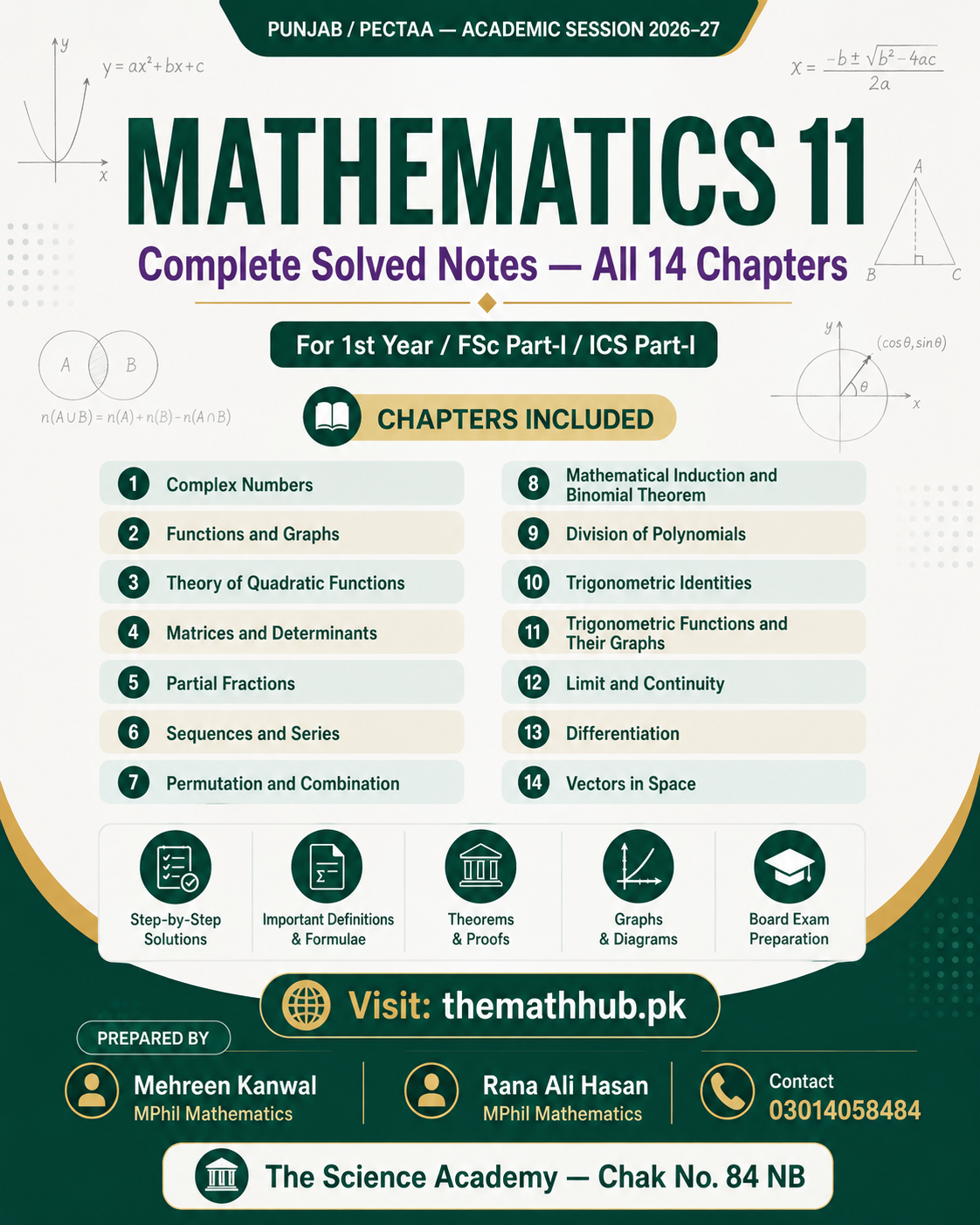
Current 1st Year unit structure
Represent and manipulate complex quantities, polar form and related algebraic ideas.
Exercise and question index
Use the published notes for the worked material available in this unit. The current textbook remains the authority for exercise numbering.
The exercise labels below identify the mathematical coverage of the supplied owner PDF without generating repeated placeholder descriptions for every question number.
Exercise 1.1 — Basic Operations, Conjugate and Modulus
Complex-number operations, real and imaginary parts, conjugates, modulus and multiplicative inverses.
Methods: complex-number algebra · conjugate method · modulus and inverse. The owner PDF contains 9 main questions under this exercise label.
Exercise 1.2 — Equality and Square Roots of Complex Numbers
Equality of complex numbers, comparison of components and square-root cases in a+ib form.
Methods: real/imaginary-part comparison · algebraic expansion · square-root method. The owner PDF contains 12 main questions under this exercise label.
Exercise 1.3 — Complex Polynomials as a Product of Linear Factors
Complex roots and polynomial factorisation, including conjugate roots and linear factors.
Methods: factor theorem · quadratic formula · linear-factor product. The owner PDF contains 8 main questions under this exercise label.
Exercise 1.4 — Roots of Unity
Powers and equations involving roots of unity, with reduction of exponents and factorisation.
Methods: roots-of-unity properties · exponent reduction · polynomial factorisation. The owner PDF contains 9 main questions under this exercise label.
Exercise 1.5 — Polar Form, Arguments, Loci and Applications
Polar representation, arguments, rectangular conversion, loci and applied complex-number models.
Methods: polar form · argument and quadrant analysis · locus interpretation. The owner PDF contains 22 main questions under this exercise label.
Read, transform and analyse functions through equations, graphs, domains and ranges.
Exercise and question index
Use the published notes for the worked material available in this unit. The current textbook remains the authority for exercise numbering.
The exercise labels below identify the mathematical coverage of the supplied owner PDF without generating repeated placeholder descriptions for every question number.
Exercise 2.1 — Functions, Domain, Range and Types of Functions
Function notation and evaluation, domains and ranges, and classification of one-one, onto and related functions.
Methods: function evaluation · domain/range analysis · function classification. The owner PDF contains 10 main questions under this exercise label.
Exercise 2.2 — Intersections and Graphs
Intersections, intercepts and graph construction or interpretation from equations and transformations.
Methods: simultaneous equations · intercept analysis · graph transformations. The owner PDF contains 5 main questions under this exercise label.
Connect quadratic equations and inequalities with roots, graphs, discriminants and algebraic structure.
Exercise and question index
Use the published notes for the worked material available in this unit. The current textbook remains the authority for exercise numbering.
The exercise labels below identify the mathematical coverage of the supplied owner PDF without generating repeated placeholder descriptions for every question number.
Exercise 3.1 — Quadratic Functions, Inverses and Absolute Values
Quadratic graphs and properties, inverse relations, absolute-value equations and inequalities.
Methods: completing the square · quadratic graph analysis · absolute-value cases. The owner PDF contains 4 main questions under this exercise label.
Exercise 3.2 — Quadratic Equations and Applications
Rational and quadratic equations together with algebraic and real-world applications.
Methods: LCM and denominator restrictions · factorisation · quadratic formula and applications. The owner PDF contains 7 main questions under this exercise label.
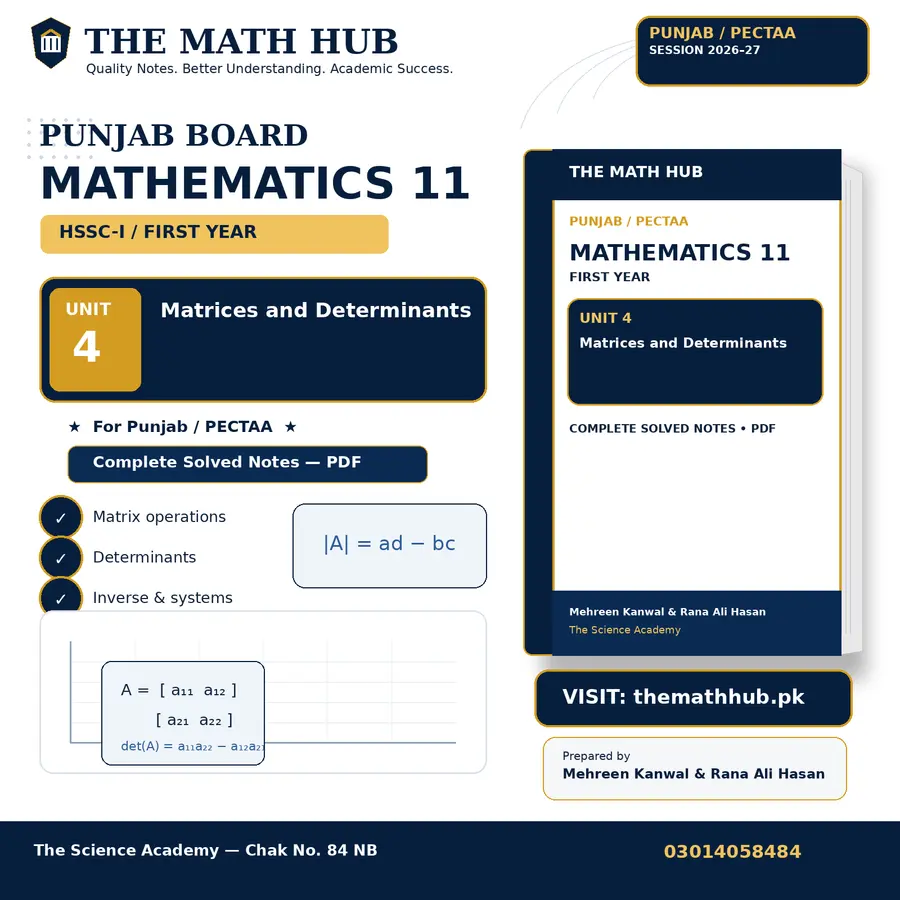
Use matrix operations and determinants to represent systems, transformations and algebraic relationships.
Exercise and question index
Use the published notes for the worked material available in this unit. The current textbook remains the authority for exercise numbering.
The exercise labels below identify the mathematical coverage of the supplied owner PDF without generating repeated placeholder descriptions for every question number.
Exercise 4.1 — Matrix Operations and Properties
Matrix notation, equality, addition, multiplication, transpose and core matrix properties.
Methods: matrix operations · transpose · matrix properties. The owner PDF contains 7 main questions under this exercise label.
Exercise 4.2 — Determinants, Cofactors and Inverse
Determinants, minors and cofactors, inverse matrices and determinant-based problem solving.
Methods: determinant expansion · minors and cofactors · matrix inverse. The owner PDF contains 10 main questions under this exercise label.
Exercise 4.3 — Easy Row Operations, Linear Systems and Transformations
Elementary row operations, rank, linear systems and matrix transformations using structured elimination.
Methods: row reduction · rank and RREF · Cramer’s rule and elimination. The owner PDF contains 11 main questions under this exercise label.
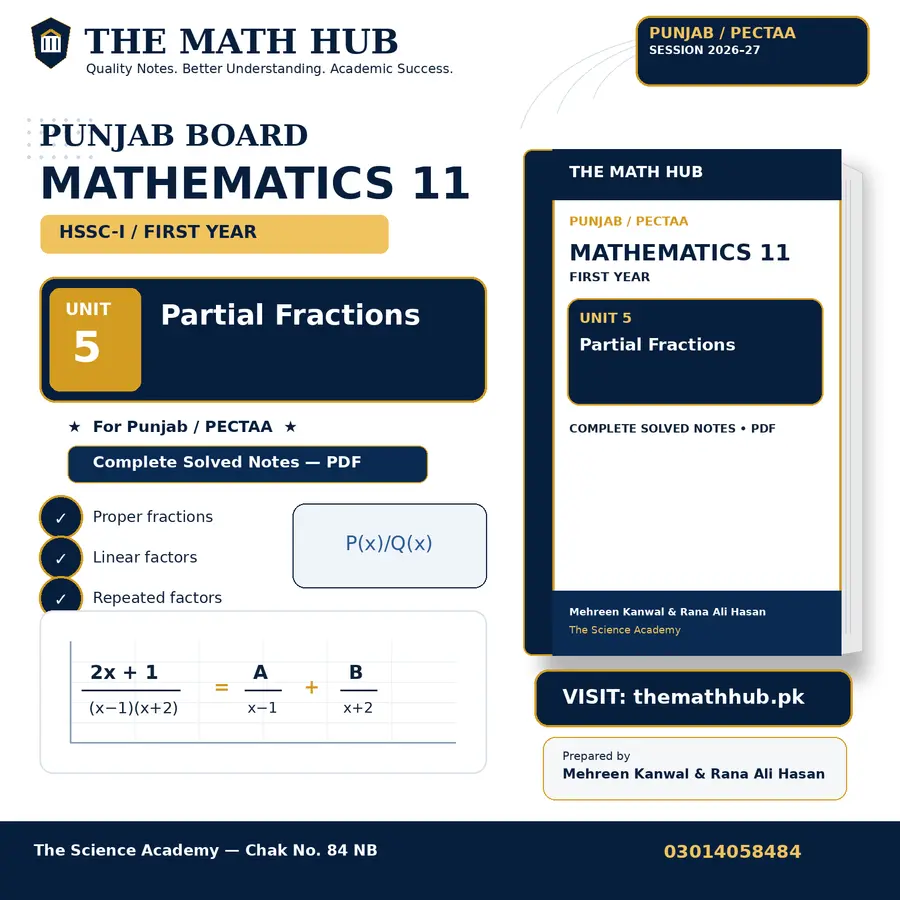
Decompose rational expressions into simpler terms that support integration and algebraic manipulation.
Exercise and question index
Use the published notes for the worked material available in this unit. The current textbook remains the authority for exercise numbering.
The exercise labels below identify the mathematical coverage of the supplied owner PDF without generating repeated placeholder descriptions for every question number.
Exercise 5.1 — Resolve into Partial Fractions
Decomposition of rational expressions with linear and repeated factors by coefficient comparison.
Methods: linear-factor decomposition · repeated-factor setup · coefficient comparison. The owner PDF contains 15 main questions under this exercise label.
Exercise 5.2 — Irreducible Quadratic Factors
Partial fractions containing irreducible quadratic factors and the algebra needed to determine constants.
Methods: irreducible-quadratic setup · coefficient comparison · algebraic simplification. The owner PDF contains 6 main questions under this exercise label.
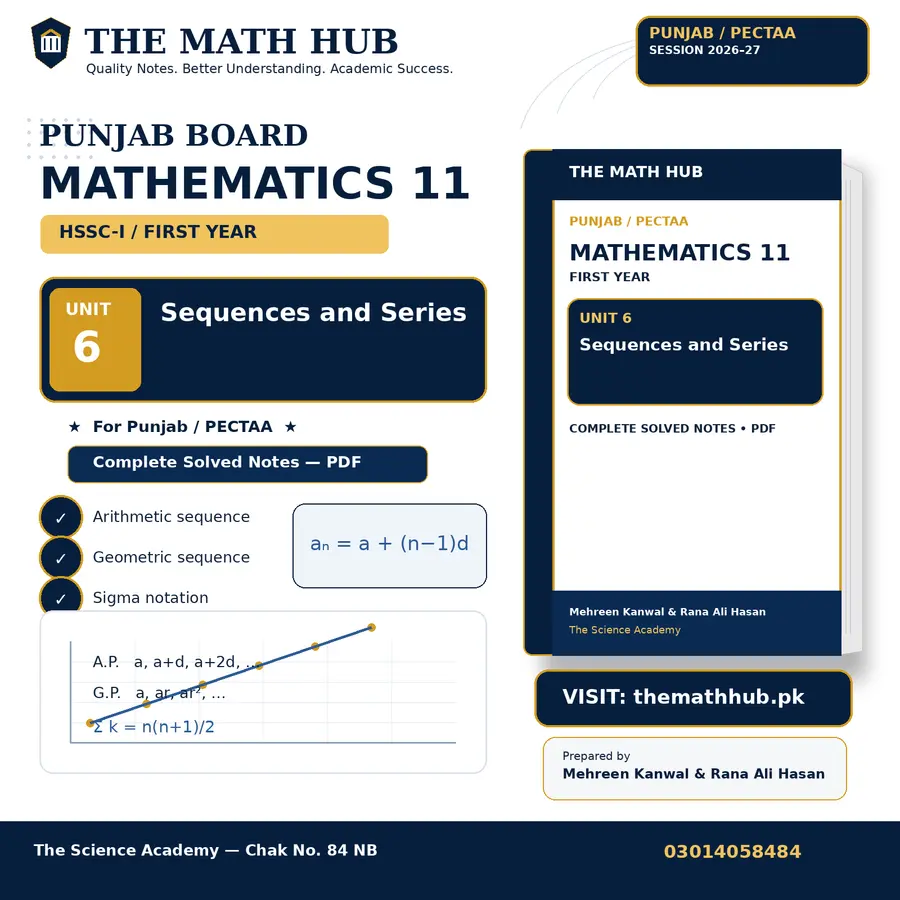
Study patterns, recurrence, convergence and summation through sequences and series.
Exercise and question index
Use the published notes for the worked material available in this unit. The current textbook remains the authority for exercise numbering.
The exercise labels below identify the mathematical coverage of the supplied owner PDF without generating repeated placeholder descriptions for every question number.
Exercise 6.1 — Sequences
Terms of sequences, patterns, nth-term descriptions and recursive relationships.
Methods: term-by-term pattern analysis · nth-term rules · recurrence reasoning. The owner PDF contains 4 main questions under this exercise label.
Exercise 6.2 — Arithmetic Progression
Arithmetic progressions, common differences and general-term calculations.
Methods: common difference · nth term of an AP · AP relationships. The owner PDF contains 23 main questions under this exercise label.
Exercise 6.3 — Arithmetic Means
Insertion and calculation of arithmetic means between given terms.
Methods: equal-step spacing · arithmetic-mean formula · AP construction. The owner PDF contains 7 main questions under this exercise label.
Exercise 6.4 — Sum of Arithmetic Series
Finite arithmetic series, sums of terms and applications of AP formulas.
Methods: sum of an AP · first/last-term pairing · series applications. The owner PDF contains 19 main questions under this exercise label.
Exercise 6.5 — Geometric Progression
Geometric progressions, common ratios and nth-term calculations.
Methods: common ratio · nth term of a GP · geometric relationships. The owner PDF contains 15 main questions under this exercise label.
Exercise 6.6 — Geometric Means
Geometric means and the equal-ratio structure between given terms.
Methods: geometric-mean formula · common-ratio construction · GP verification. The owner PDF contains 8 main questions under this exercise label.
Exercise 6.7 — Sum of Geometric Series
Finite and related geometric-series sums using the common ratio and number of terms.
Methods: finite GP sum · ratio powers · series simplification. The owner PDF contains 6 main questions under this exercise label.
Exercise 6.8 — Arithmetico-Geometric Series
Series whose terms combine arithmetic and geometric patterns, including sums to n terms.
Methods: arithmetico-geometric structure · shift-and-subtract summation · finite-series algebra. The owner PDF contains 11 main questions under this exercise label.
Exercise 6.9 — Harmonic Progression
Harmonic progressions, reciprocals and applications involving relationships between terms.
Methods: reciprocal sequence · HP relationships · algebraic equation solving. The owner PDF contains 18 main questions under this exercise label.
Exercise 6.10 — Sigma Notation and Standard Sums
Sigma notation, standard polynomial sums and expansion of summation expressions.
Methods: sigma notation · standard sums · summation expansion. The owner PDF contains 4 main questions under this exercise label.
Exercise 6.11 — Applications of Sequences and Series
Applied sequence and series models using growth, saving, instalment and repeated-pattern reasoning.
Methods: AP/GP modelling · finite sums · applied equation solving. The owner PDF contains 15 main questions under this exercise label.
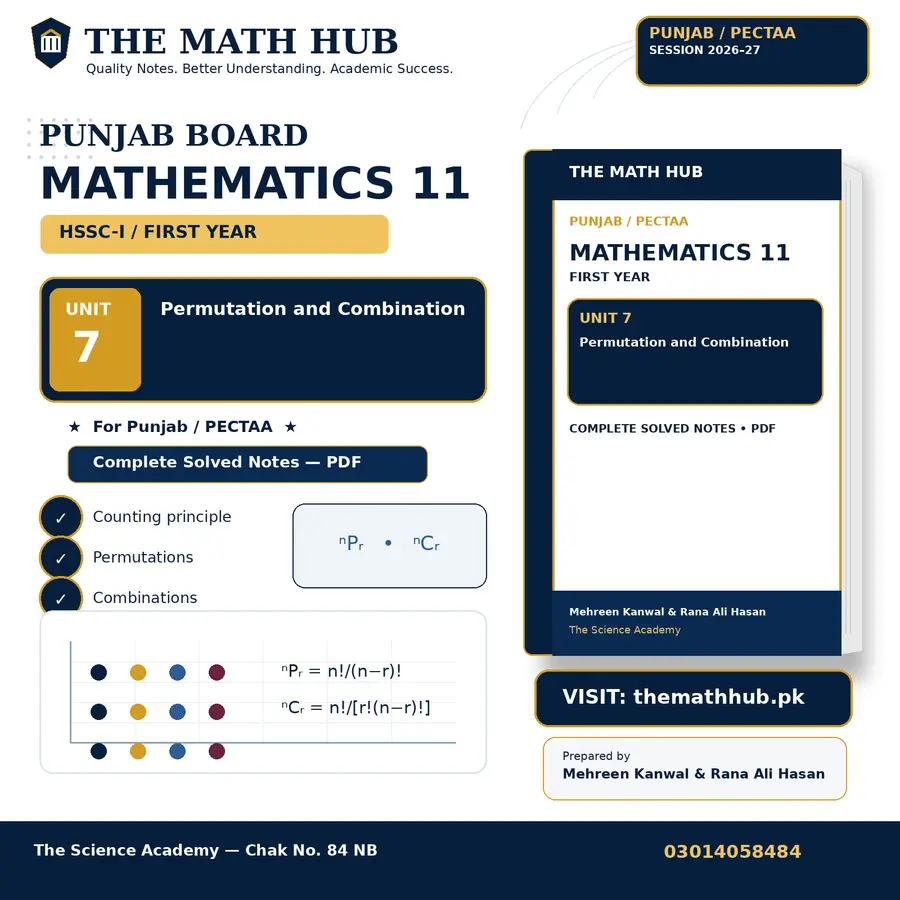
Count ordered and unordered arrangements and connect combinatorial reasoning to probability.
Exercise and question index
Use the published notes for the worked material available in this unit. The current textbook remains the authority for exercise numbering.
The exercise labels below identify the mathematical coverage of the supplied owner PDF without generating repeated placeholder descriptions for every question number.
Exercise 7.1 — Factorials and the Fundamental Principle of Counting
Factorial notation and the multiplication principle as foundations for counting arrangements.
Methods: factorial cancellation · fundamental counting principle · factorial equations. The owner PDF contains 7 main questions under this exercise label.
Exercise 7.2 — Permutations of Distinct Objects
Ordered arrangements of distinct objects, digits, signals, books and people under stated restrictions.
Methods: permutation formula · arrangement restrictions · digit and signal counting. The owner PDF contains 15 main questions under this exercise label.
Exercise 7.3 — Repeated Objects and Circular Permutations
Arrangements with repeated objects and circular or necklace-style permutation problems.
Methods: repeated-object formula · circular permutations · restricted arrangements. The owner PDF contains 14 main questions under this exercise label.
Exercise 7.4 — Combinations and Selection Problems
Unordered selections, committee and team formation, card choices and combinatorial applications.
Methods: combination formula · selection by cases · committee and probability-style counting. The owner PDF contains 20 main questions under this exercise label.
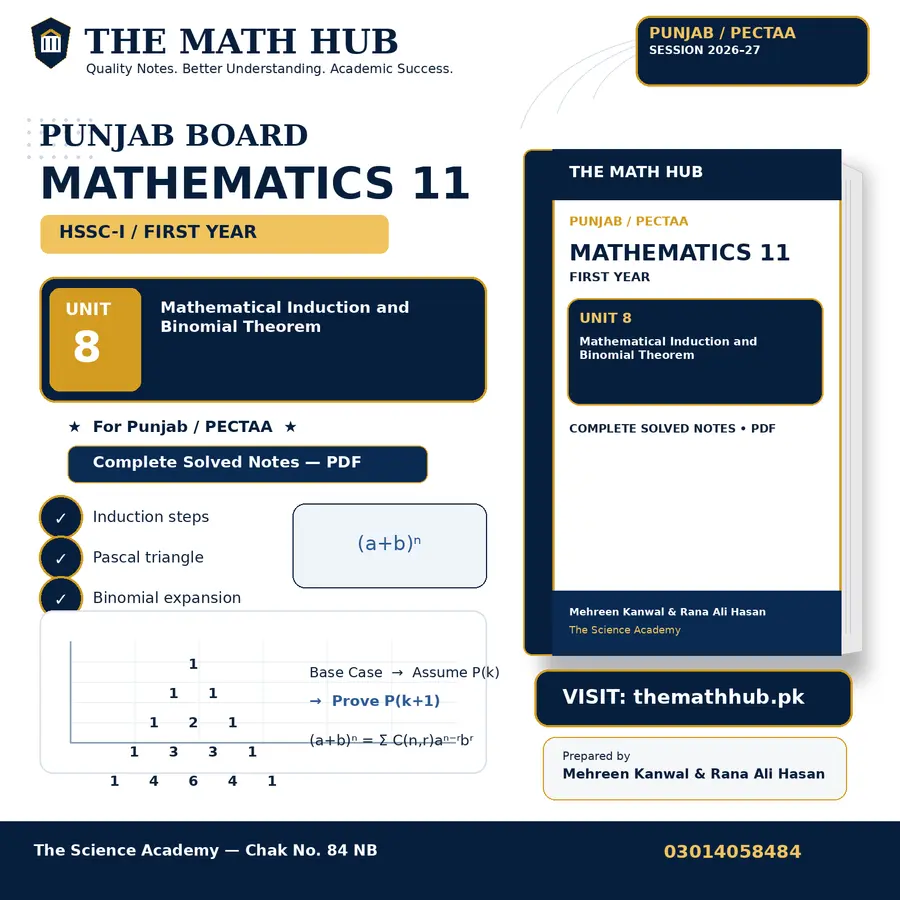
Use mathematical induction and binomial expansions to prove and organise algebraic results.
Exercise and question index
Use the published notes for the worked material available in this unit. The current textbook remains the authority for exercise numbering.
The exercise labels below identify the mathematical coverage of the supplied owner PDF without generating repeated placeholder descriptions for every question number.
Exercise 8.1 — Mathematical Induction
Base cases, induction hypotheses and induction steps for algebraic identities, inequalities and applications.
Methods: base case · induction hypothesis · induction step. The owner PDF contains 11 main questions under this exercise label.
Exercise 8.2 — Binomial Theorem
Binomial expansion, general terms, coefficients, middle terms and terms independent of a variable.
Methods: binomial expansion · general-term formula · coefficient and middle-term analysis. The owner PDF contains 10 main questions under this exercise label.
Exercise 8.3 — Binomial Approximations and Coefficients
Finite binomial expansions, coefficients and approximations when higher powers are negligible.
Methods: binomial expansion · coefficient extraction · small-quantity approximation. The owner PDF contains 10 main questions under this exercise label.
Exercise 8.4 — Divisibility, Remainders and Applications
Unit digits, remainders, divisibility proofs and numerical or growth applications using binomial ideas.
Methods: binomial remainder method · divisibility proof · periodic digit reasoning. The owner PDF contains 9 main questions under this exercise label.
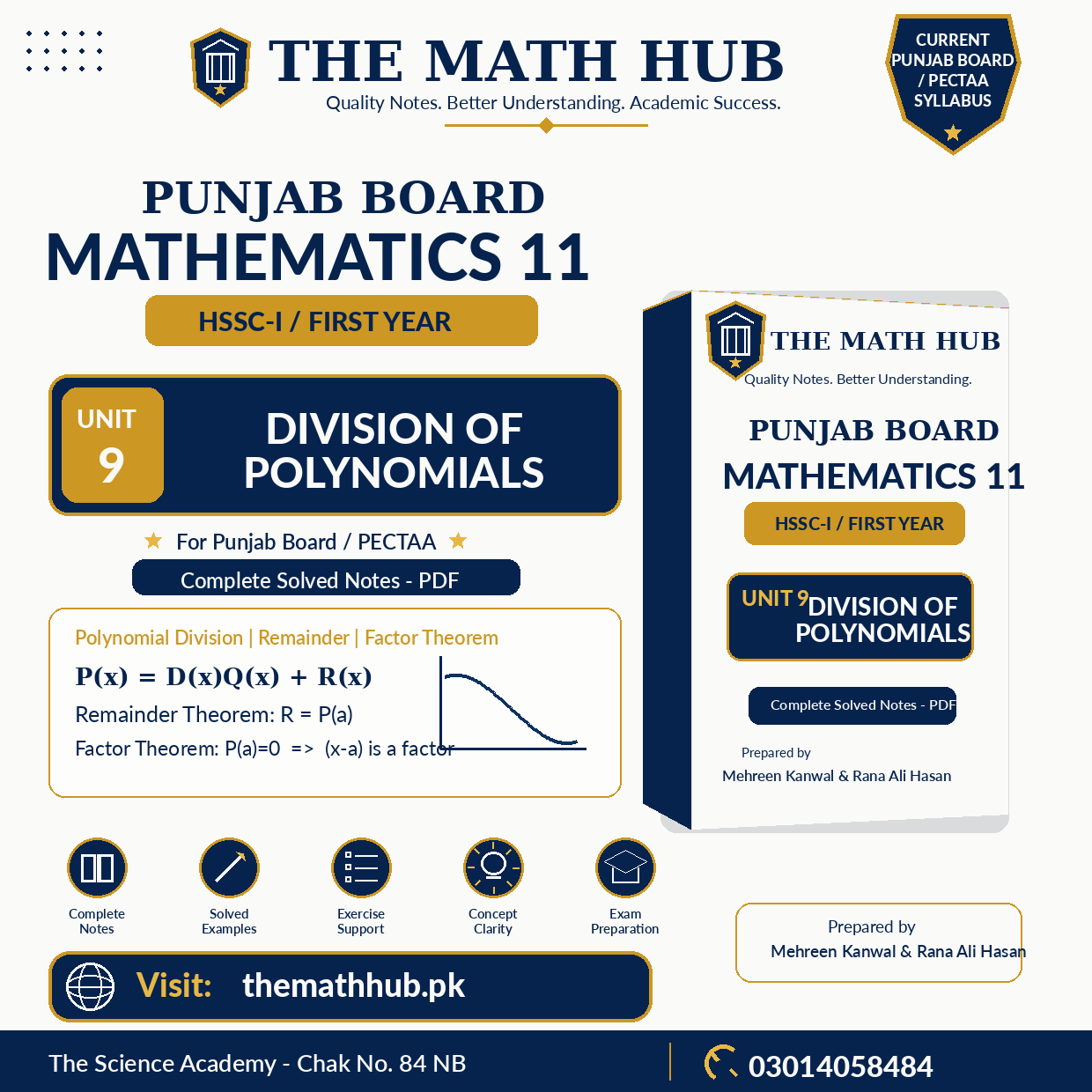
Analyse polynomial division, factors, remainders and algebraic equations.
Exercise and question index
Use the published notes for the worked material available in this unit. The current textbook remains the authority for exercise numbering.
The exercise labels below identify the mathematical coverage of the supplied owner PDF without generating repeated placeholder descriptions for every question number.
Exercise 9.1 — Division of Polynomials
Polynomial division, quotient and remainder, and factor or remainder tests for algebraic expressions.
Methods: polynomial division algorithm · remainder theorem · factor theorem and synthetic division. The owner PDF contains 10 main questions under this exercise label.
Exercise 9.2 — Division of Polynomials: Applied Models
Applied polynomial models checked through factor, remainder and division relationships.
Methods: factor/remainder testing · polynomial modelling · synthetic division. The owner PDF contains 7 main questions under this exercise label.
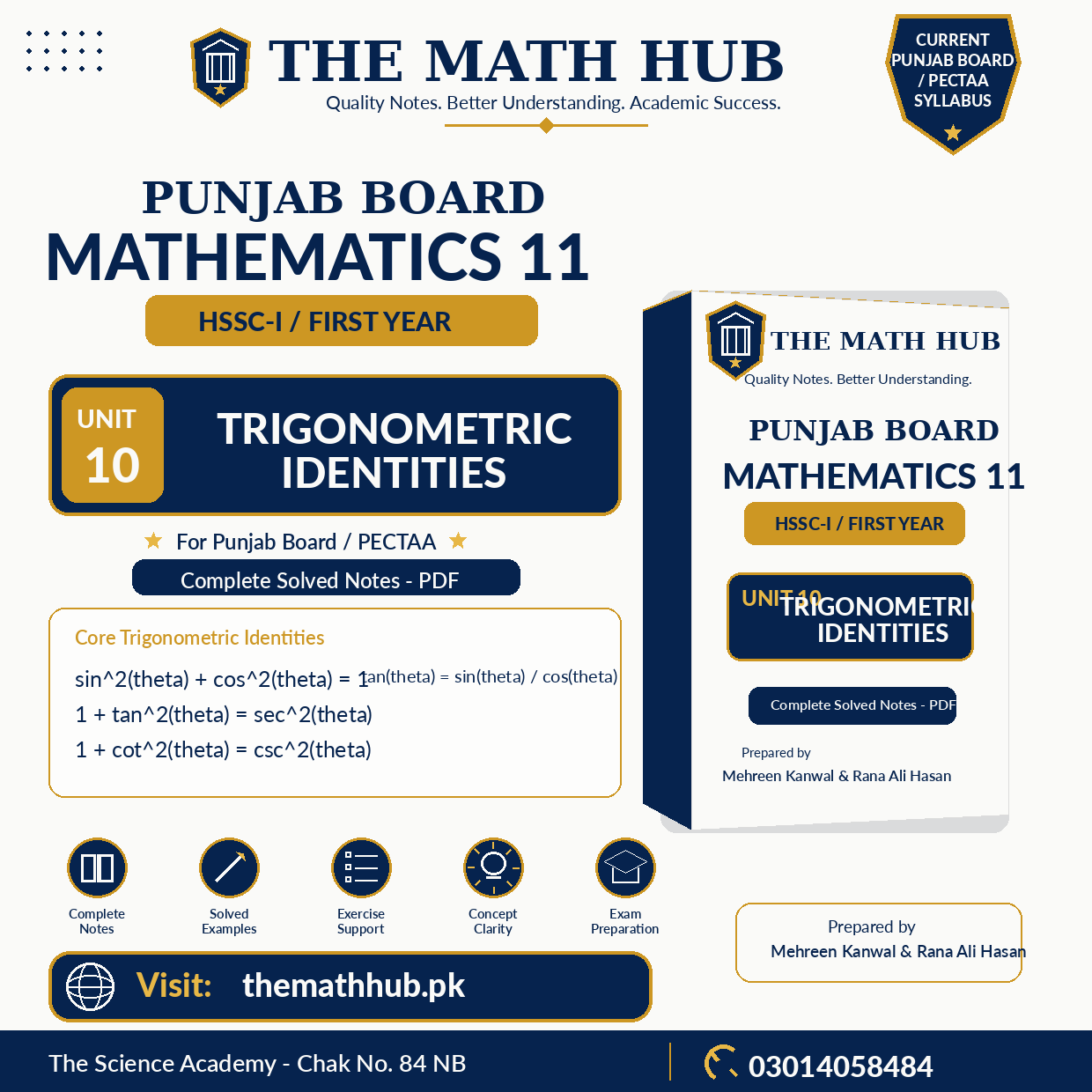
Transform trigonometric expressions with identities and prove equivalent forms.
Exercise and question index
Use the published notes for the worked material available in this unit. The current textbook remains the authority for exercise numbering.
The exercise labels below identify the mathematical coverage of the supplied owner PDF without generating repeated placeholder descriptions for every question number.
Exercise 10.1 — Allied Angles and Trigonometric Ratios
Exact trigonometric values, allied angles, reference angles and identity verification.
Methods: reference-angle method · exact basic-angle values · quadrant signs. The owner PDF contains 6 main questions under this exercise label.
Exercise 10.2 — Addition and Subtraction Formulae
Sine, cosine and tangent addition or subtraction formulas in exact-value and proof questions.
Methods: addition/subtraction formulas · compound-angle evaluation · identity proof. The owner PDF contains 12 main questions under this exercise label.
Exercise 10.3 — Double-Angle and Half-Angle Identities
Double-angle and half-angle identities, exact values and transformations between equivalent forms.
Methods: double-angle formulas · half-angle formulas · identity manipulation. The owner PDF contains 2 main questions under this exercise label.
Exercise 10.4 — Product-to-Sum and Sum-to-Product Identities
Conversion between products, sums and differences, followed by identity proofs and deductions.
Methods: product-to-sum formulas · sum-to-product formulas · identity deduction. The owner PDF contains 10 main questions under this exercise label.
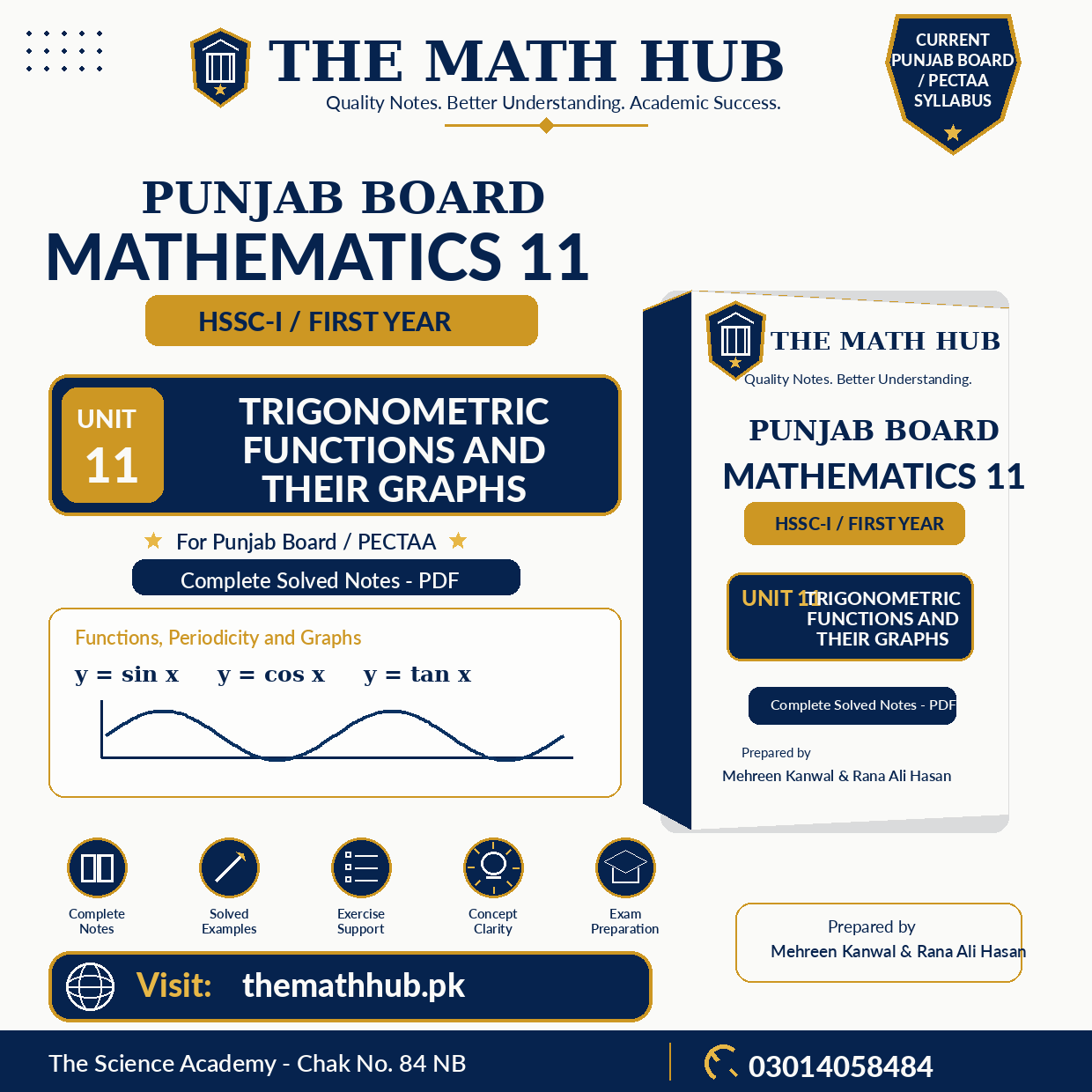
Interpret trigonometric graphs, identities and equations across periodic domains.
Exercise and question index
Use the published notes for the worked material available in this unit. The current textbook remains the authority for exercise numbering.
The exercise labels below identify the mathematical coverage of the supplied owner PDF without generating repeated placeholder descriptions for every question number.
Exercise 11.1 — Even / Odd Functions and Periods
Testing trigonometric functions for evenness or oddness and finding their periods.
Methods: f(-x) comparison · period calculation · trigonometric symmetry. The owner PDF contains 2 main questions under this exercise label.
Exercise 11.2 — Graphs of Trigonometric Functions
Sketching and comparing trigonometric graphs using amplitude, period, midline and transformations.
Methods: amplitude and period · graph transformation · graphical equation solving. The owner PDF contains 3 main questions under this exercise label.
Exercise 11.3 — Maximum / Minimum Values and Applications
Maximum and minimum values of trigonometric expressions and periodic models of temperature, motion and population.
Methods: sine/cosine bounds · periodic modelling · maximum/minimum analysis. The owner PDF contains 9 main questions under this exercise label.
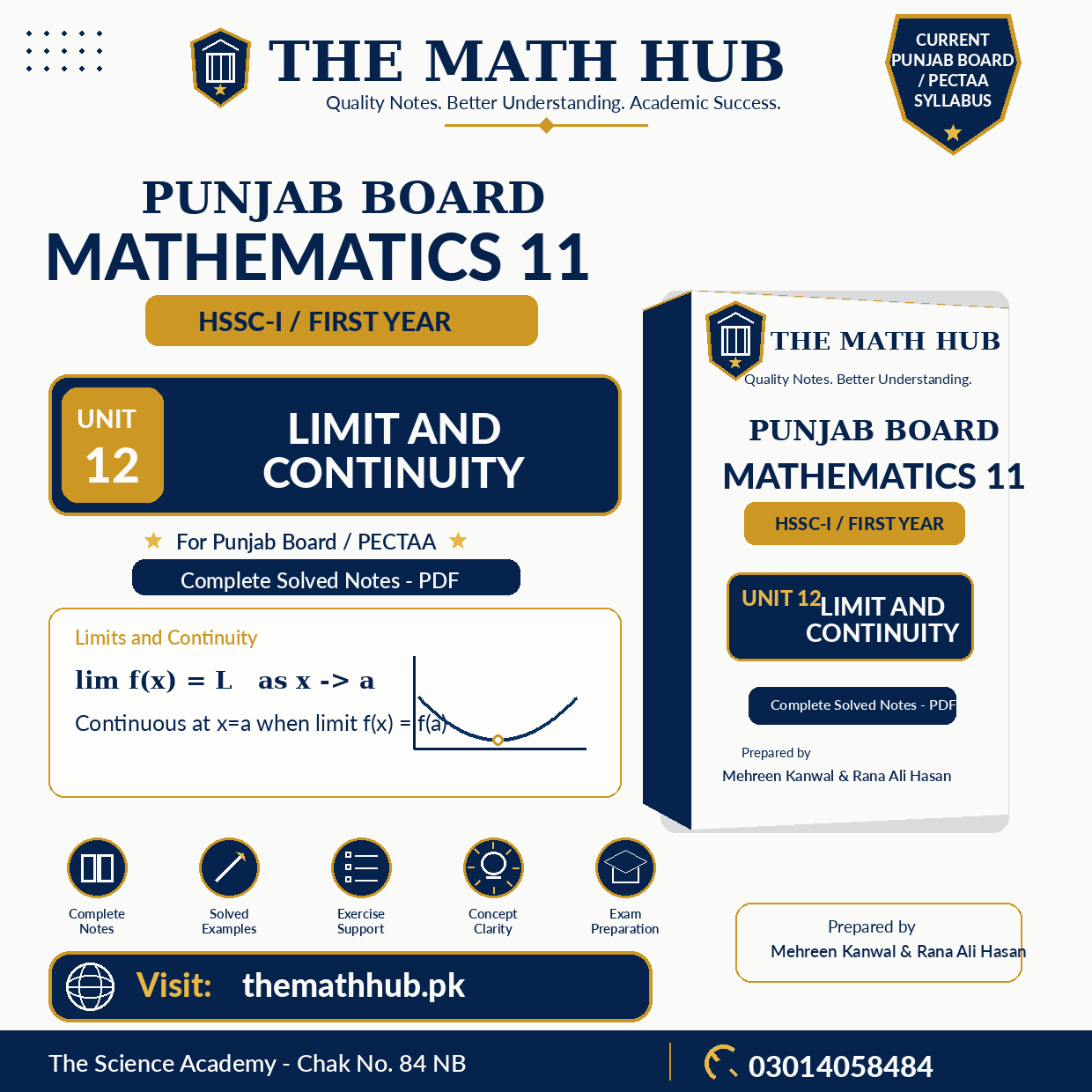
Describe limiting behaviour and continuity as the foundation for calculus.
Exercise and question index
Use the published notes for the worked material available in this unit. The current textbook remains the authority for exercise numbering.
The exercise labels below identify the mathematical coverage of the supplied owner PDF without generating repeated placeholder descriptions for every question number.
Exercise 12.1 — Limits
Evaluation of limits using algebraic, trigonometric and exponential-limit techniques.
Methods: limit laws · algebraic simplification · standard exponential limits. The owner PDF contains 5 main questions under this exercise label.
Exercise 12.2 — Continuity
One-sided limits, continuity tests and constants that make a piecewise function continuous.
Methods: left/right-hand limits · continuity condition · piecewise-function analysis. The owner PDF contains 7 main questions under this exercise label.
Exercise 12.3 — Limit and Continuity Applications
Limits and continuity in decay, sales, signal, price, cost and inflation models.
Methods: exponential models · limiting behaviour · continuity checks. The owner PDF contains 8 main questions under this exercise label.
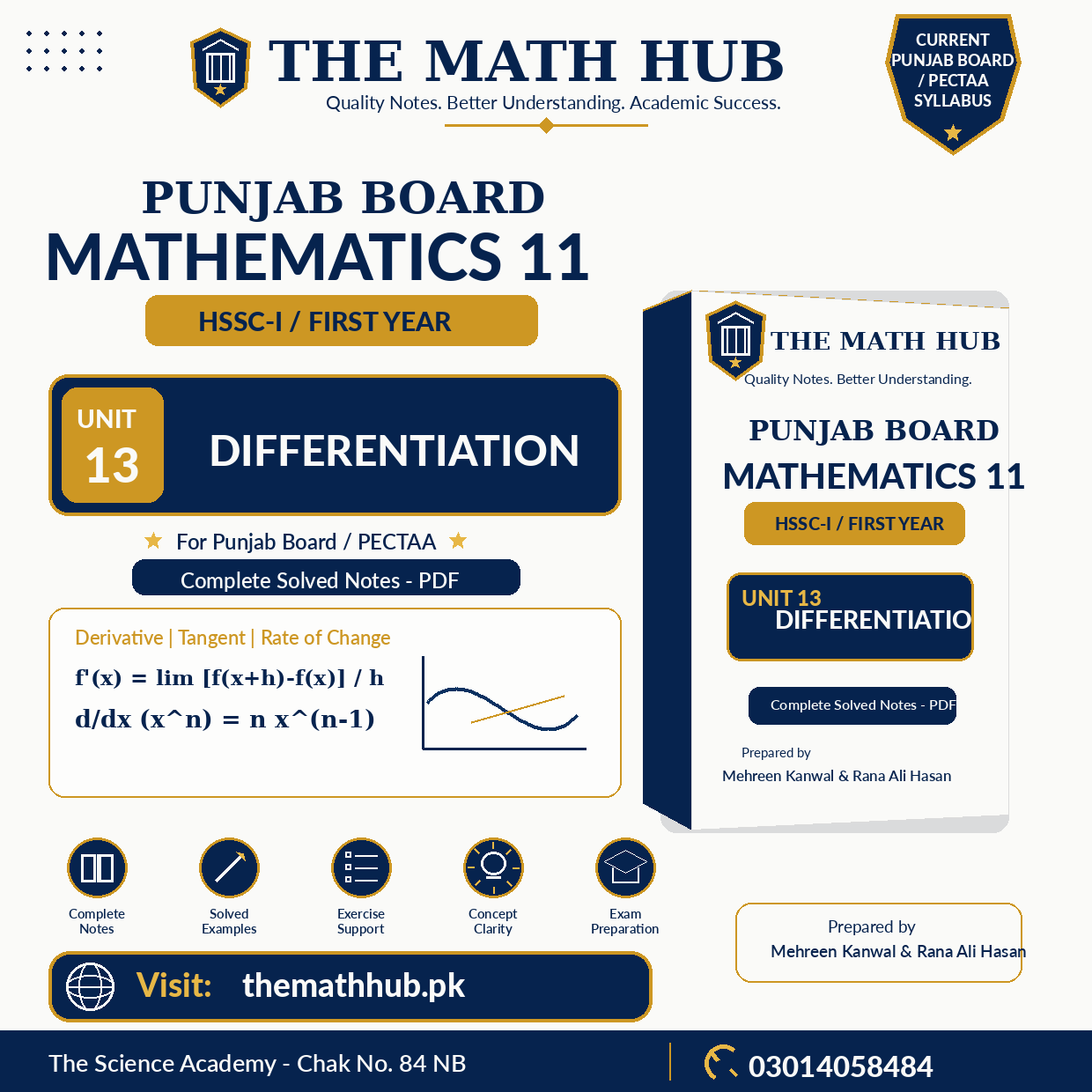
Use derivatives to describe rate of change, tangents, extrema and mathematical models.
Exercise and question index
Use the published notes for the worked material available in this unit. The current textbook remains the authority for exercise numbering.
The exercise labels below identify the mathematical coverage of the supplied owner PDF without generating repeated placeholder descriptions for every question number.
Exercise 13.1 — Differentiation from First Principles, Tangents and Rates
Derivative definition, first-principle calculations, tangent gradients and rates of change.
Methods: first principle · tangent equation · rate-of-change model. The owner PDF contains 12 main questions under this exercise label.
Exercise 13.2 — Derivative Rules
Differentiation of algebraic expressions and verification of derivative relationships.
Methods: power and product rules · quotient and chain rules · derivative identities. The owner PDF contains 5 main questions under this exercise label.
Exercise 13.3 — Applications of Differentiation
Derivatives in motion, revenue, cost, growth, optimization and related rate applications.
Methods: derivative modelling · optimization · rates of change. The owner PDF contains 8 main questions under this exercise label.
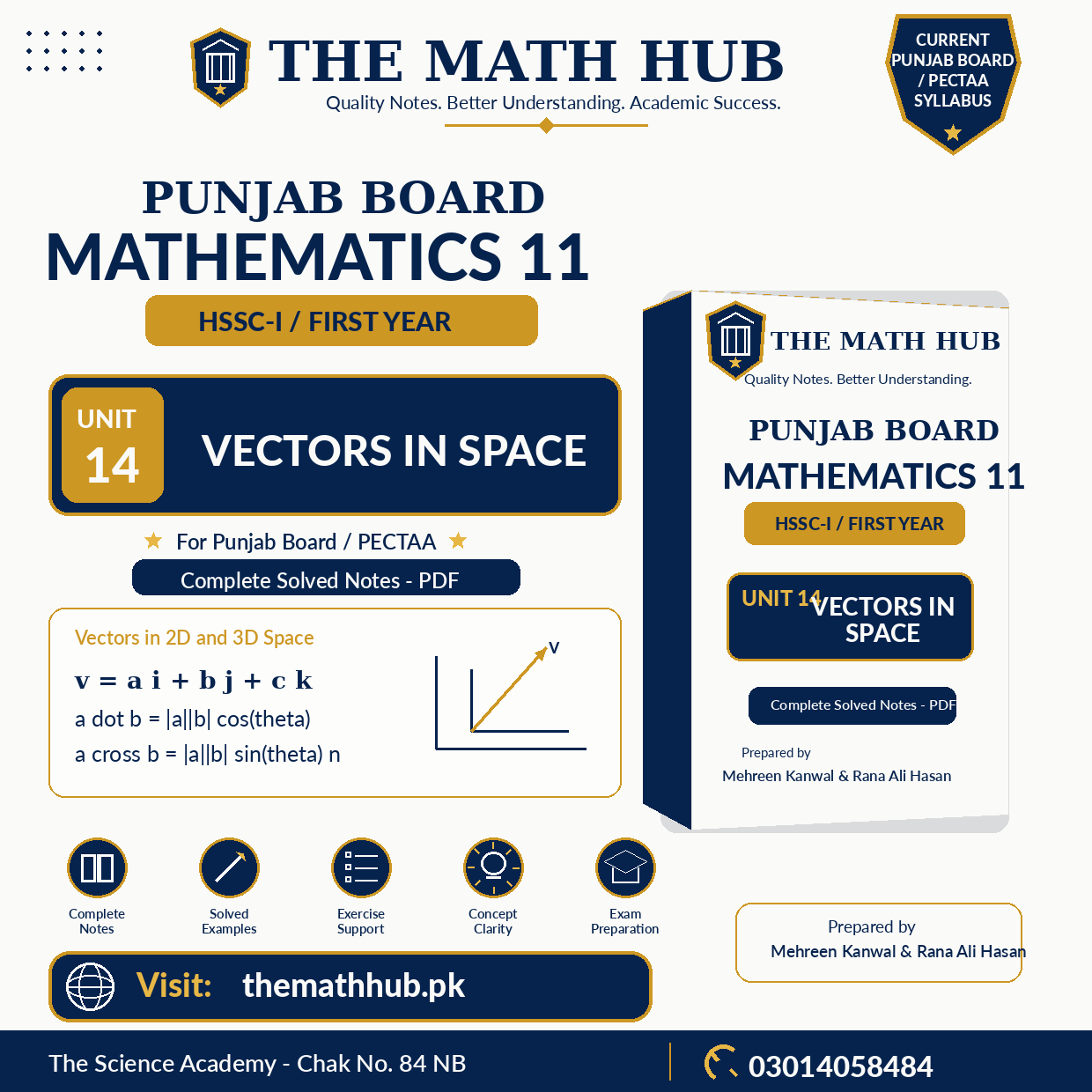
Represent magnitude, direction, position and geometric relationships with vector methods.
Exercise and question index
Use the published notes for the worked material available in this unit. The current textbook remains the authority for exercise numbering.
The exercise labels below identify the mathematical coverage of the supplied owner PDF without generating repeated placeholder descriptions for every question number.
Exercise 14.1 — Vectors in Space: Components, Magnitude and Direction
Three-dimensional vector components, magnitude, direction cosines, unit vectors and parallelism.
Methods: component form · magnitude and direction cosines · parallel-vector tests. The owner PDF contains 12 main questions under this exercise label.
Exercise 14.2 — Dot Product, Projection and Applications
Dot products, angles, projections, triangle identities and force or displacement applications.
Methods: dot product · vector projection · angle and force applications. The owner PDF contains 16 main questions under this exercise label.
Exercise 14.3 — Cross Product, Area and Moments
Cross products, perpendicular vectors, areas, identities and moments of forces in space.
Methods: cross product · area by vector product · moment of a force. The owner PDF contains 16 main questions under this exercise label.
Exercise 14.4 — Scalar Triple Product, Volume and Coplanarity
Scalar triple products for volumes, coplanarity, geometric proofs and applied force or displacement problems.
Methods: scalar triple product · volume and tetrahedron · coplanarity test. The owner PDF contains 15 main questions under this exercise label.
Current textbook structure verified 18 August 2026. Smart/reduced exam guidance does not replace the full curriculum.