Identify the quantities
Write what is known, what is asked and which unit or base controls the relationship.
This Percentage MCQs resource contains 100 fully solved competitive-exam questions arranged for fast topic-wise revision. It focuses on percentage of a quantity, fraction/decimal/percentage conversion, percentage increase and decrease, reverse percentage, successive percentage change, then extends into marks and result percentages, salary and population change, price-consumption problems, discount/tax percentage, comparison percentages, exam-speed percentage shortcuts. Each question gives four options followed immediately by mathematical working, so a candidate can review both the correct answer and the shortest reliable route to it. It is intended for PPSC, FPSC, CSS MPT, PMS, NTS and other authentic one-paper/testing contexts only where the current examination actually includes the relevant mathematics.
Backup Copy is not displayed because no verified backup URL is available.
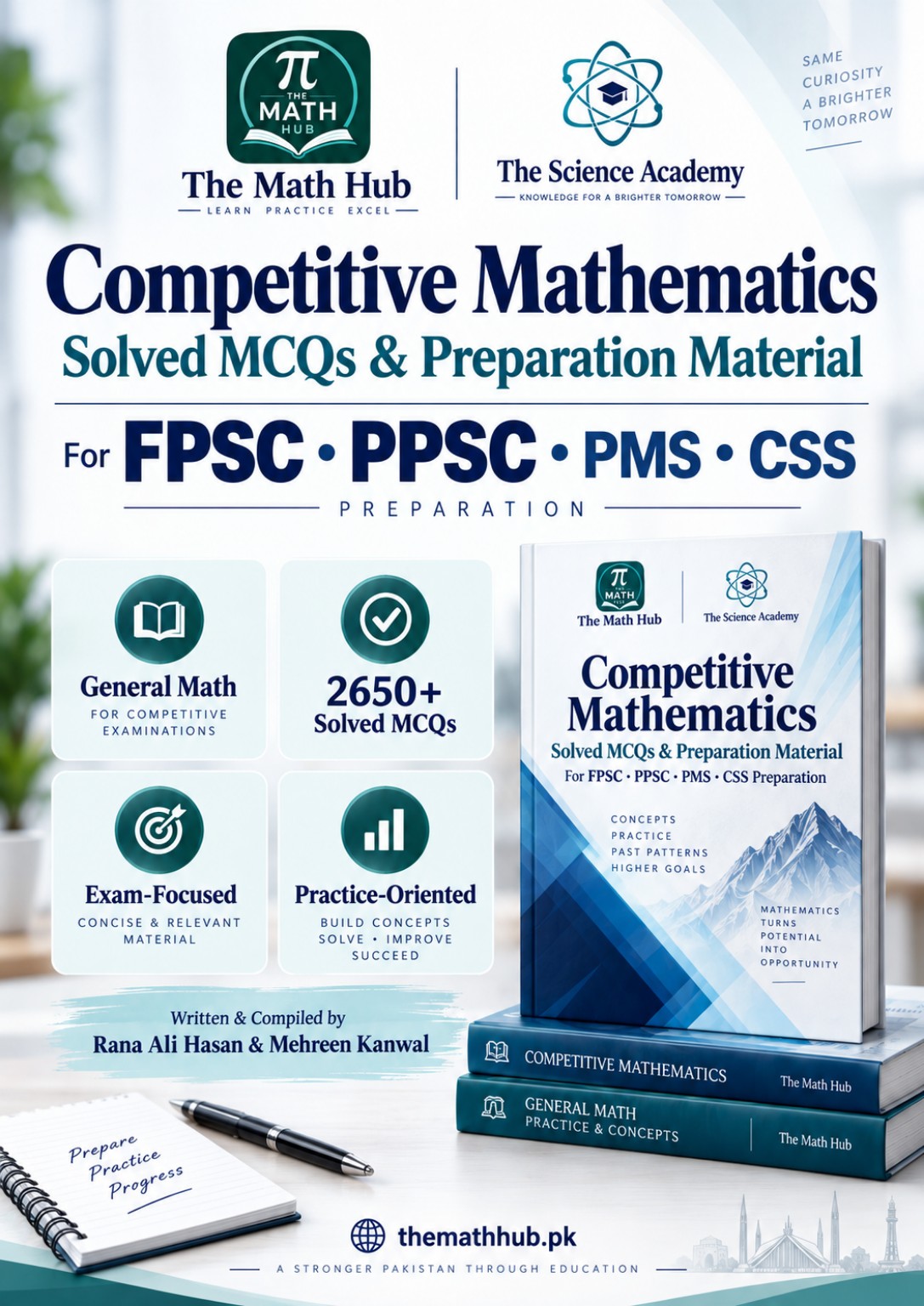
This Percentage MCQs resource contains 100 fully solved competitive-exam questions arranged for fast topic-wise revision. It focuses on percentage of a quantity, fraction/decimal/percentage conversion, percentage increase and decrease, reverse percentage, successive percentage change, then extends into marks and result percentages, salary and population change, price-consumption problems, discount/tax percentage, comparison percentages, exam-speed percentage shortcuts. Each question gives four options followed immediately by mathematical working, so a candidate can review both the correct answer and the shortest reliable route to it. It is intended for PPSC, FPSC, CSS MPT, PMS, NTS and other authentic one-paper/testing contexts only where the current examination actually includes the relevant mathematics.
A percentage expresses a part as a number out of 100. In a timed paper, early recognition helps you select a reliable route and reserve attention for questions with more than one condition.
Use the booklet to connect the headline topic with its nearby forms: percentage of a quantity, fraction/decimal/percentage conversion, percentage increase and decrease, reverse percentage, successive percentage change, and the extended applications listed below.
Write what is known, what is asked and which unit or base controls the relationship.
Use the relevant percentage of a quantity, fraction/decimal/percentage conversion, percentage increase and decrease relationship before trying a shortcut.
Substitute, estimate or reverse-check the result so a sign, unit or denominator error does not survive.
Percentage = (part ÷ whole) × 100New value = original value × (1 ± rate/100)Successive changes use multipliers, not simple addition.The PDF places the options before the mathematical working. Use each solution to identify the first decision: the base, rate, variable, diagram relation, sample space or unit conversion that makes the rest of the calculation dependable.
Basic mathematics is common in screening and one-paper preparation, but the exact topics, marks and eligibility are post- and advertisement-specific. The Math Hub is an independent educational platform; it is not affiliated with PPSC, FPSC, CSS, PMS, NTS or any other testing body. Verify the latest official advertisement and syllabus for the post you are applying for.
Percentage MCQs may be useful for PPSC, FPSC, CSS MPT, PMS, NTS or another one-paper test only when the current official notice includes the relevant mathematics. The Math Hub does not claim an official commission affiliation, universal marks distribution or guaranteed appearance.
After topic repair, use the complete resource for cross-topic switching and the five mixed mock tests. The Mathematics Library also keeps this topic booklet discoverable as a separate canonical record.
This Percentage MCQs resource contains 100 fully solved competitive-exam questions arranged for fast topic-wise revision. It focuses on percentage of a quantity, fraction/decimal/percentage conversion, percentage increase and decrease, reverse percentage, successive percentage change, then extends into marks and result percentages, salary and population change, price-consumption problems, discount/tax percentage, comparison percentages, exam-speed percentage shortcuts. The coverage list on this page shows the included subtopics.
No. This is independent solved practice material. Treat it as exam-style preparation unless an item has a traceable official source.
Possibly, where the relevant current notice includes this mathematics. Always verify the exact post-specific advertisement and syllabus.
This topic booklet contains 100 fully solved questions across 19 A4 PDF pages.
Yes. Each MCQ is designed to show four options followed immediately by mathematical working for checking both the answer and method.
Yes. View PDF opens the owner PDF, while Download PDF uses a same-domain download route. A Backup Copy button is omitted because no verified backup URL is available.
Open the owner PDF, download this topic booklet or return to the complete 2,650-question pathway.
Backup Copy is not displayed because no verified backup URL is available.